Confidential Next Generation Home Care AI OS

The AI Operating System for Homecare

Transforming the Future of Home Care

CAIRE unifies real-time scheduling, predictive intelligence, and autonomous replanning in a single decision engine for Nordic-scale care teams. It layers on top of existing systems to orchestrate staff, routes, and financial outcomes automatically while leadership tracks impact through investor-grade analytics.

CAIRE AI OS connecting data, teams, and care delivery
Investor & Partner Briefing

Executive Contents

A curated overview for external stakeholders to grasp the market thesis, roadmap, and technical moat in one glance before diving deeper into the full CAIRE AI OS business vision.

75–80%+ Target workforce utilisation
15–20% Travel time reduction
24 months Level 2 → Level 4 roadmap

The Trillion-Dollar Opportunity

Home care is the last trillion-dollar industry still scheduled by spreadsheets. By replacing fragmented planning with AI-driven orchestration, CAIRE unlocks exponential value across the Nordics and beyond.

Global home care market outlook (USD)
$400–450B
Current global home care & home health market
$750B+
Projected market size by 2030 powered by AI scheduling
20–30%
Caregiver time lost to admin, travel, documentation today
1% = Billions
Every 1% productivity gain returns billions of care minutes
Industry Market Size AI Scheduling Impact
Airlines $900B Crew & gate scheduling → 5–10% cost reduction, delays down
Logistics (UPS, DHL) $5T Route optimization → 10–20% fewer miles, billions saved annually
Ride-hailing (Uber, Bolt) $330B Real-time driver matching → dynamic routing transformed an industry
Manufacturing $16T Shift & machine scheduling → throughput up, downtime down
Hospital operating rooms $350B+ OR scheduling → 5–15% more surgeries without adding staff
Why Home Care Is Next

Home care faces a bigger scheduling crisis than airlines or logistics — and it is deeply human. Tens of billions are wasted every year on inefficient manual planning. The AI Schedule Engine optimizes staff, routes, competencies, and time windows, then re-plans instantly when reality changes. Modern Nordic providers become the reference case for solving a global problem that matters most.

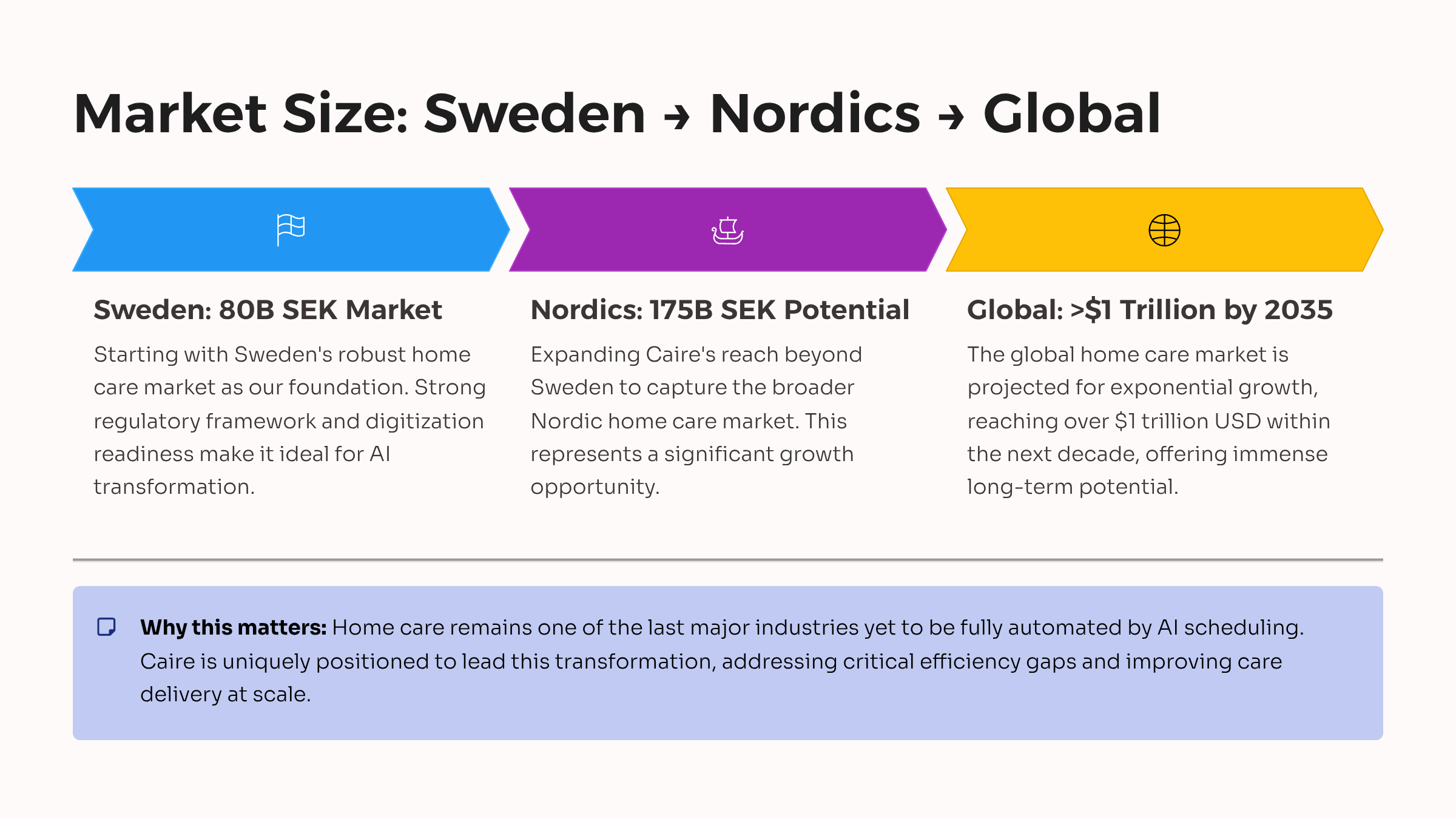
Nordic Scale Snapshot

Leading Nordic providers operate at unmatched scale — a living dataset powering measurable AI gains across the region.

  • 500 000 care recipients representing a 175 B SEK annual market.
  • 350 million service hours delivered yearly, equal to ~259 000 caregivers (70 % in direct care).
  • Even a 1 % productivity uplift returns 3.5 million staffed hours back to hands-on care.

Market Opportunity to Execution Flow

How the top-down market thesis converts into an investible execution plan.

flowchart LR
    A[Global Market Insight] --> B[Nordic Opportunity Sizing]
    B --> C[AI-First Delivery Engine]
    C --> D[Operational Roadmap]
    D --> E[AI Flywheel]
    E --> F[Investor & Partner Outcomes]
                

The Problem We're Solving

Home care is collapsing under rising demand, chronic workforce shortages, and manual planning that burns hours on travel instead of hands-on service. Operators fight margin erosion while clients and caregivers lose continuity and stability.

Sweden & Nordic providers – current operating reality
Productivity Drain

Only ~60% of Funds Reach Direct Care

While caregivers spend 70–80% of their time on care, only ~60% of total funds go to actual care delivery. The rest covers overhead: cars, admin staff, office, software, and operational costs.

Inefficient Travel

Billions Wasted Annually

Fragmented routes and reactive planning waste enormous resources on travel, overtime, and idle gaps, squeezing already thin margins.

Continuity Breakdown

Trust Erodes for Clients

Clients meet new caregivers weekly, driving anxiety and lower satisfaction, while schedulers lack tools to enforce continuity targets.
Illustration showing a worried operator facing a 40% cost increase while productivity drops
Manual planning drives up costs as operators lose up to 40% of time to non-care tasks.

Our Solution: CAIRE AI OS

The AI Operating System augments—not replaces—existing planning tools. It ingests live schedules, optimizes them with constraint-based AI, and returns executable playbooks with full financial transparency.

Unified Decision Stack

From Data to Daily Execution

Data ingestion, predictive models, optimization, and human-in-the-loop approvals run on a single platform. Operators can move from scenario exploration to signed-off schedules in minutes.

Always-On Replanning

Resilient to Real Life

Absences, urgent visits, or traffic disruptions trigger instant re-optimization. Reinforcement learning policies recommend the least disruptive swaps to keep continuity KPIs intact.

Board-Ready Analytics

Investor-Grade Transparency

Scenario comparisons quantify travel-time savings, staff-efficiency gains, and margin lift. Results export directly into executive packs for boards, investors, and municipal partners.

Hands presenting the CAIRE AI heart chip orchestrating home care operations
Vision mockup: CAIRE AI OS orchestrates staff, patients, and society through a unified heart of automation.

What Is CAIRE: The Homecare AI Operating System?

CAIRE unifies real-time scheduling, predictive intelligence, and autonomous replanning in a single decision engine for Nordic-scale care teams. It layers on top of existing systems to orchestrate staff, routes, and financial outcomes automatically while leadership tracks impact through investor-grade analytics.

The Story Behind Caire

From Tech Leadership to Healthcare Innovation

Tech Leadership Legacy

Decades of Scaling Digital Platforms

More than twenty years leading global product, data, and AI organisations—shipping digital services that transformed established industries and proved what AI-at-scale can deliver.

Personal Wake-Up Call

Healthcare Needs a New Operating System

Founder Björn Evers experienced fragmented home care during his own health journey, seeing how manual spreadsheets steal precious minutes from care teams and the people they support.

Mission-Driven Innovation

AI That Elevates Human Care

Caire now co-designs solutions with Nordic providers, building AI that safeguards continuity, increases service efficiency, and strengthens the human connection at the heart of every visit.

Born from personal insight and powered by decades of tech expertise, Caire is building a future where AI handles the complexity of care coordination so caregivers can focus on warmth, attention, and exceptional service for every individual they support. Technology should amplify humanity, not replace it.

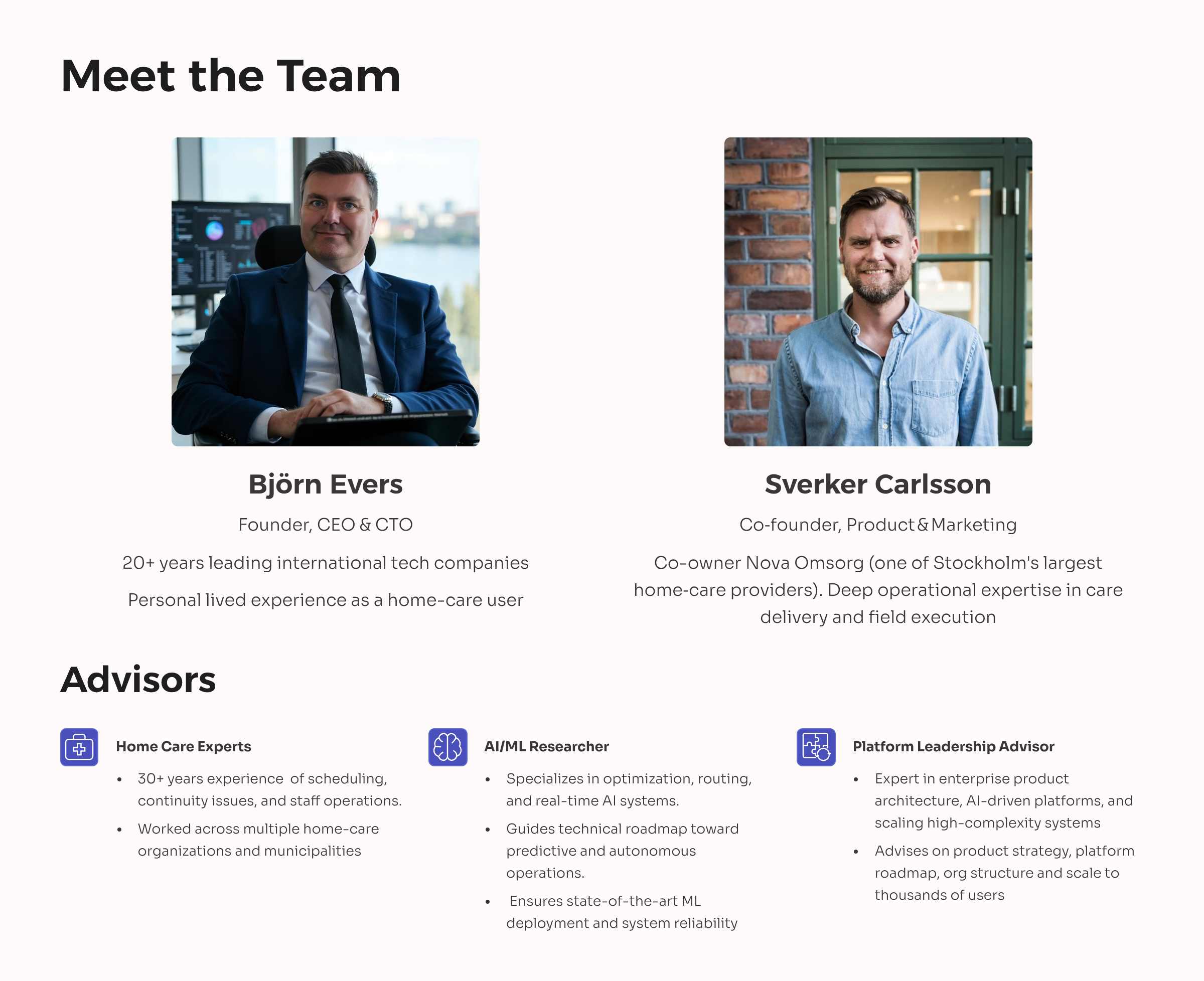
Leadership & Team

The Caire team blends senior Nordic healthcare leaders, AI engineers, and operator advisors who have scaled mission-critical platforms across 30+ countries. Together they translate municipal realities into resilient, production-ready AI services.

Strategic Leadership

Executive team led by Björn Evers, partnering with municipal CEOs and healthcare innovators to align AI orchestration with real-world labour law, workforce incentives, and sustainability targets.

Product & Engineering

Specialists in large-scale optimisation, streaming data platforms, and human-in-the-loop design—delivering cloud-native, secure infrastructure trusted for municipal-grade reliability.

Advisors & Clinical Partners

Care directors, schedulers, and frontline supervisors ensure every feature reflects daily practice, turning AI outputs into measurable improvements in continuity and staff wellbeing.

Portrait of Björn Evers

Björn Evers

Founder, CEO & CTO

20 years’ experience leading international tech companies & user of home-care services since 2021.

LinkedIn
Portrait of Sverker Carlsson

Sverker Carlsson

Co-founder, Product & Marketing

Co-owner, Nova Omsorg – one of Stockholm’s largest home-care providers.

LinkedIn

Why Now?

AI, data maturity, and political urgency have converged. Investors and operators are ready for an operating system that turns fragmented planning into proactive orchestration.

AI Readiness

Solver Breakthroughs

Advanced constraint solving, reinforcement learning, and managed AI services let us optimize in real time—triggered on schedule creation or disruption, not on a fixed timer.

Data Liquidity

Digitized Time Reporting

Carefox, Welfare, and mobile check-in systems provide structured visit data, enabling predictive models and automated learning loops.

Macro Pressure

Aging Population Shock

25% of Swedes will be over 65 by 2030 and 40% by 2050. Municipalities need automation to prevent welfare budgets from breaking.

Political Mandate

Quality & Transparency

Regulators demand continuity guarantees, staff wellbeing, and transparent ROI—AI-powered decision support is becoming a requirement.

Illustration of the growing elderly population in Nordic towns by 2030
Nordic municipalities prepare for a rapidly growing elder population that demands smarter planning.

Competitive Landscape & Market Positioning

Legacy tooling manages shifts; CAIRE orchestrates outcomes. The analysis below positions CAIRE against Nordic and international competitors across maturity levels, showing how the AI OS unlocks value where others plateau.

Dimension Manual & Spreadsheet Workflow Legacy Workforce SaaS CAIRE AI OS System
Travel & Utilization +0% improvements, often hidden overtime and travel reimbursements. Generic routing engines; 5–8% travel savings at best, limited continuity awareness. 15–20% travel reduction and 75–80% utilization confirmed in pilots using real-world constraints.
Continuity & Preferences Dependent on planner memory, no auditable targets. Basic tagging; no weighted scoring, struggles with regulatory nuances. Soft/hard constraints tied to client thresholds, documented 5–10% continuity lift.
Re-optimization Speed Hours of phone calls; impossible during peak disruptions. Batch-only recompute; limited to daily refreshes. Streaming triggers rescore schedules in minutes, backed by RL policies.
Data Ownership & Flywheel No structured data repository, insights lost each day. Data locked in vendor silos, limited export rights. Providers retain data in Amazon RDS, fueling free-tier benchmarking and premium upsell.
ROI Transparency Impossible to quantify improvements or forecast demand shifts. Basic dashboards without before/after attribution. Scenario comparison, KPI analytics, and investor-ready ROI packs built-in.

Competitor Analysis by Maturity Level

CAIRE's technical roadmap positions us ahead of all known Nordic and international competitors, with clear multi-year leads at Level 3 and industry-first opportunity at Level 4.

Provider Geography Maturity Level Core Strengths Critical Gaps
Carefox Sweden/Nordics Level 1 – Digital Planning Market leader in Swedish home care planning; established customer base; reliable data export. No optimization engine; export-only model; planners still schedule manually; no AI roadmap.
Alfa eCare / Welfare Sweden/Nordics Level 1 – Digital Planning Integrated with municipal systems; structured data; digital visit tracking. No optimization intelligence; vendor-locked data; no scenario planning; manual scheduling bottleneck.
Stalmarck Sweden Level 1-2 – Beta Focus on continuity and route optimization; Swedish market awareness. Beta stage (unproven at enterprise scale); no production guardrails; labor law depth unclear; limited partner integrations.
AlayaCare Canada/North America Level 2 – Partial Scenario planning; demand forecasting; established SaaS platform. Generic routing (lacks continuity depth); no Swedish labor law compliance; vendor-locked data; no streaming re-optimization.
ClearCare / WellSky USA Level 2 – Partial Large US market presence; basic scenario comparison. International focus (no Nordic regulatory expertise); limited routing sophistication; manual approval bottleneck; no RL roadmap.
Konvoj International Level 2 – Plateau AI-assisted scheduling; some automation features. Stuck at manual approval; no evidence of streaming re-optimization; continuity sophistication unclear; no published L3 roadmap.
CAIRE Sweden/Nordics → Global Level 2 Built (Rolling out) → Level 4 Vision (Seed) L2 already built, rolling out now (Nov 2025 → Q2 2026) to prove ROI; L3 & L4 to be built with seed (Q2 2026 → Q1 2028); Nordic-scale data; free-tier flywheel; AWS-managed stack. Early-stage company; L2 needs pilot validation; requires seed capital to build L3-4; execution risk on 24-month roadmap.

Visual Market Positioning

CAIRE sits in the top-right quadrant—highest automation paired with deepest continuity and compliance. Competitors cluster in lower quadrants, lacking either technical maturity or regulatory depth.

Competitive Positioning Matrix

High Compliance • Low Automation
📋 Carefox
Level 1 — Digital planning
📋 Alfa eCare
Level 1 — Digital planning
🏆 Winner Quadrant
🚀 CAIRE
Level 2 production → Level 4 vision
✓ Production-ready today
✓ Deep continuity focus
Legacy Zone
📞 Manual scheduling
Level 0 — Phone & spreadsheets
Tech Focus • Limited Compliance Depth
Stalmarck (L1–2 beta)
Konvoj (L2, basic compliance)
AlayaCare/ClearCare (L2 partial)
CONTINUITY & COMPLIANCE →
← AUTOMATION LEVEL →
LOW
HIGH
L0
L4

Winner quadrant position: CAIRE uniquely combines Level 2 production readiness with deep continuity sophistication. The trajectory arrow captures our path toward Level 4—fully adaptive scheduling with RL policies—while competitors remain stuck at lower automation without regulatory depth.

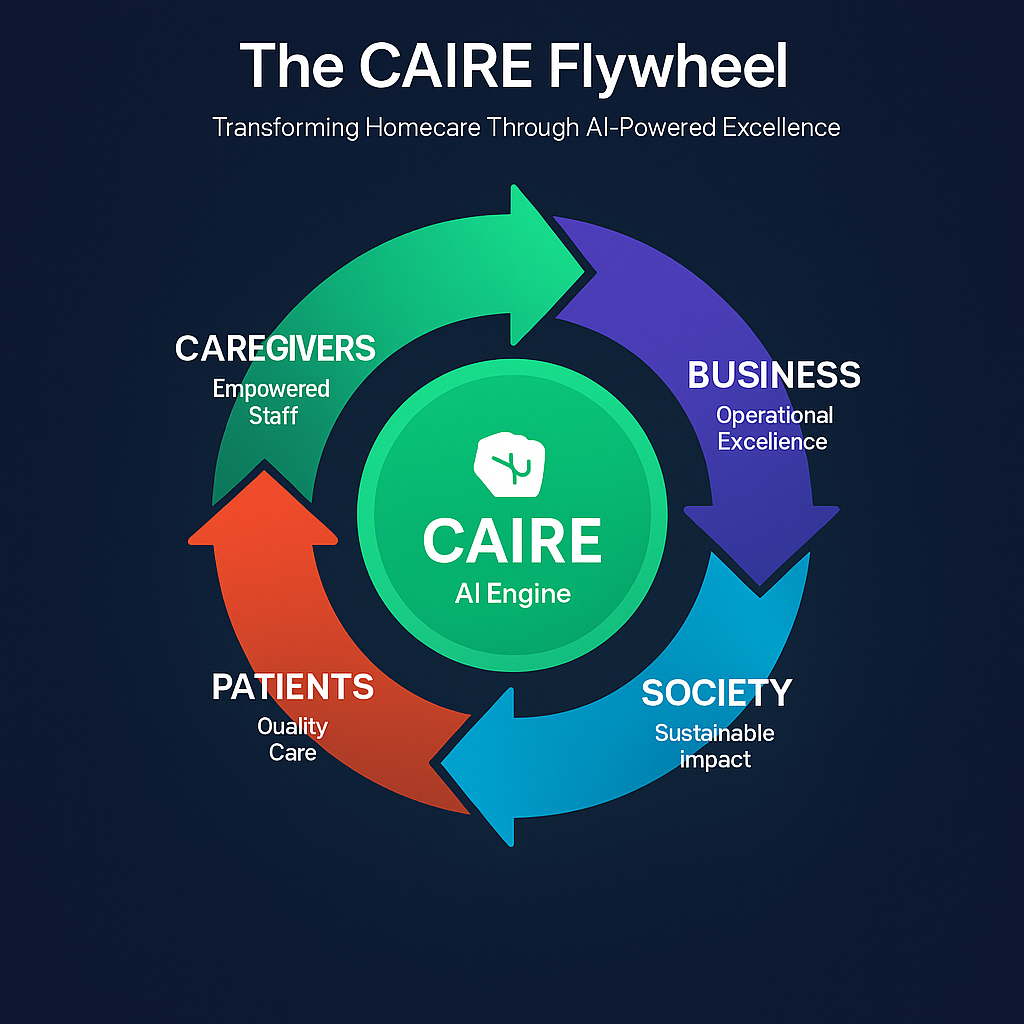
Business Model & Flywheel

Every provider that connects makes the models smarter while unlocking recurring revenue: free analytics tier → optimization activation → premium automation exports → enterprise SLAs.

Data Ingestion

Connect scheduling, capacity & outcome data

Import visits, staffing, geography, competencies, and historical outcomes securely via managed AWS services. Immediate insights highlight current inefficiencies and prime the AI Schedule Engine for optimization.

AI Optimization

AI Schedule Engine orchestrates every constraint

Constraint solving, predictive analytics, and reinforcement learning work together to cut travel 15–20%, raise staff utilization to 75–80%+, and maximize continuity.

People & Financial Impact

Employees deliver more care with less stress

Real-time adjustments remove chaos. Clients see familiar caregivers. Finance teams measure higher margins and reduced overtime. Every outcome is captured back into the AI models.

Flywheel Growth

Free tier + auto-optimization unlock scale

Offer a free analytics tier for home care providers to connect data and view before/after recommendations. Monetize automated schedule exports. More data improves models for everyone.

The CAIRE flywheel linking caregivers, patients, society, business, and the AI engine
Visualizing how connected providers feed the AI flywheel and unlock recurring value.
Dataset Advantage & Free Tier Strategy

Flagship pilot volumes provide an unrivalled training corpus: millions of visits per year with rich preference metadata and executed-visit outcomes recorded in existing check-in systems. By offering a free “connect & analyze” tier, we ingest anonymised datasets from regional municipalities and smaller providers, sharpening the models for everyone.

  • Free tier delivers KPI benchmarking, cancellation forecasts, and “what good looks like” metrics — zero switching cost for prospects.
  • Premium tier unlocks push-button auto-optimization exports back to Carefox/Welfare plus real-time replanning APIs.
  • More connected providers = better AI for every district — a compounding data moat investors can underwrite.

Data Flywheel Dynamics

Visualising how data creates sustainable differentiation.

flowchart LR
    Connect[Connect Provider Data] --> Optimize[AI Schedule Engine Optimization]
    Optimize --> Impact[Operational & Financial Impact]
    Impact --> Grow[Partner Expansion & Free Tier]
    Grow --> Learn[Model Retraining & Feature Store]
    Learn --> Optimize
                

System Flywheel & Guardrails

The AI Schedule Engine operates as a closed loop: ingest changes, score, solve, guardrail, and feed telemetry back into the models—preserving continuity targets at every step.

Continuity Optimisation Flow

The end-to-end loop that keeps continuity targets on track.

flowchart TB
    Data[Live data ingest & schedule deltas]
    Score[Constraint scoring layers]
    Solver[AI Schedule Engine solve]
    Guardrails[Runtime guardrails & alerts]
    Feedback[Telemetry & model feedback]
    Data --> Score --> Solver --> Guardrails --> Feedback --> Score
                    
Constraint Scoring Stack

Multi-Layer Objective Function

Candidate rosters are graded through ordered layers—feasibility, continuity, efficiency, fairness. Continuity penalties reference live contactAssignments so introducing substitutes automatically tightens the score if the roster is already near its limit.

  • Penalty weights auto-adjust when continuity KPIs drift in a district or client cohort.
  • Solver telemetry (violations, penalties, rationale) is logged for replay, QA, and explainability.
  • Fallback heuristics generate alternative rosters when hard constraints clash with continuity rules.
Rolling State Synchronisation

Realtime Data Assimilation

Each schedule creation materializes visits from timeless master-data templates for the chosen date range. Deltas from Carefox/Welfare, mobile check-ins, municipal updates, and manual overrides flow in via CSV upload or API. Breaks import as PAID for solver compatibility, then payroll flows adjust downstream.

  • Kinesis/EventBridge streams push cancellations, sick leave, and new visits within seconds.
  • Shift buffers and break windows hydrate directly from shifts and shiftBreaks to maintain compliance.
  • Roster locking prevents new faces when a client nears continuity thresholds unless no feasible alternative exists.
Learning & Calibration

Closed-Loop Model Governance

Predictive services provide probability envelopes (cancellation risk, travel slowdown, overtime likelihood) that influence scoring. Realised outcomes flow into SageMaker Feature Store, refining objective weights and reinforcement learning policies.

  • XGBoost cancellation scores reserve continuity-safe slack for high-risk visits.
  • Ray RLlib policies learn which substitutes restore the schedule fastest without harming continuity.
  • Automated drift monitors alert when continuity, punctuality, or utilisation deviate from historical baselines.
Quality Safeguards

Runtime Guardrails & Monitoring

Guardrails execute alongside every solve, flagging continuity breaches, drive-time anomalies, overtime exposure, and unassigned visits. Alerts feed the CAIRE operations console, Slack channels, and compliance logs before planners publish.

  • Continuity alerts surface client history, scheduled caregivers, and swap suggestions to stay within roster limits.
  • Idle-gap hints recommend continuity-safe visits to fill spare minutes.
  • All guardrail outputs flow to the analytics warehouse for audit trails and retrospective QA.

Roadmap: From Pilot Rollout to Best-in-Class Platform

A two-phase execution: deploy production-ready Level 2 to pilot in Phase 1, then build Level 3 & 4 from scratch in Phase 2 using AWS managed services, continuous reinforcement learning, simulation, and multi-tenant architecture.

1
Phase 1 • Nov 2025 → Q2 2026 • ROLLOUT Level 2

Deploy production-ready Level 2, prove ROI, prepare for seed

  • Months 0–1: Pilot kickoff with partner, secure AWS production environments, ingest historical schedules from pilot region, establish baseline KPIs (travel, utilization, continuity).
  • Month 2: Fine-tune predictive models with pilot data, align continuity scorecards with partner requirements, establish reporting cadence.
  • Months 3–4: Deploy solver with partner-specific constraints, validate travel-time matrices, run optimization cycles on pilot district, iterate based on planner feedback.
  • Month 5: User acceptance testing with scheduling teams, refine UX workflows, validate KPI calculations, prepare executive reporting.
  • Month 6: Measure and document ROI (15-20% travel reduction, 75-80% utilization, continuity improvements), publish case study, prepare seed round materials.
  • Outcome: Level 2 validated in production, proven ROI metrics, seed round secured, lessons learned inform Level 3 architecture.
2
Phase 2 • Q2 2026 → Q1 2028 • BUILD Level 3 & 4

Build streaming re-optimization and RL policies from scratch

  • Q2 2026 (Months 6–9): Architect Level 3 streaming foundation based on Phase 1 learnings, introduce tenant isolation, onboard second pilot region, automate optimization workflows.
  • Q3 2026 (Months 9–12): Build streaming ingestion (Kinesis/EventBridge), develop real-time re-optimization engine, implement vector database (Pinecone/Weaviate) for embeddings, prototype RL dispatch policies.
  • Q4 2026 (Months 12–15): Build simulation studio with scenario templates, expand analytics for operations/finance/M&A stakeholders, develop free-tier analytics platform.
  • Q1 2027 (Months 15–18): Load and security testing, complete GDPR/ISO documentation, launch beta with free "connect & analyze" tier, finalize auto-optimization pricing.
  • Q2–Q4 2027 (Months 18–24): Build and deploy RL policies to production, automate retraining pipelines (SageMaker Pipelines + Feature Store), optimize cloud costs, establish enterprise SLAs.
  • Outcome: Level 3 (streaming + auto-approve) and Level 4 (RL + adaptive scheduling) built and deployed.

AI OS Maturity Levels

The roadmap shows how providers move from manual scheduling to autonomous, reinforcement-learning operations while preserving human oversight.

Level Description Key Shift Status
0 — Manual Scheduling Phone trees, spreadsheets, and whiteboards drive daily rosters with no shared data model. Relies entirely on human memory, phone calls, and paper notes; no single source of truth. Legacy baseline replaced during every migration.
1 — Digital Planning Carefox/Welfare exports flow into CAIRE, giving planners scenario sandboxes and analytics. Data becomes structured and comparable; planners can simulate scenarios while execution stays manual. Live across CAIRE customers today. Carefox • Welfare • eCare • Stalmarck beta
2 — AI-Assisted Proposals Optimization engine produces alternative rosters; planners compare KPI deltas before publishing. AI generates ready-to-publish schedules with KPI transparency while humans stay in control of approvals. CAIRE: BUILT → Rolling out Q2 2026 CAIRE production-ready • Konvoj • AlayaCare/ClearCare partial
3 — Auto-Optimize + Approve Streaming events trigger background re-optimization; planners review guardrail alerts and publish. Optimization runs continuously so planners focus on exceptions and compliance approvals. CAIRE roadmap: Q2 2026 → Q2 2027 CAIRE seed roadmap • No known competitors
4 — Fully Adaptive Scheduling Reinforcement-learning policies adjust plans continuously; compliance guardrails enforce continuity. Policies self-tune with telemetry, keeping schedules compliant and efficient without manual retriggers. CAIRE vision: Q2 2027 → Q1 2028 CAIRE seed vision • Industry-first
Level 0 — Manual Scheduling

Phone trees, whiteboards, and spreadsheets orchestrate the day with no central data store. Every change requires manual calls and rework.

  • Disconnected systems and ad-hoc status tracking.
  • No objective metrics on travel, continuity, or bottlenecks.
  • Schedulers spend most of the day firefighting.
Level 1 — Digital Planning

Carefox, Welfare, and eCare exports land in CAIRE so planners can sandbox scenarios, document baselines, and circulate analytics.

  • Digitised visits, staff, and geography inside CAIRE’s data model.
  • Scenario comparisons highlight travel savings and utilization lift.
  • Publishing still requires manual execution.
Level 2 — AI-Assisted Proposals (Current)

Constraint-based optimization produces ready-to-publish proposals. Planners review KPIs and approve each run. Level 2 is built and entering pilot rollout.

  • Status: Production-ready. Phase 1 (Nov 2025 → Q2 2026) focuses on rollout, ROI proof, and seed preparation.
  • Features: Manual-triggered optimization, scenario lab, unified scheduling flow, KPI dashboards, analytics on every CAIRE module.
  • Business impact: 50%+ less manual scheduling, 15–20% travel reductions, 75–80% utilization, higher continuity, board-ready reporting.
  • Human role: Trigger runs, compare KPIs, approve publication.
  • Market position: CAIRE production-ready. Konvoj remains approval-bound; AlayaCare/ClearCare offer partial Level 2 features.
Level 3 — Auto-Optimize + Approve

Streaming ingestion (absences, urgent visits, traffic) triggers background re-plans. Planners review exception queues instead of re-running jobs.

  • Timeline: Phase 2 months 6–18, built on Level 2 production base.
  • Features: EventBridge/Kinesis streams, background optimization, guardrail alerts, vector embeddings, approval queues, auto-suggested swaps.
  • Business impact: Plans stay current without manual triggers; sub-5-minute latency for most reruns; continuity preserved during disruptions.
  • Human role: Approve guardrail alerts and rare exceptions.
  • Market position: 6–18 month roadmap advantage; no known home care competitors with streaming re-optimization.
Level 4 — Fully Adaptive Scheduling

Reinforcement-learning policies and automated retraining keep schedules aligned with continuity targets and demand swings.

  • Timeline: Phase 2 months 18–24, layered on Level 3 streaming foundation.
  • Features: Ray RLlib policies, SageMaker Pipelines + Feature Store retraining, guardrail automation, proactive compliance monitoring.
  • Business impact: Maximised utilization, continuity, and compliance without manual re-plan cycles.
  • Human role: Governance, oversight, and strategic planning.
  • Market position: Industry-first opportunity; RL-based home care scheduling is still only in research papers.

Key Differences & Value Progression

Every maturity level unlocks deeper automation, new human touchpoints, richer data handling, and smarter AI—compounding financial and operational upside as organisations advance.

Dimension Level 2 (Current) Level 3 (6–18 months) Level 4 (18–24 months)
Automation Depth Optimises whenever planners trigger a run. Background re-optimisation reacts to intraday changes (absences, urgent visits, traffic). Continuous RL policies adjust proactively before disruptions surface.
Human Touchpoints Manual approval required every run. Human review limited to exceptions and guardrail alerts. Humans provide oversight and policy governance only.
Data Handling Manual CSV or API imports from Carefox/eCare, triggered when creating a schedule. Streaming deltas via EventBridge/Kinesis update state within seconds. Continuous telemetry keeps state aligned and policies tuned.
AI Sophistication Constraint solving (OR-Tools) + static analytics. + Vector embeddings for matching and automated guardrail scoring. + Reinforcement learning, automated retraining, predictive interventions.
Response Latency Minutes to hours after manual trigger. <5 minutes for most intraday reruns. Seconds to minutes; anticipates issues before they surface.
Business Impact Proves ROI (15–20% travel ↓, 75–80% utilisation ↑); halves manual scheduling effort. Keeps plans optimal amid daily change; planners focus on strategic work. Maximises utilisation, continuity, and compliance autonomously; planners shift to growth initiatives.
Compounding Value

Across every CAIRE experience—index.html, platform-overview.html, scheduling.html, ess-fsr-technical.html, analytics.html—Level 2 already delivers measurable savings and transparency. Levels 3 and 4 amplify automation and intelligence so planners evolve from "run optimisation" to "monitor exceptions" and ultimately "govern autonomous policies," all while delivering board-grade ROI.

Clinical AI Layer: Medical Speech-to-Text & Agentic Framework

Transforming CAIRE from a pure operations platform into a safety, quality, and compliance layer that reduces administrative burden by 50-80% while improving care outcomes through real-time risk detection and automated clinical documentation.

Vision

CAIRE orchestrates who does what, when, where. The Clinical AI Layer understands what actually happened clinically in each encounter.

By integrating medical-grade speech-to-text, clinical reasoning AI, and agentic workflows, CAIRE becomes the first end-to-end AI platform that not only optimizes home-care operations but also captures, analyzes, and acts on clinical intelligence in real time.

C
Phase 1 • Q3 2026 → Q4 2026 • Foundation

Medical STT & Basic Document Generation

  • Medical Speech-to-Text Integration: Swedish language support with home-care domain vocabulary, >95% accuracy, <3 second latency, EU/EEA data residency.
  • Structured Note Generation: SOAP-style clinical documentation automatically generated from caregiver voice notes, extracting vital signs, mobility status, medications, ADL completion.
  • CAIRE Mobile App Integration: Voice recording, audio streaming, offline mode support for caregivers in areas with poor connectivity.
  • Basic Care Plan Updates: Automatic extraction of constraint changes (skill requirements, visit duration, continuity preferences) fed into scheduling engine.
  • Pilot Deployment: 10-20 caregivers in one municipality, 100+ test visits, validation of core workflow and user adoption.
  • Outcome: 50-80% reduction in documentation time, >90% note completeness, real-time constraint updates enable better scheduling.
C
Phase 2 • Q4 2026 → Q1 2027 • Intelligence

Risk Detection & Escalation Workflows

  • Clinical Risk Scoring: Fall risk, deterioration risk, hospitalization risk models with baseline comparison and trend analysis.
  • Real-Time Escalation: Automated alerts to on-call nurses, care managers, with recommended actions (urgent visit, medication review, reassessment).
  • Care Manager Dashboard: Risk overview, alert queue, trend visualizations, proactive intervention suggestions.
  • Integration with On-Call Systems: Seamless handoff from automated risk detection to human clinical decision-making.
  • Success Metrics: >95% true positive rate on risk detection, <1 hour time-to-detection, 10-15% reduction in emergency hospitalizations.
  • Outcome: Proactive care management, early intervention prevents crises, structured audit trail for quality and compliance.
C
Phase 3 • Q1 2027 → Q2 2027 • Automation

Full Scheduling Integration & Agentic Workflows

  • Real-Time Constraint Updates: Clinical notes automatically update scheduling constraints (mobility changes, skill requirements, visit duration) with <5 minute latency.
  • Scheduling Engine Integration: Optimization engine consumes real-time clinical context, improving continuity, skill matching, and visit quality.
  • AI Copilot for Care Managers: Natural language queries ("Show all clients with worsening mobility"), automated message drafting, cohort analysis, root cause analysis for scheduling bottlenecks.
  • Billing Automation: Automatic visit coding, time reconciliation, structured billing export to municipal systems, >95% automation rate.
  • Workflow Automation: Task generation (reassessments, medication reviews), compliance reports, quality dashboards.
  • Outcome: Care managers 60-70% more efficient, schedulers have real-time clinical context, finance team focuses on exceptions not routine coding.
C
Phase 4 • Q2 2027 → Q4 2027 • Scale & Production

Multi-Tenant Production Deployment

  • Scalability: Support 1000+ concurrent audio streams, 10,000+ visits per day, horizontal scaling across EU/EEA regions.
  • Infrastructure: 99.9% uptime healthcare-grade SLA, cost optimization, pay-per-use pricing model.
  • Advanced Analytics: Predictive insights, quality dashboards, compliance reporting, municipal system integrations (billing, quality metrics).
  • Compliance & Security: GDPR documentation (DPIAs, vendor assessments), ISO 27001, HL7 FHIR compatibility, complete audit trails.
  • Multi-Organization Deployment: 5+ municipalities, 500+ caregivers, validated ROI (50%+ admin time reduction, 10%+ hospitalization reduction).
  • Outcome: Production-ready Clinical AI Layer integrated across CAIRE platform, measurable business impact, defensible competitive moat.
Ambient Documentation

Zero-Admin Visits

Caregivers speak during or after visits. Clinical AI generates structured SOAP notes automatically, reducing documentation time from 10-15 minutes to 2-3 minutes per visit.

Risk Detection

Proactive Safety

Real-time risk scoring (fall risk, deterioration, hospitalization) with automated escalation. Early intervention prevents crises, reduces hospitalizations by 10-15%.

Intelligent Planning

Real-Time Constraints

Clinical notes automatically update scheduling constraints (mobility changes, skill requirements, visit duration). Scheduling engine always uses current care needs, <5 minute latency.

AI Copilot

Care Manager Assistant

Natural language queries, automated message drafting, cohort analysis. Care managers 60-70% more efficient, focus on strategic work not administrative tasks.

Billing Automation

Revenue Optimization

Automatic visit coding, time reconciliation, structured billing export. >95% automation rate, <2% dispute rate, audit-ready documentation packages.

Compliance

Audit-Ready

Complete audit trails, structured documentation, GDPR compliance, ISO 27001. Zero compliance violations, DPIA documentation, vendor risk assessments.

Integration with CAIRE Platform

The Clinical AI Layer integrates seamlessly with CAIRE's existing scheduling and optimization infrastructure:

  • Real-Time Constraint Updates: Clinical notes feed directly into Timefold optimization engine, ensuring schedules reflect current care needs
  • Analytics Integration: Structured clinical data enriches CAIRE analytics dashboards with quality metrics, risk trends, compliance reports
  • Mobile App Unified: Voice documentation lives in same CAIRE mobile app caregivers already use for scheduling and check-ins
  • Municipal System Export: Billing and quality data automatically exports to Carefox, eCare, Welfare, municipal procurement platforms
Expected Business Impact
50-80%
Documentation time reduction
10-15%
Hospitalization reduction
60-70%
Care manager time savings
>95%
Billing automation rate
<1 hr
Risk detection latency

Competitive Technical Landscape

CAIRE's technical architecture outpaces Nordic and international competitors across solver sophistication, real-time capability, continuity depth, and data ownership—building a defensible moat on production-grade infrastructure and regulatory expertise.

Capability Manual/L0 Carefox/eCare (L1) Stalmarck (L1–2 beta) AlayaCare/ClearCare (L2 partial) Konvoj (L2 plateau) CAIRE (L2→L4)
Solver Technology None None (export-only) Basic routing (beta, unproven) Generic routing engines AI-assisted scheduling Google OR-Tools + Advanced scoring + Ray RLlib (roadmap)
Real-time Re-optimisation Manual phone calls (hours) Nightly batch exports Unknown/beta Daily batch refresh Batch on-demand Streaming (L3: <5 min) → RL continuous (L4: seconds)
Continuity Constraints Planner memory only Basic client ↔ staff tagging Continuity focus, unproven at scale Basic preferences Some continuity weighting Soft + hard thresholds, roster locking, historical scoring
Swedish Labor Law Depth Manual compliance checks Exported data only Unknown N/A (international focus) Unknown To be added in pilot rollout
Data Ownership Model Siloed spreadsheets Vendor-locked Unknown Vendor-locked SaaS Unknown/proprietary Provider-owned (Amazon RDS) + free-tier data flywheel
MLOps & Retraining None None None (beta) Basic forecasting Unknown SageMaker Pipelines + Feature Store + automated drift detection
Platform Integrations None Native system only Unknown Limited API connectors Unknown Carefox/eCare/Welfare APIs + municipal, finance, salary, HR roadmap
Production Status Legacy operations Live (planning only) Beta (unproven enterprise) Live (limited features) Live (manual approval bottleneck) Production + clear L2→L4 roadmap on AWS managed scale
Three Winning Factors

CAIRE's advantage compounds through three self-reinforcing dimensions that rivals cannot replicate quickly:

🧲

Growth Flywheel

Free-tier benchmarking attracts prospects → premium conversions → more data → better models → magnetic growth loop. Competitors lack a free tier to ignite the flywheel.

🔗

Platform Connections

Deep integrations with Carefox, eCare, Welfare plus roadmap to Fortnox, Visma, HR, and municipal systems. Full-stack coupling creates switching costs that rivals cannot match without multi-year projects.

📊

Data Advantage

Nordic-scale municipal volumes with rich preference metadata and executed outcomes beat synthetic datasets. AWS Feature Store + automated retraining increase accuracy over time.

CAIRE's Unfair Advantages & Defensible Moat

Six compounding pillars create a multi-year structural lead that widens over time. This is not a feature gap—it's a moat built on data scale, platform network effects, and regulatory depth that competitors cannot easily replicate.

Nordic-Scale Data Flywheel

Real Municipal Volumes, Not Synthetic Datasets

Millions of visits annually from flagship pilot partners with rich preference metadata and executed outcomes. Real production telemetry from 30,000+ employee workforces serving 10,000+ clients across Swedish municipalities.

  • Free-tier strategy attracts regional providers → more data → better models → magnetic growth loop
  • Check-in systems validate executed visits, enabling supervised learning competitors lack
  • Statistical significance for enterprise-grade predictions with confidence intervals
Deep Platform Connections

Integration Network Effects

Full-stack coupling with Carefox, eCare, Welfare plus roadmap to bookkeeping (Fortnox), salary (Visma), HR systems, and municipal procurement platforms. Years of integration work competitors can't replicate quickly.

  • Bidirectional sync: import → optimize → export back, full round-trip tested at scale
  • Expanding platform connections create switching costs and network lock-in
  • Organization-wide integrations (finance, HR, operations) impossible to replicate without multi-year sprints
AI-First Delivery Velocity

Scale with Compute, Not Headcount

CI/CD pipelines, automated test suites, agent-driven development, managed AWS services. Ship features in days, not quarters. McKinsey research shows top-quartile orgs achieve 4–5× business performance through automation.1

  • PRD → code → production in days; velocity compounds over time
  • Automated testing guardrails let AI agents ship production code confidently
  • Managed services eliminate undifferentiated infrastructure work
Closed-Loop Learning

Telemetry → Feature Store → Retraining

Every optimization, cancellation, continuity outcome feeds Feature Store. SageMaker Pipelines automate retraining and drift detection—learning loop competitors on static rules cannot match.

  • Automated retraining without manual ML engineer intervention
  • Multi-tenant advantage: lessons from one municipality improve all providers
  • CloudWatch + custom KPI watchers flag model drift before accuracy degrades
Integrated Analytics

Decision Support Built-In

Scenario lab, KPI benchmarking, board-ready ROI narratives in same platform as optimization. Creates switching costs and demonstrates value immediately without separate BI tools.

  • Free-tier analytics hook prospects with zero switching cost
  • Scenario sandboxes: simulate "what-if" before committing resources
  • Board-ready exports formatted for executive and investor presentations
Why Competitors Can't Close the Gap

Each moat component compounds over time, creating a multi-year lead that widens rather than narrows:

  • Level 1 Players (Carefox, eCare, Stalmarck beta): Must rebuild entire AI platform from scratch—optimizer, guardrails, MLOps, regulatory expertise. Requires 18–24 months minimum plus significant hiring.
  • Level 2 Plateau (AlayaCare, ClearCare, Konvoj): Stuck at manual approval bottleneck. Lack streaming architecture, Feature Store, closed-loop learning. No published Level 3 roadmap or RL capabilities.
  • Level 3 Gap: No known production home care implementations globally. Field service routing has streaming but lacks continuity sophistication. CAIRE's 6–18 month roadmap advantage is significant.
  • Level 4 Vision: RL-based adaptive scheduling exists only in academic research papers. Industry-first opportunity with 18–24 month execution window before fast followers emerge.
  • 🚀 Data Flywheel Acceleration: Every new provider connection strengthens CAIRE's dataset while competitors remain static. Gap widens monthly, not narrows. Capital investment feeds compute → development velocity → dataset growth → model accuracy → more providers in infinite loop.
References
  1. McKinsey & Company, "Developer Velocity Index," 2020; updated 2023. Top-quartile software organizations achieve 4–5× better business performance through automated tooling vs. additional hiring.

Technical Pillars

Six engineering pillars compound into lower cost, happier caregivers, and measurable continuity gains—fueling both the free analytics tier and premium automation.

Continuity Optimisation

Familiar Faces, Happier Clients

The solver boosts scores when the same caregiver meets continuity targets. Conservative scenarios weight continuity ~70%; aggressive scenarios relax weightings to deal with shortages.

  • 5–10% uplift in “same caregiver” assignments observed in pilots
  • Continuity weight tunable per scenario and per client cohort
  • Hard locks for sensitive groups (e.g., dementia = 90% continuity)
Travel & Idle Time

Every Minute Back to Care

High-resolution coordinates power distance matrices and route compression that cut travel 15–20%. Idle gaps shrink while mandatory breaks still land correctly.

  • Service vs travel vs waiting time tracked for analytics and billing
  • Predictive buffers for known congestion windows
  • Auto-fill micro gaps with compatible visits without breaking guardrails
Demand Forecasting

Prepared Before the Spike Hits

Historical cancellation rates and seasonal demand power XGBoost/Prophet models plus Amazon Forecast, flagging risky days before they arrive.

  • Highlights high-risk visits for proactive rescheduling
  • Identifies under-utilised client hours
  • Guides capacity planning ahead of policy decisions
Prioritisation Engine

Match Skills to Every Assignment

Visit priorities, certifications, language/gender requirements, and wage rates influence the solver scoring so complex care gets senior staff while simpler tasks go to junior caregivers.

  • Dynamic caregiver ranking based on historic outcomes
  • Respects employment type (full-time vs hourly) for margin control
  • Supports multi-employee visits (e.g., double lifts)
Scenario Simulation

Test Before You Commit

Run Conservative, Balanced, Aggressive, or custom scenarios on live data, compare travel, overtime, continuity, and margin deltas side-by-side.

  • Clone rosters into sandbox without touching production
  • Quantify trade-offs (cost savings vs continuity impact)
  • Create board-ready comparison packs automatically
Real-Time Adaptation

From Firefighting to Autonomous Control

Streaming check-ins, traffic, and absence data trigger partial reruns. Ray RLlib policies learn which swaps recover the day fastest while preserving continuity.

  • Automated sick-leave handling with human oversight
  • Micro-adjustments keep rosters feasible through the shift
  • Closed-loop learning: outcomes feed straight back into policy training

These pillars are live or committed within the 24-month roadmap. Constraint solving (Google OR-Tools), predictive modelling (SageMaker XGBoost, Amazon Forecast), vector search (Pinecone/Weaviate), and reinforcement learning (Ray RLlib) combine to create a technical moat.

Architecture Overview

Designed for Nordic enterprise scale—500,000 caretakers, 5,000,000 service hours, and 100,000 caregivers FTE. The AI OS architecture unifies data, optimisation, and governance into one cohesive operating model.

20%↓
Travel time reduction via AI route optimisation and constraint solving
75–80%+
Workforce utilisation by compressing idle gaps and placing smarter breaks
70–80%
First-time schedule approval rate through continuity and preference matching
Powered by Proven Data Model

The AI OS is production-ready and wired directly into CAIRE’s live schema (visits, employees, clients, preferences, shifts). Every contractual, municipal, and labour-law constraint stays intact from ingestion to published rosters. Proprietary orchestration inside the AI Schedule Engine keeps integration detail internal while planners, executives, and partners experience a unified, glassmorphism interface.

Data Model Foundations

Every AI capability rests on a rigorously modelled schema aligned with Swedish labour law, municipal contracts, and the day-to-day reality of Nordic home care. These pillars are lifted straight from CAIRE’s production data model.

Time Windows & Flexibility

Precision Boundaries (Visits Table)

Each visit carries minStartTime, maxStartTime, and maxEndTime so the solver respects client windows while optimising sequencing inside the interval. Pre-planning groups visits (e.g. “Morning 07:00–10:00”) before they enter the AI pipeline.

  • Supports multi-staff visits (two caregivers for lift procedures)
  • Configurable tolerance bands per visit (±15 / ±30 minutes)
  • Feeds directly into AI Schedule Engine scoring layers
Continuity of Care

Primary Caregiver Visibility & Targets

Client records store minimumContinuityThreshold, lastMonthEmployeeCount, and primary caregiver assignments (ContactAssignment) so the solver penalises unnecessary switches and rewards trusted relationships.

  • Continuity targets per client cohort (e.g. dementia clients at 90%)
  • Historical caregiver lists drive preference scoring and guardrail hints
  • Scenario modes adjust weighting for conservative vs aggressive staffing
Multi-Layer Preferences

Human-Centric Assignment Logic

The data model captures bilateral client ↔ caregiver preferences, mandatory competencies, language or gender requirements, and forbidden pairings. Each visit exposes preferredVehicles and prohibitedVehicles arrays for soft vs hard constraints.

  • Client-to-caregiver priorities (preferred, neutral, avoid)
  • Caregiver comfort levels for specific clients or tasks
  • Per-visit overrides for specialist or clinical scenarios
Real-Time Updates

Operational Resilience

Visits track cancelled and absent states while shifts capture working hours, breaks, and overtime limits. When reality changes—sick leave, traffic disruption, hospital discharge—the AI OS runs fresh solves instantly with live data.

  • Dynamic planning window derived from visit time windows (no fixed rolling horizon)
  • Immediate re-optimisation when statuses change
  • Shift buffers and break placement enforce Swedish labour law
Type-Safe Data Layer

The AI OS reads and writes through type-safe Drizzle repositories aligned with CAIRE’s schema, guaranteeing parity between production data and optimisation payloads. Nothing is mapped manually—contractual rules, municipal regulations, and edge cases persist throughout the stack.

Managed Services Strategy from Day One

We retain AWS EC2 for core workloads while layering fully managed services that accelerate delivery, reduce risk, and ensure compliance for enterprise scale.

AWS SageMaker

Prediction & model hosting

Train and serve cancellation, continuity, and demand models. Automate retraining pipelines with SageMaker Pipelines and Feature Store.

AI Schedule Engine

Auto-optimization & re-planning

Constraint solving with reinforcement learning overlays, orchestrated via Lambda, Step Functions, and containerized workers on Fargate/EKS as we scale.

Streaming & Insights

Kinesis, Lambda, QuickSight

Stream real-time events for instant re-optimization, store historical data in S3 data lake, serve dashboards to operations, finance, and M&A teams.

Security & Compliance

Multi-tenant isolation & governance

RDS with tenant-specific schemas, end-to-end encryption, IAM guardrails, audit logging, and GDPR-ready governance from the start.

Architecture Flow

How data enters CAIRE, is optimised by AI services, and flows back to planners, caregivers, and executives.

flowchart TB
    Sources["External Data Sources
• Carefox API / CSV
• Welfare & eCare APIs
• Mobile check-in streams
• Municipal PDFs / OCR"] DataLayer["Data Layer
• Amazon RDS PostgreSQL
• Type-safe Drizzle repositories
• Audit & change tracking"] AIStack["AI & Optimization
• AI Schedule Engine (Google OR-Tools)
• Predictive models (SageMaker XGBoost / Forecast)
• Reinforcement learning (Ray RLlib)
• Vector search (Pinecone / Weaviate)"] Orchestration["Orchestration & Integration
• AWS Lambda & Step Functions
• EventBridge / Kinesis streams
• CAIRE APIs & webhooks"] Analytics["Analytics & Reporting
• QuickSight dashboards
• CAIRE Analytics module
• Scenario & KPI exports"] Experience["Product Interfaces
• Scheduling UI / dashboard
• Executive & investor insights
• Automation tier & auto-optimization"] Sources -->|Secure ingest| DataLayer DataLayer -->|Live state| AIStack AIStack -->|Optimised payloads| Orchestration Orchestration -->|Events & APIs| Analytics Orchestration -->|Realtime updates| Experience Analytics -->|Insights & exports| Experience
Data Layer

Amazon RDS + Drizzle Repositories

  • Normalised schema for visits, shifts, preferences, competencies.
  • Dynamic planning window per schedule creation run maintained in production.
  • Audit trail for optimisation jobs and manual adjustments.
AI & Optimisation

Constraint Solver + Predictive Stack

  • Solver: Google OR-Tools VRP with CAIRE soft/hard scoring.
  • Predictive: SageMaker XGBoost, Amazon Forecast.
  • RL Sandbox: Ray RLlib for intraday dispatch agility.
Orchestration

Lambdas, Step Functions & Streams

  • Nightly batch imports plus on-demand reruns via APIs.
  • EventBridge/Kinesis detect schedule drift in near real time.
  • Webhook integrations sync results back to partner systems.
Analytics

QuickSight & CAIRE Analytics

  • Executive dashboards covering utilisation, margin, travel.
  • Scenario exports for board and investor packs.
  • Free-tier analytics feeding the broader data flywheel.
Security

Enterprise Governance

  • GDPR-compliant residency in AWS Stockholm.
  • Tenant isolation through schema separation and IAM guardrails.
  • Clerk SSO with MFA and fine-grained role control.
Data Layer

Amazon RDS + Drizzle Repositories

  • Normalised schema for visits, shifts, preferences, competencies.
  • Dynamic planning window per schedule creation run maintained in production.
  • Audit trail for optimisation jobs and manual adjustments.
AI & Optimisation

Constraint Solver + Predictive Stack

  • Solver: Google OR-Tools VRP with CAIRE soft/hard scoring.
  • Predictive: SageMaker XGBoost, Amazon Forecast.
  • RL Sandbox: Ray RLlib for intraday dispatch agility.
Orchestration

Lambdas, Step Functions & Streams

  • Nightly batch imports plus on-demand reruns via APIs.
  • EventBridge/Kinesis detect schedule drift in near real time.
  • Webhook integrations sync results back to partner systems.
Analytics

QuickSight & CAIRE Analytics

  • Executive dashboards covering utilisation, margin, travel.
  • Scenario exports for board and investor packs.
  • Free-tier analytics feeding the broader data flywheel.
Security

Enterprise Governance

  • GDPR-compliant residency in AWS Stockholm.
  • Tenant isolation through schema separation and IAM guardrails.
  • Clerk SSO with MFA and fine-grained role control.
Integration Footprint

Today: Carefox API/CSV, mobile check-in exports, municipal PDF ingestion, Google Maps.
Roadmap: Welfare/eCare API connectors, vector database for caregiver embeddings, fully automated SageMaker retraining pipelines.

Technology Stack Deep Dive

We assemble the best of AWS managed services, open-source solvers, and modern AI tooling so partners gain speed without sacrificing reliability or compliance.

Machine Learning & Forecasting

Anticipate cancellations, demand spikes, and continuity risks

  • SageMaker XGBoost for visit cancellation probability and staff sick-leave risk.
  • Amazon Forecast / Facebook Prophet for hour-by-hour demand trends by service area.
  • Feature Store to reuse engineered features (continuity score, unused hours) across models.
Optimization & Simulation

Solve complex routing and workforce constraints at enterprise scale

  • Google OR-Tools VRP + Advanced scoring for time windows, continuity, skills, and preferences.
  • Ray RLlib reinforcement learning for intraday dispatch policies and dynamic rerouting.
  • Scenario engine cloning live schedules into sandbox environments for “what-if” planning.
Data & Integrations

Seamless connection to today’s systems and tomorrow’s ecosystem

  • Ingest: Carefox/Welfare APIs & CSVs, existing mobile check-in exports, municipal PDFs via OCR.
  • Storage: Amazon RDS PostgreSQL (multi-tenant), S3 data lake, Redis cache for solver speed.
  • Delivery: QuickSight dashboards, secure exports back to Carefox/Welfare, automated KPI digests.
MLOps, Observability & Compliance

Automated quality controls for mission-critical AI

  • SageMaker Pipelines & MLflow for continuous retraining, approval gates, and drift monitoring.
  • CloudWatch, Sentry, and custom KPI watchers ensure solver health and SLA adherence.
  • GDPR-ready logging, encryption in transit/at rest, audit trails for every optimization decision.

Why We Win: AI-First Delivery Engine

Our AI-first software factory lets us ship faster than incumbents while holding enterprise-grade guardrails. Product ideas move from PRD → code → automated tests → production in a single, repeatable loop—exactly what industry leaders say is required for GenAI to deliver in production.1–5

Organization

Scale with compute, not headcount

McKinsey's Developer Velocity research shows the top quartile software organizations achieve 4–5× better business performance by investing in automated tooling over additional hiring.3 We mirror that playbook: lean product pods orchestrate the AI delivery engine, while elastic GPU/CPU capacity handles burst demand for optimization runs, testing, and AI-assisted development.

Engineering

In-house AI coding stack

Gartner stresses that AI coding assistants need curated ecosystems — opinionated architectures, testing harnesses, security checks — before they can ship production code.1 Our templates, linting rules, infra-as-code, and fully automated unit/E2E test suites give agents clear boundaries. As Karpathy predicted in “Software 2.0,” the heavy lifting shifts from manual coding to compute once the feedback loops exist.4

Product Management

Continuous PRD → Code → Ship loop

Microsoft & GitHub’s Copilot studies found velocity gains come when teams maintain rigorous reviews and automated testing.2 Because our CI/CD pipeline auto-runs unit, integration, and end-to-end suites on every change, product managers can focus on roadmap sequencing while the AI delivery engine handles regression protection and deployment orchestration.

Marketing & Sales

AI-augmented go-to-market

NVIDIA GTC and AWS re:Invent showcase how “AI software factories” pair automated monitoring, analytics, and content generation to scale customer acquisition with compute.5 Our sales and marketing teams tap the same playbook — AI-generated collateral, personalized outreach, and closed-loop analytics — all fed by the same observability stack that powers engineering.

Continuous Improvement Loop

This AI-first delivery engine means every feature becomes cheaper and faster to ship over time. The more we automate testing, deployment, monitoring, and analytics, the more our AI agents learn the architecture — letting us scale innovation with compute capacity instead of additional programmers.

References
  1. Gartner, “How Generative AI Will Transform Software Engineering,” 2023.
  2. Microsoft Research & GitHub, “Productivity Assessment of GitHub Copilot,” 2022.
  3. McKinsey & Company, “Developer Velocity Index,” 2020; update 2023.
  4. Andrej Karpathy, “Software 2.0,” 2017.
  5. NVIDIA GTC 2024 Keynotes; AWS re:Invent 2023 “AI Software Factory” sessions.

AI-First Delivery Loop

A continuous loop from product discovery to production, powered by automation and compute.

flowchart LR
    PRD[Product Brief & KPI Targets] --> Analyze[AI-Assisted Design Review]
    Analyze --> Build[AI Coding Agents + Templates]
    Build --> Test[Automatic Unit & E2E Suites]
    Test --> Deploy[Secure CI/CD & Monitoring]
    Deploy --> Learn[Telemetry, KPIs, Feedback]
    Learn --> PRD
                

What Partners Gain

Immediate operational savings and a defensible data advantage across the Nordics.

Operational ROI

Recover 15–20% of travel time, raise staff utilization to 80%, cut manual scheduling hours in half, and improve continuity by 5–10% within the first pilot unit.

Strategic Control

Early access to the AI Schedule Engine roadmap, direct influence on constraint libraries, and first mover advantage across Nordic municipalities (Sweden, Finland, Denmark, Norway).

Security & Compliance Trust

Multi-tenant data isolation in Amazon RDS, end-to-end encryption, IAM guardrails, Clerk SSO with MFA, audit trails for every optimization decision, and GDPR-ready retention policies give CIOs, DPOs, and municipal partners confidence from day one.

Next Steps for Your Organization

From pilot kickoff to Nordic-wide deployment, CAIRE’s AI OS is ready to partner with large home-care workforces and their leadership teams.

Collaboration Blueprint

Pilot Playbook

  • Kickoff workshops with planners, data leads, security, and union representatives.
  • Secure data ingest (historical export + live delta feeds).
  • Weekly steering guild tracking travel, utilisation, continuity KPIs.
  • Board and investor-ready ROI narrative upon completion.

Want to go deeper? Book a session with CAIRE’s architecture team to review solver constraints, MLOps pipelines, and security posture—or jump straight into pilot planning.

Contact Our Team

Ready to explore the CAIRE AI OS for your organisation? Book a walkthrough, request a tailored pilot plan, or connect for an investor briefing with our architecture team.