Caire
More time for care.
A plan that holds.
Caire brings visits, caregivers, skills, routes and rules into one shared planning picture. The AI explains and proposes — a planner chooses what gets published.
AI support for the whole home-care day
app.caire.se
 EXAMPLE UNIT
SELECTED PLAN · BALANCE 1
Weeks 31–32 · 14 days
Staffed1,491 / 1,500
Client-time share71.2%
Continuity4.2 average
Above 7.46 clients
Rule-driven optimization with human approval
01
Caire
ONE SHARED OPERATING PICTURE
The whole care day is one connected system.
The schedule decides at the same time who receives care, who delivers it, when it happens, how far staff travel, what continuity is created and what the day costs.
- 01Analyze
- 02Explain
- 03Propose
- 04Approvethe planner
Care plans
tasks and needs
Visits + time windows
when, how long, how often
Caregivers + shifts
availability and working conditions
CAIRE
Planning
one shared operating picture
Skills
the right skill in the right place
Geography + travel
distance and driving time
P
Parking + traffic
fixed time + percentage buffer
Cost
paid shift time and idle time
Continuity
relationships that create security
FEEDBACK FROM THE DAY
position · estimated arrival · check-in · actual visit
time
the outcome updates Caire's planning picture
Staffed visitsTime with clientsCaregivers per clientRight skills
The schedule is the result. The relationships are the product.
Solid = the plan's relationships · dashed = the day's outcome
back to Caire02
From care plan to a schedule you can actually staff.
Every task becomes a visit with a time, a duration, a skill and a degree of flexibility. Caire compares the whole visit demand with the available shifts before a schedule is proposed.
The planner sees when the shifts are enough — and exactly where they are not.
MODELLED HISTORICAL DATA · 2 ANONYMIZED VALIDATIONS 7.5–10% model-validated improvement against a historical baseline See the evidence →
EDIT VISIT
Bath/Shower · 31 min
Every week · preferably 09:42 ±17 min
MONTUEWEDTHUFRI
09:2509:4209:59
Skill and preferred caregiver come with it
VISITS + TRAVEL PER 30 MINUTES
bar = concurrent shifts needed
Each bar shows visits and travel per half hour · the line shows
active shifts
03
QUICKSTART · ISOLATED ANALYSIS
From two reports to a first analysis.
Choose an existing unit as the source or create a new analysis unit. Upload the visit report plus the client and address register — without overwriting production.
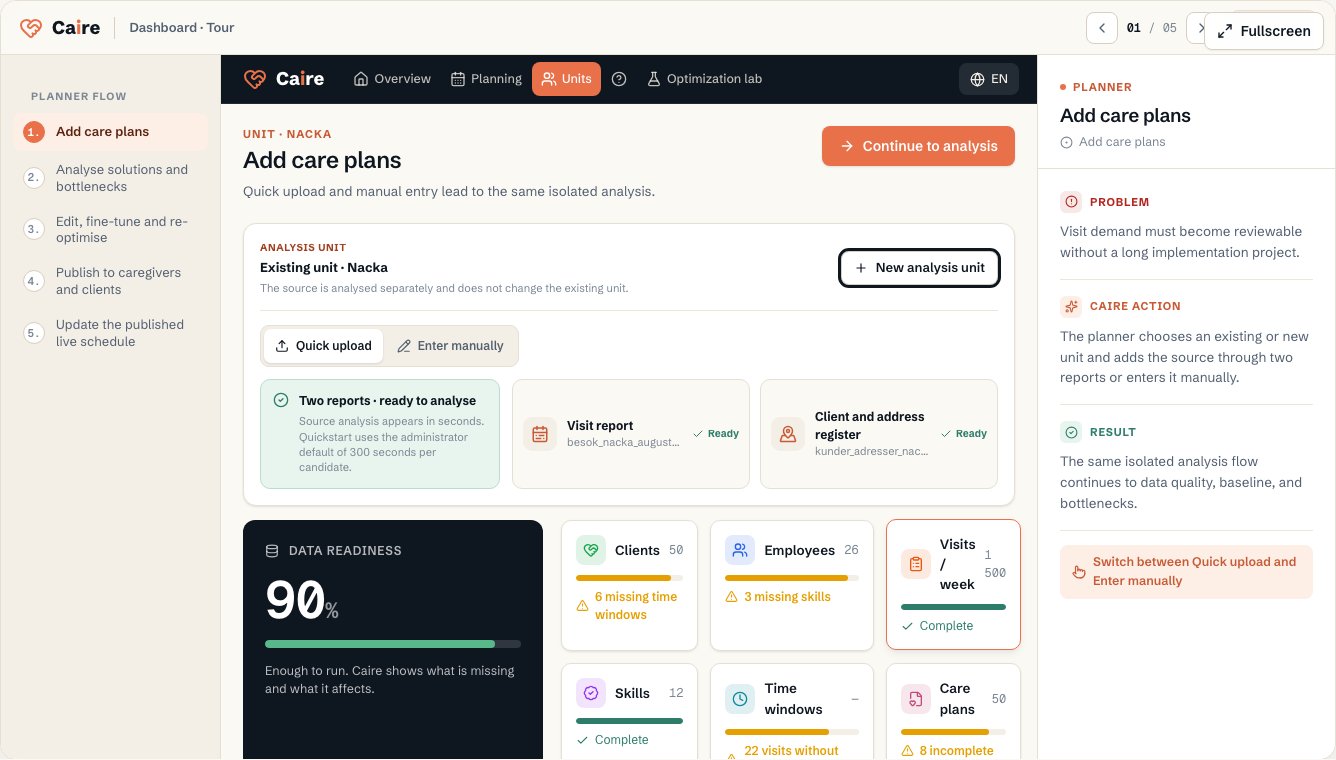
1 · CHOOSE ANALYSIS UNIT
EXISTING SOURCE
Nacka Home Care · Demo
Caire creates a separate analysis unit. The source remains
unchanged.
OR CREATE NEW
Nacka analysis · August
Created inline in the same import flow.
- 01Sign upaccount + organisation
- 02Uploadtwo reports
- 03Read reportplanned + actual
- 04Open calendarsame period
- 05Switch solutionplanner chooses
Synthetic Nacka demo · no real personal data · existing unit is
used only as the source04
VISIT-FIRST · WHOLE PAID SHIFTS
One demand. Several solutions. No automatic winner.
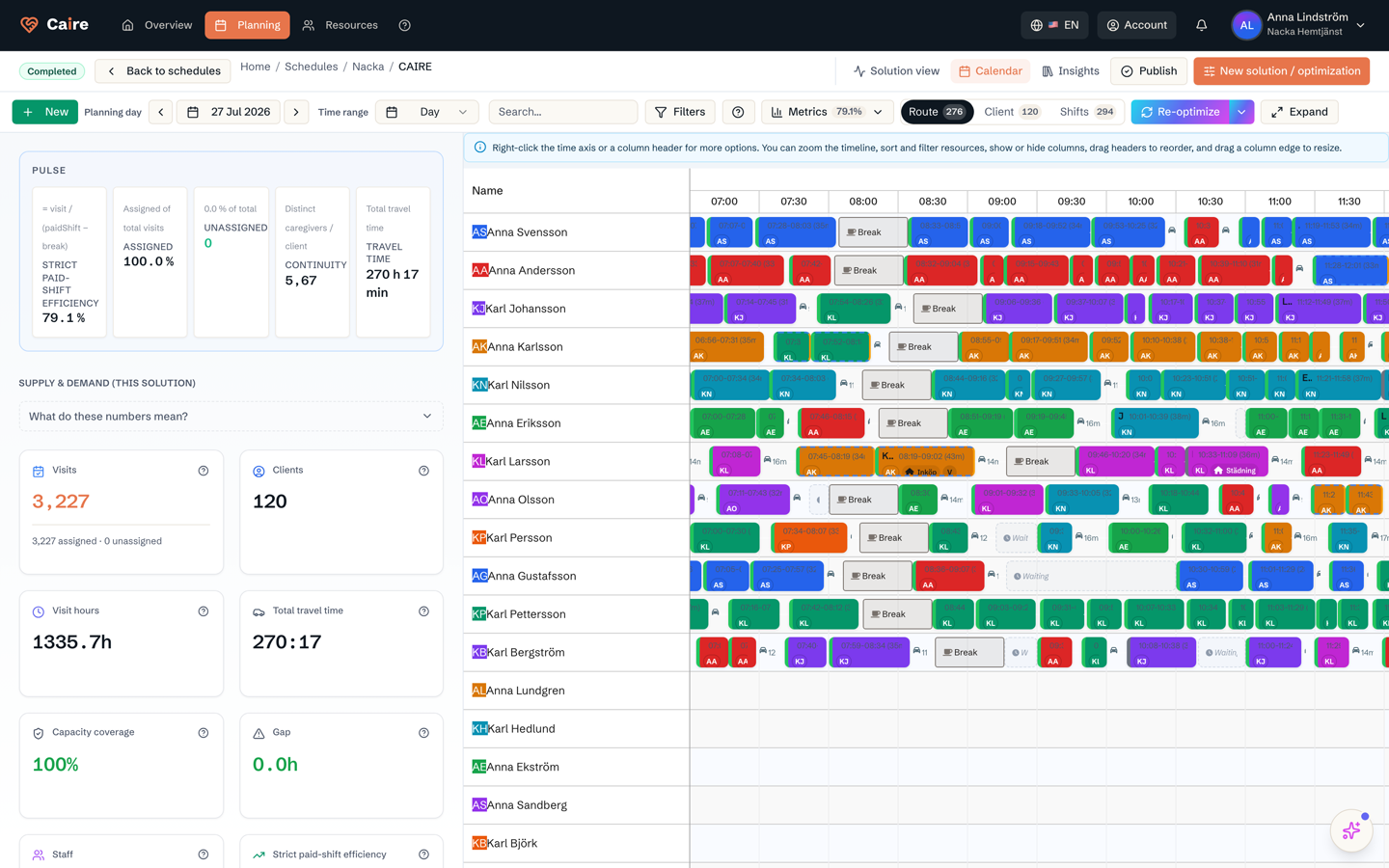
Visits determine demand. Caire opens whole shifts from operational templates and shows how assignment rate trades off against client-time share.
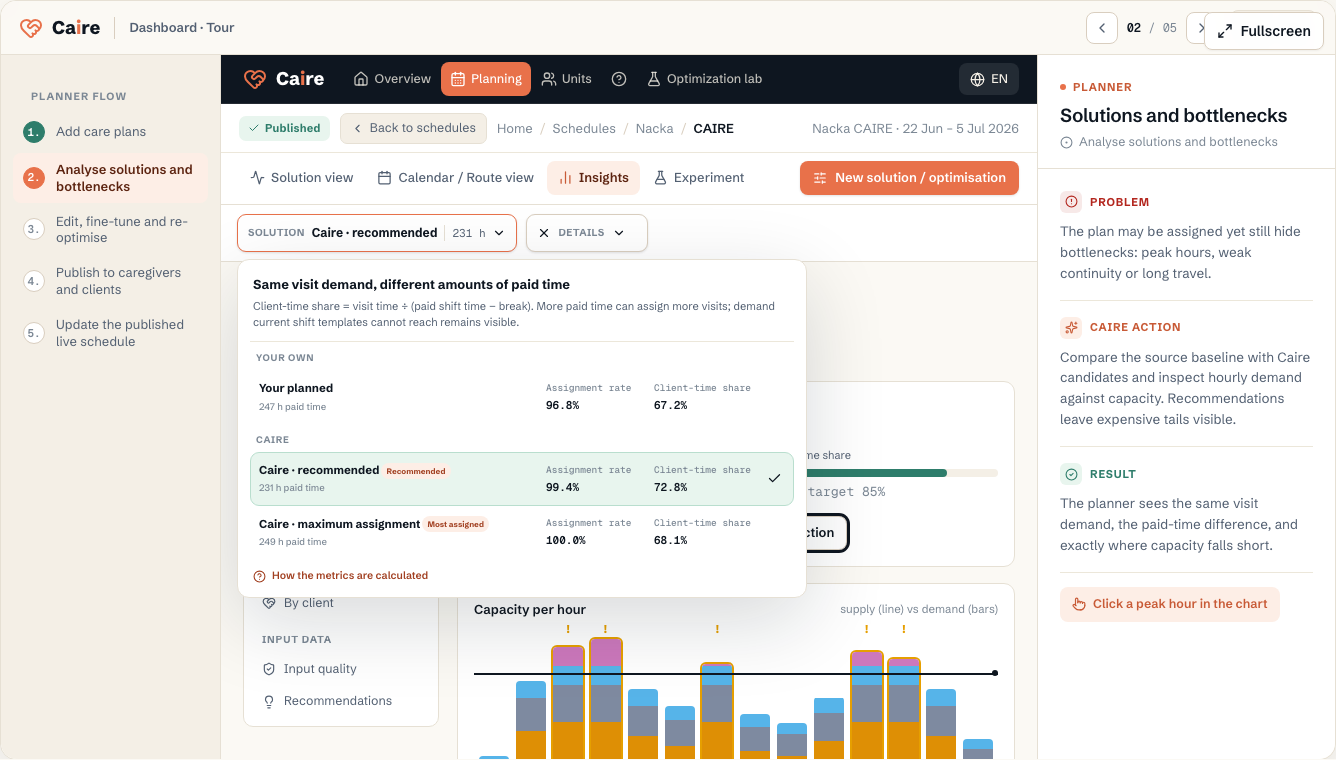
Planned
Coverage
Balanced
100% assignment may require a whole extra shift for one small
expensive tail05
SAME DATE · SAME VIEW
Switch solution in the same calendar.
Select a frontier point and review which visits are assigned, which whole shifts open, and how routes change — without losing calendar context.
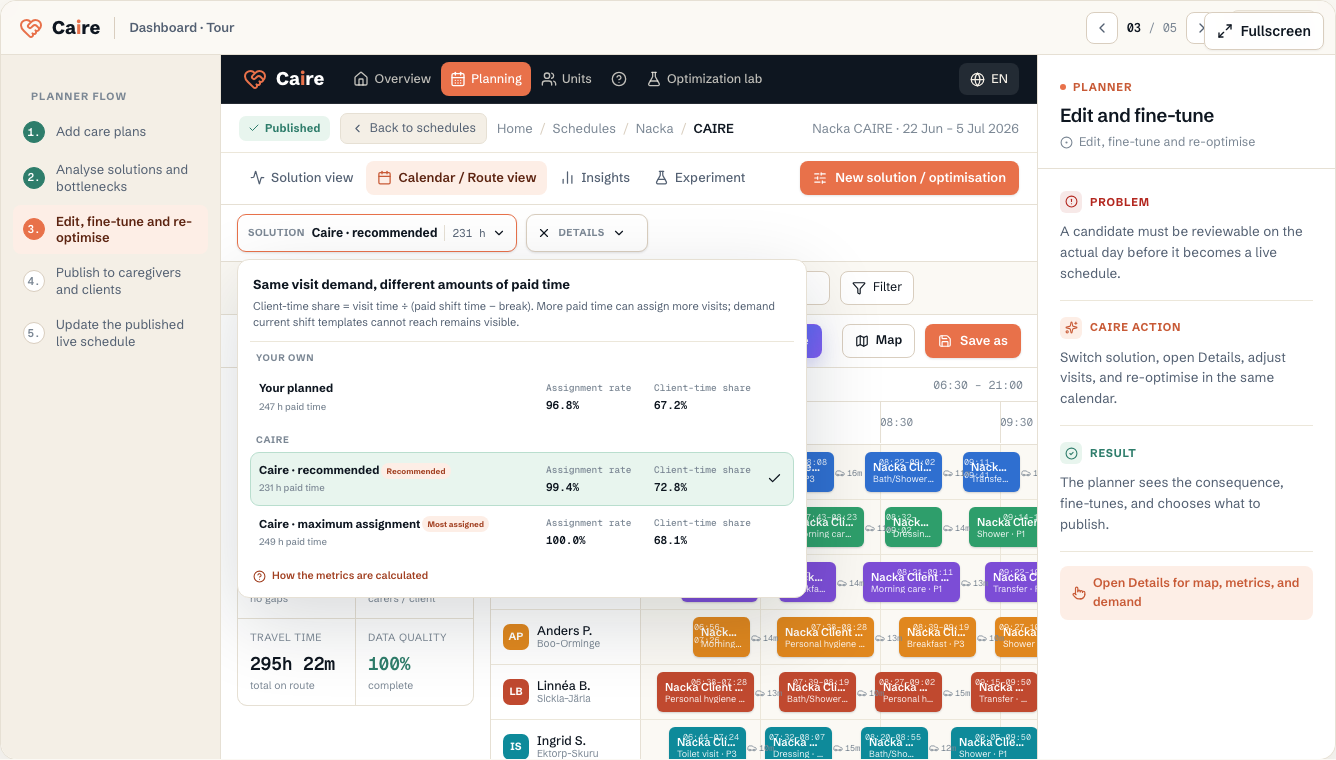
PlannedCoverageCAIRE · Balanced
TUESDAY 25 AUGUST · DAY VIEW
ANNA
4 routed visits07:30–11:40 · 18 km
BO
Office work09:00–10:00 · no travel
3 routed visits10:10–12:10
CLARA
Cleaning · overlap allowed10:00–11:00
Planned, Coverage, and CAIRE candidates are reviewed in the same
period and calendar view06
LAYER 2 · shiftScope · dayScope
Preferred time remains. The allowed window can widen.
For selected non-time-critical services, Caire can widen placement space. The same scope is frozen with the candidate through solve, campaign, and replay.
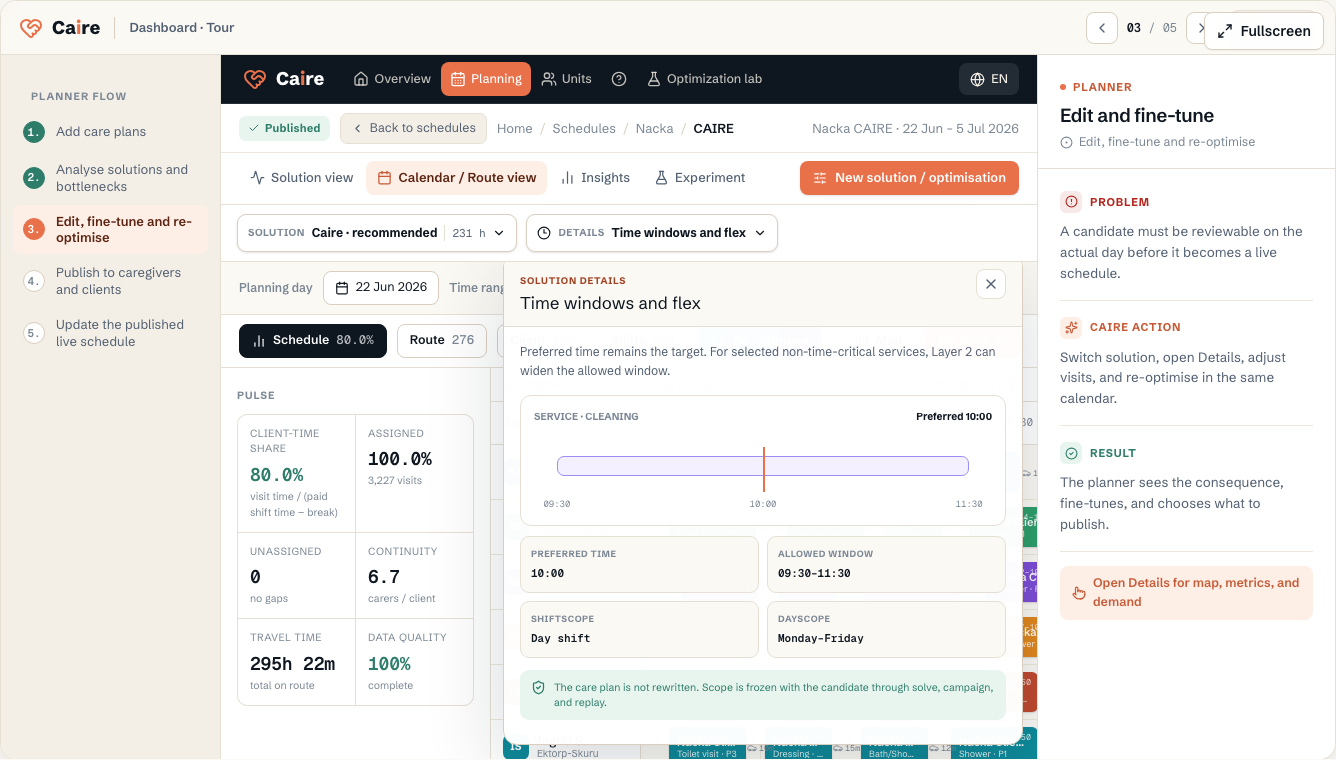
SERVICE · CLEANING
PREFERRED TIME10:00The source target remains visible and can be compared
with the proposal.
ALLOWED WINDOW09:30–11:30Layer 2 widens only the candidate scope chosen by the
operation.
09:3010:0011:30
Preferred time and allowed time window are separate
concepts07
THREE INDEPENDENT PROPERTIES
Routing, office work, and overlap are not one service type.
Caire treats travel, location, and simultaneity separately. Routed field visits, office work, and allowed overlap can therefore combine without conflating rules.
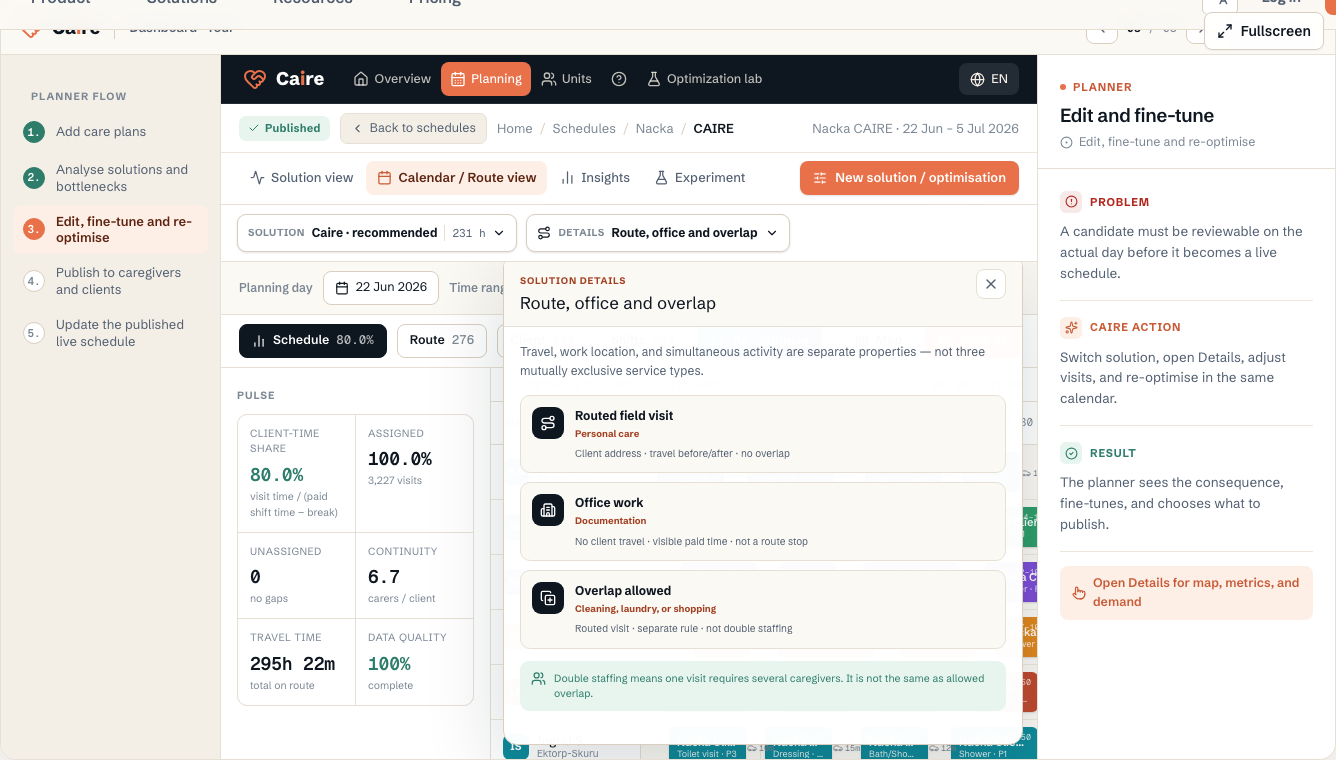
- Client address
- Travel before and after
- May allow overlap
- No client travel
- Visible paid time
- Separate from field visits
- Examples: cleaning, laundry, shopping
- Separate configuration
- Not double staffing
Double staffing means one visit requires several employees — not
that two activities may overlap08
MODELLED HISTORICAL DATA
7.5% higher client-time share. The same 1,517 hours with clients.
7.5–10%
model-validated improvement against a historical
baseline
2 anonymized pilot validations
METRICHISTORICAL PLANMODELLED CAIRE PLANCHANGE
- Visit time
- 1,517 hhistorical
- 1,517 hmodelled
- 0 hunchanged
- Paid shift time minus break
- 2,502 hhistorical
- 2,327 hmodelled
- −175 h−7.0%
- Client-time share
- 60.6%historical
- 65.2%modelled
- +7.5%relative improvement
The capacity can be used for
- more visits and growth
- absence and variation
- less overtime or external staffing where that is relevant
One of two evidence sets · retrospective two-week model ·
anonymized confidential pilot data
09
See the whole loop in the film. Then try it yourself.
The film shows how demand becomes an approved plan. Then try the dashboard and the three mobile roles with example data — without signing in.
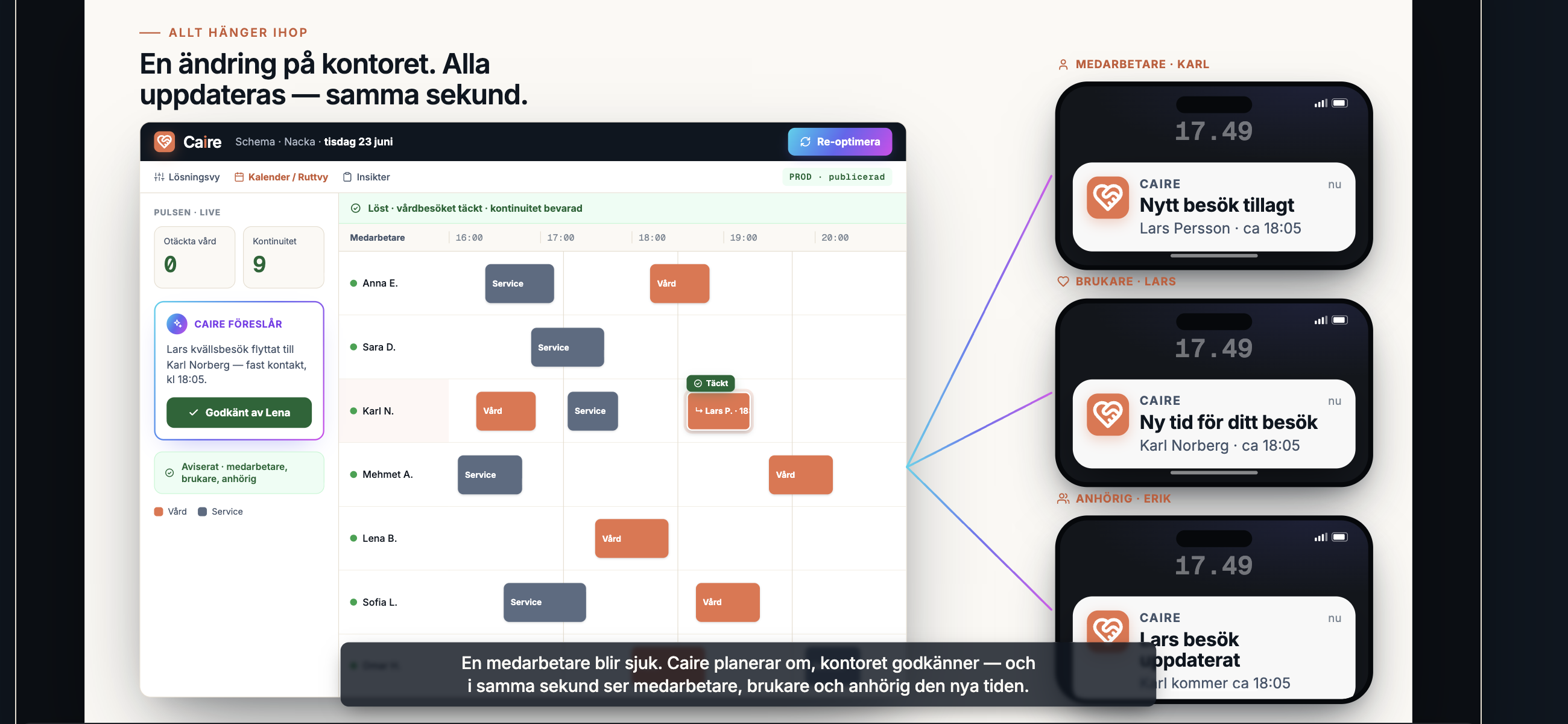
INTERACTIVE PRODUCT FILM
A day with Caire
Open the film ↗
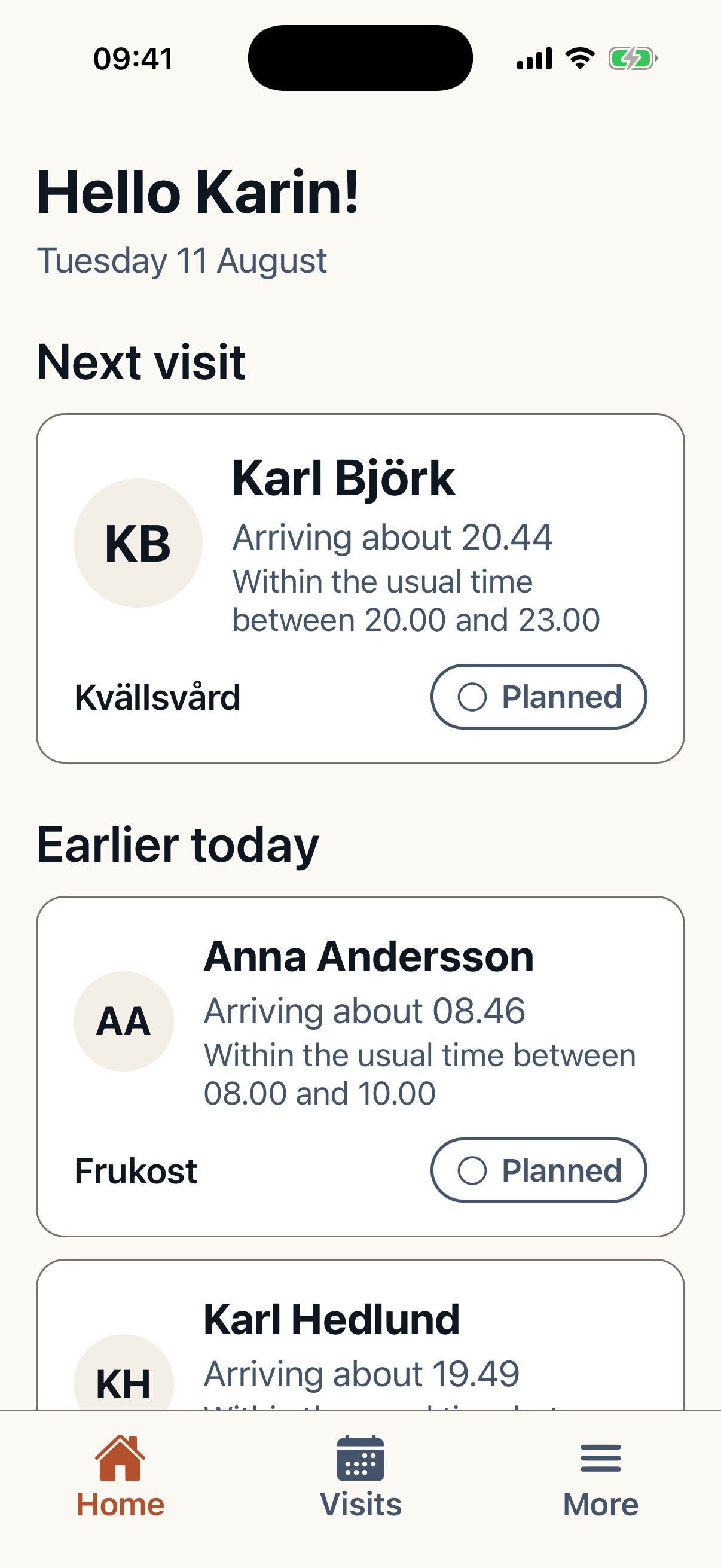 CLIENT
 FAMILY
Open the film or try the interactive product views
10
Ask the operation in plain English.
“Five people are off sick today — what can we cover without losing continuity?”
- Analyze
- Explain
- Propose
- Approve
Nothing runs from chat text alone. An explicit button press creates a new version.
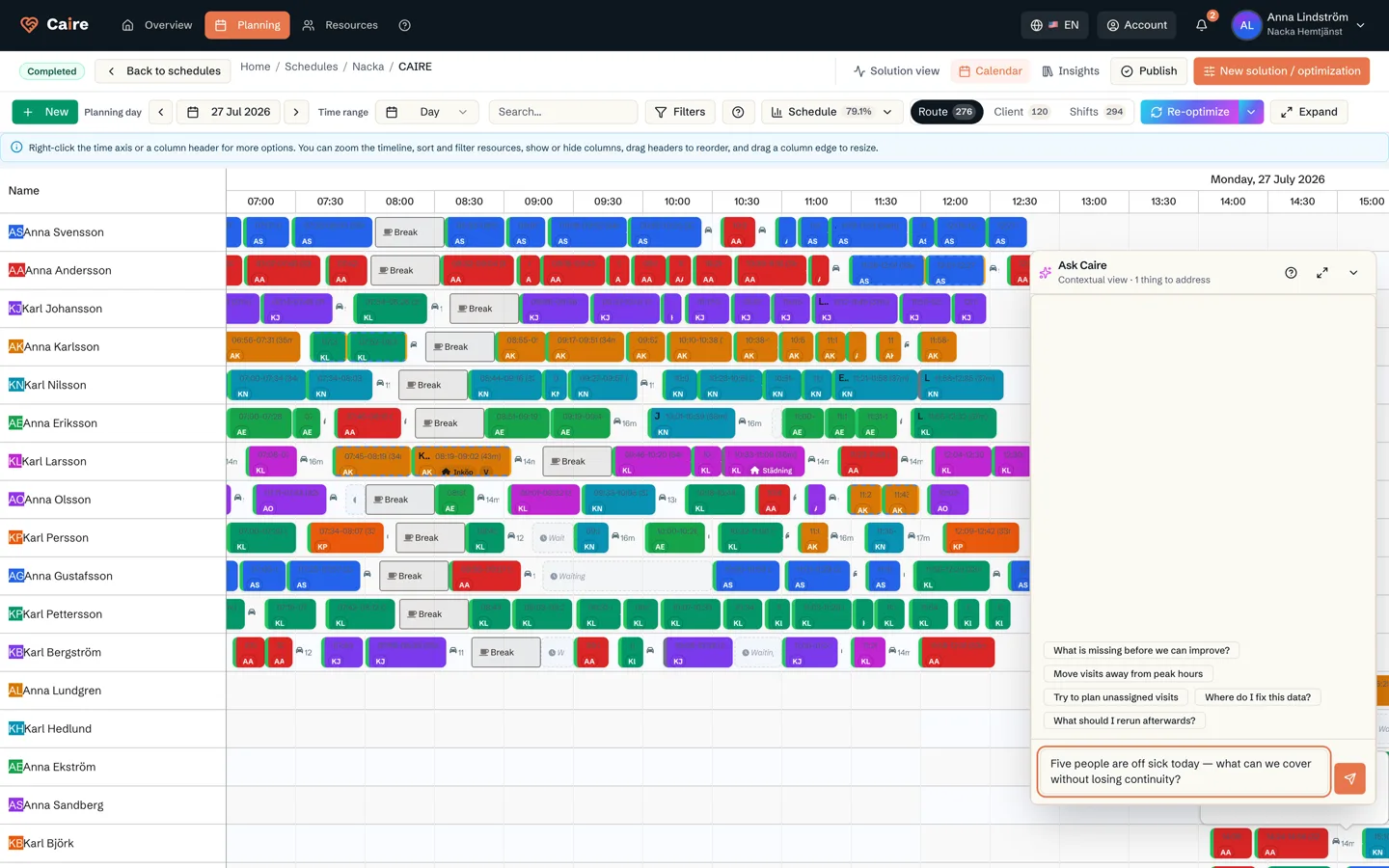
Direct shift changes and publishing are still office
decisions
11
One delay updates the whole chain.
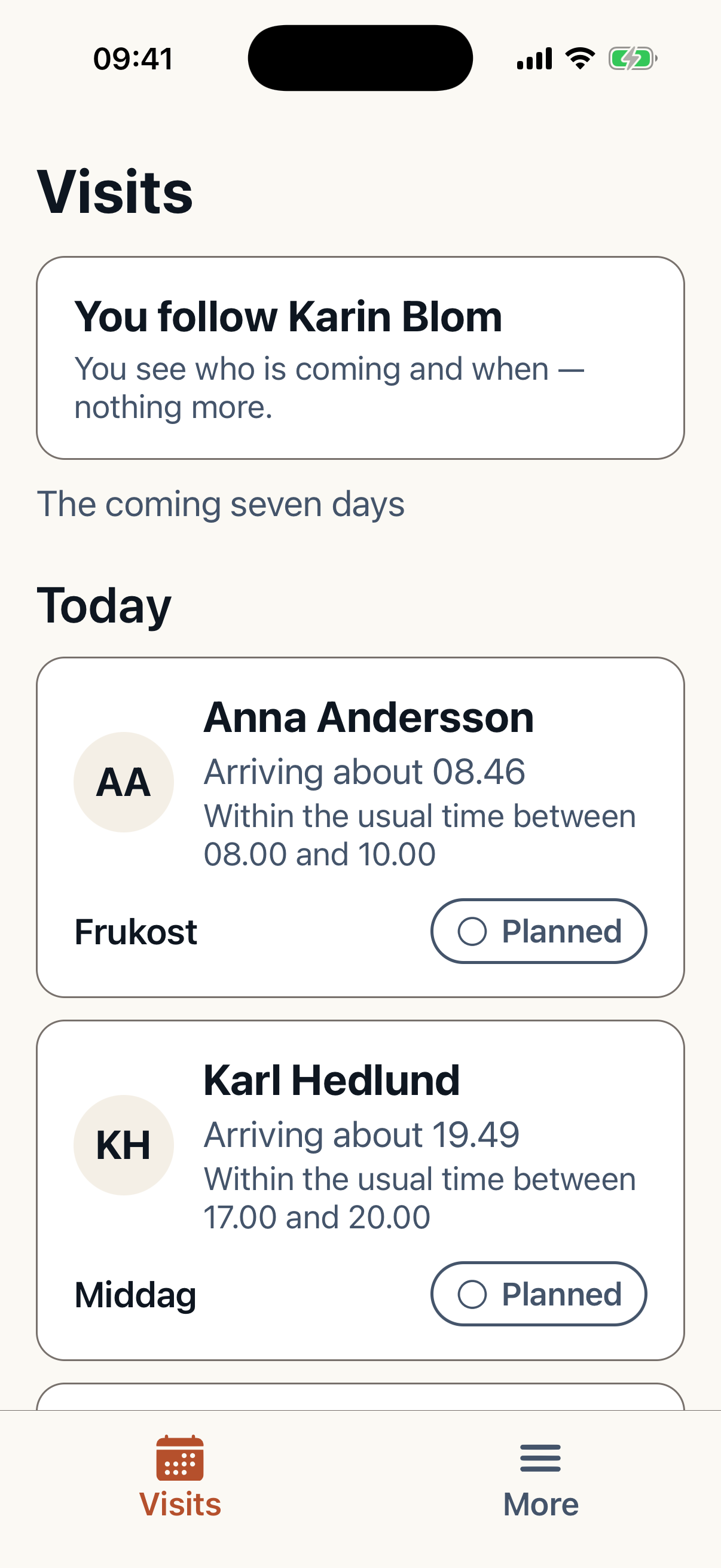
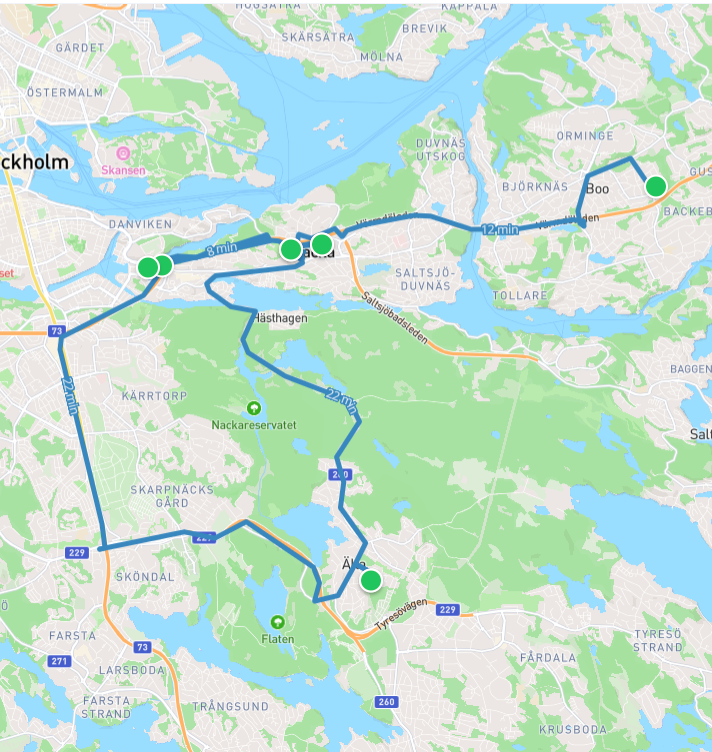
The caregiver's GPS and field status update Caire. On a delay the planner sees the impact immediately, while the client app shows who is coming, the new estimated arrival and the journey on the map.
 KA
KA
GPS + “I'll be late”
17:08 · FIELD NOTICE
New estimated arrival 17:20
Planner and admin see the impact
+ fixed parking time
+ percentage traffic buffer
+ actual position
The schedule changes only after the office decides
new time + live position
KA
Position is shared only during the active journey or the active
visit · not as constant background tracking
12
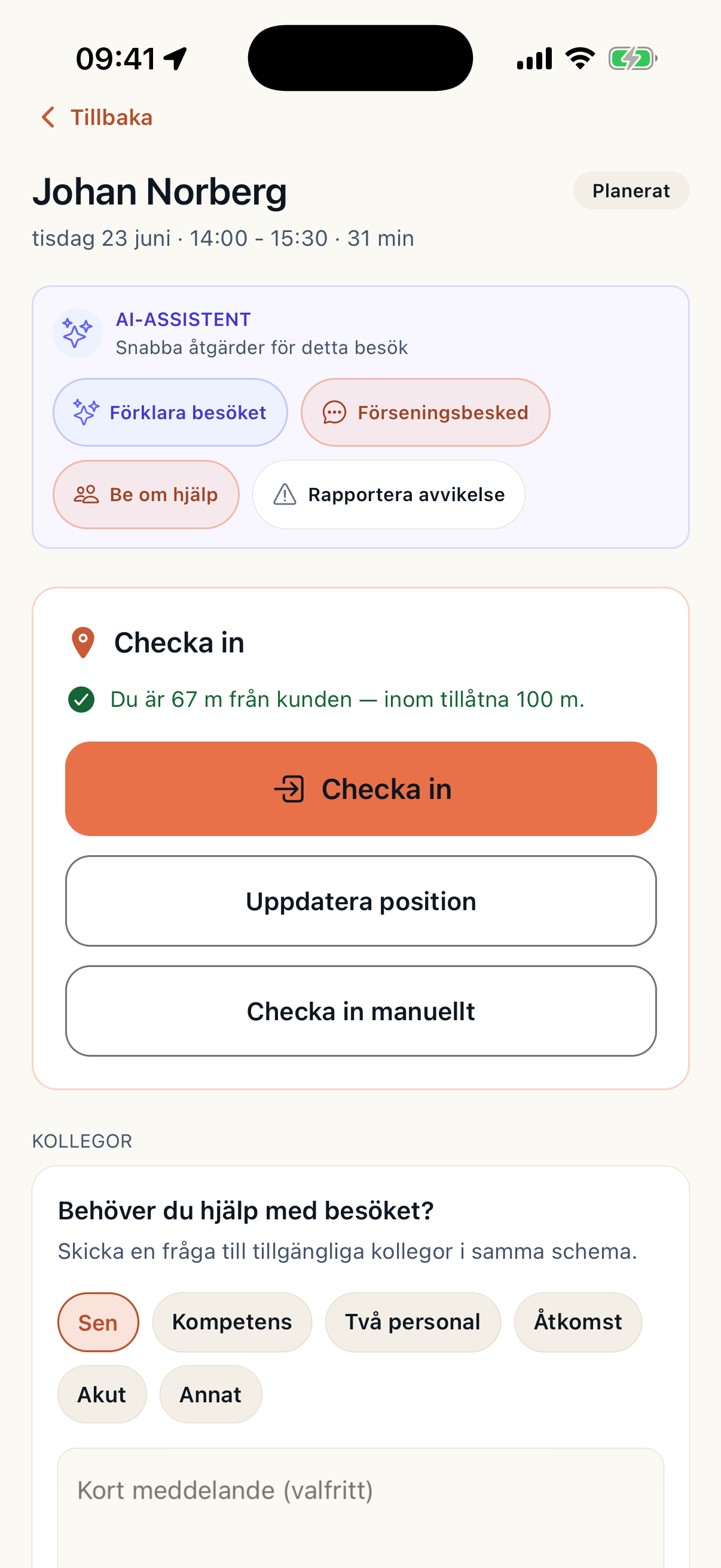
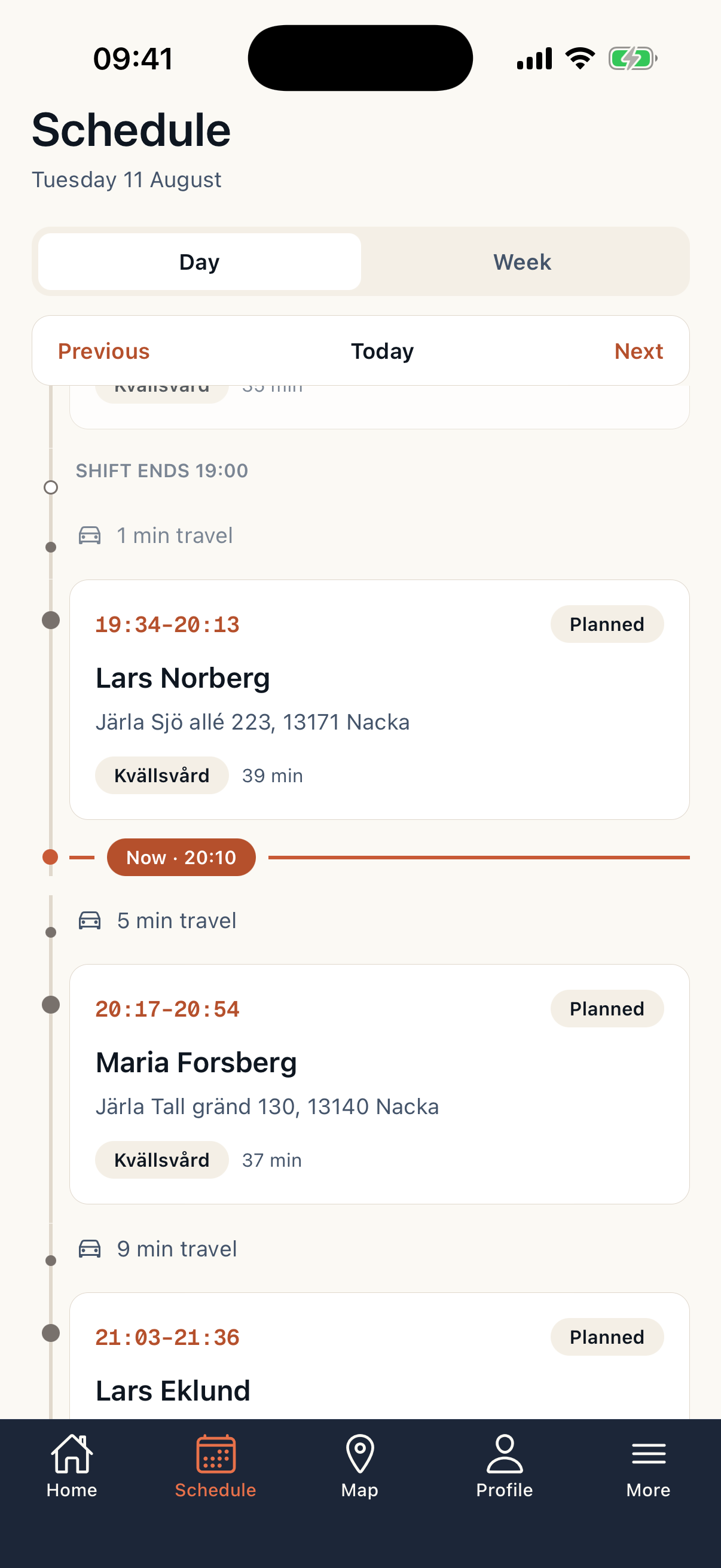
The caregiver sees the next step — and can ask for help.
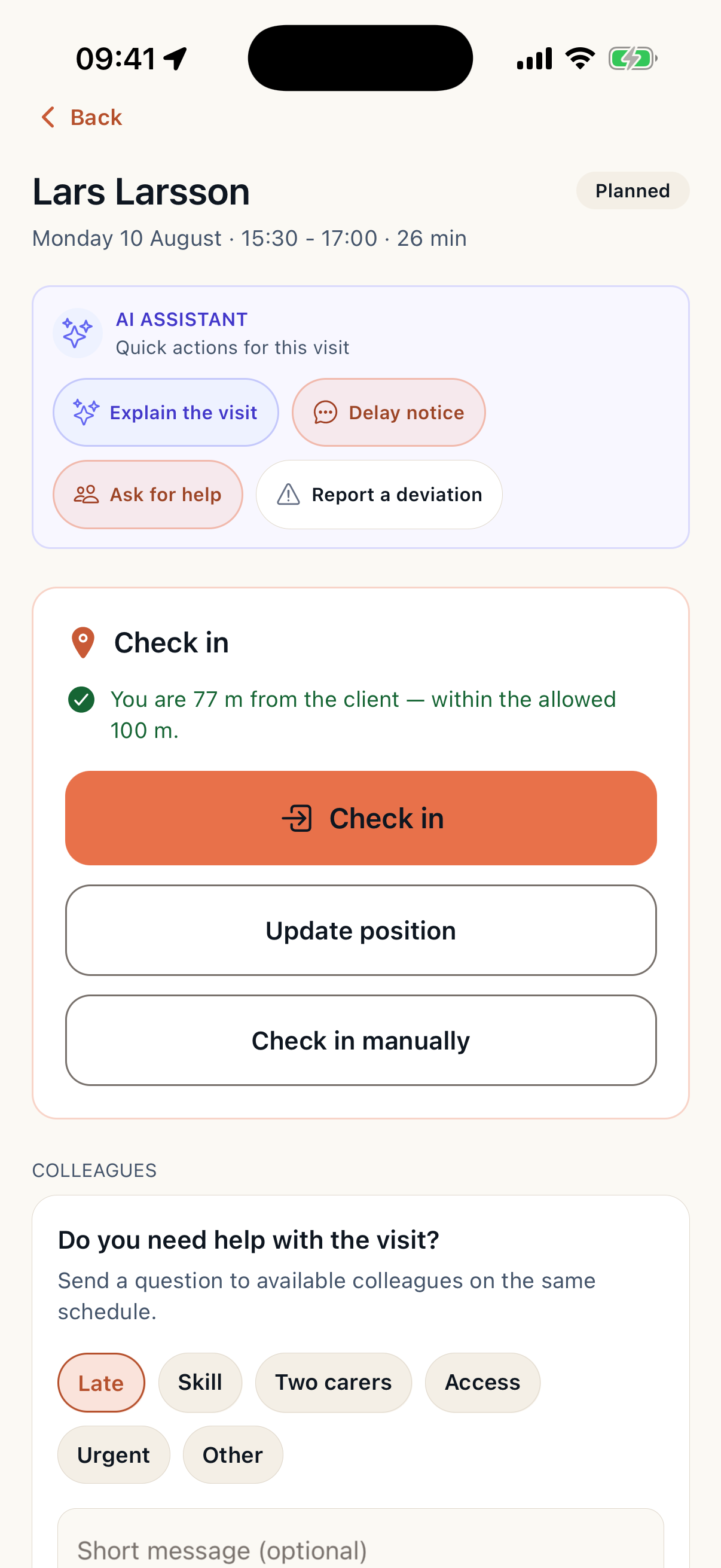
The day's route and travel time follow along in the phone. On an exception the caregiver can notify the client, ask for help and start an office-coordinated reassignment.
Route + estimated arrivalVisit registrationDelay noticeAsk for helpRequest reassignmentOffline
Position is shared only during the active journey, the active visit or a help request — and is then switched off.
03 · EXCEPTION
I'll be late
Notify the client
I need help
Ask the office or a colleague for support
Offline support and registration method depend on the enabled
configuration
13
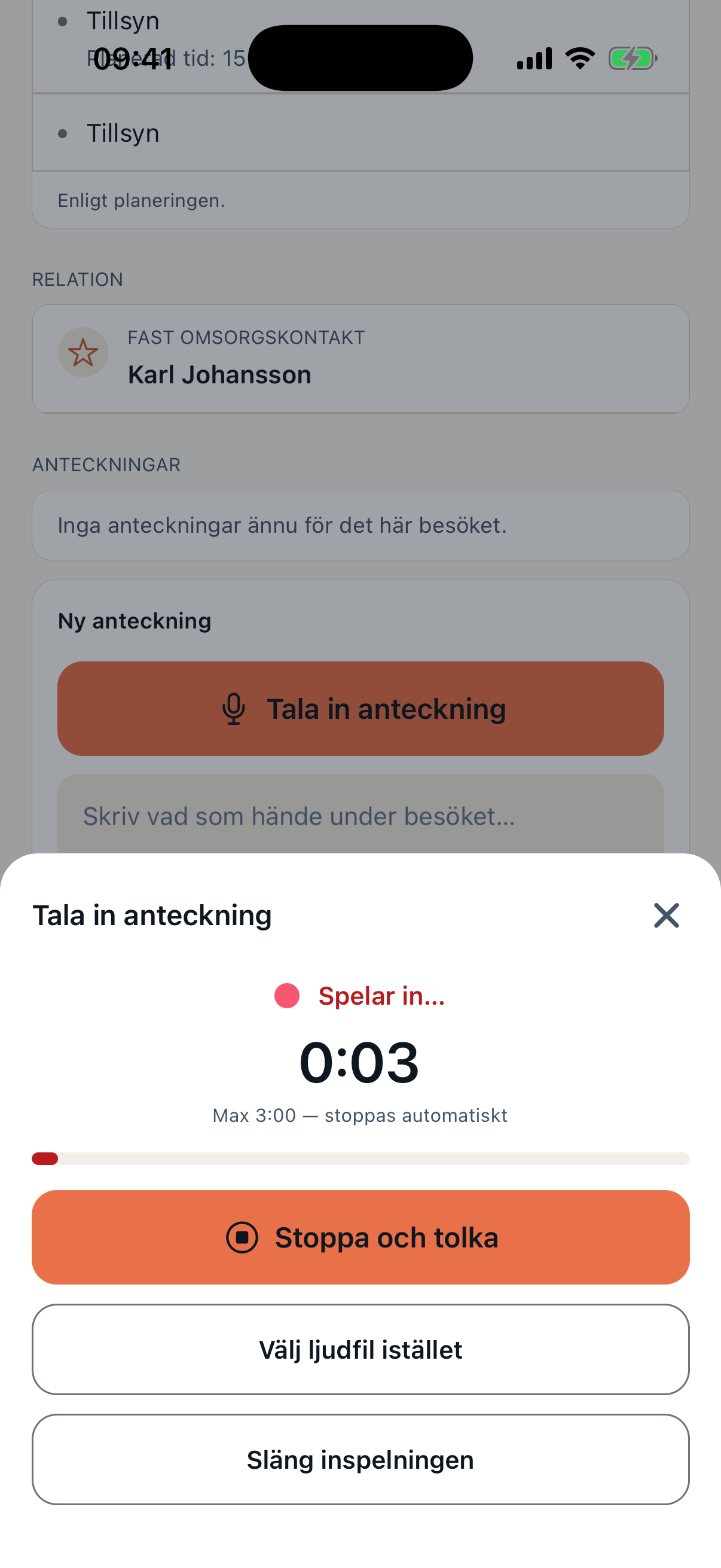
Document in the moment. Save only after review.
The caregiver dictates what happened. Clinical AI creates a structured draft that can be edited, approved or rejected.
- 01Dictate
- 02AI draft
- 03Review and edit
- 04Approve or reject
No autonomous clinical judgement. No AI draft is saved silently.
A structured summary with highlighted fields to review.
EditApprove
A human decision is required
Azure EU is used when the speech feature is enabled14
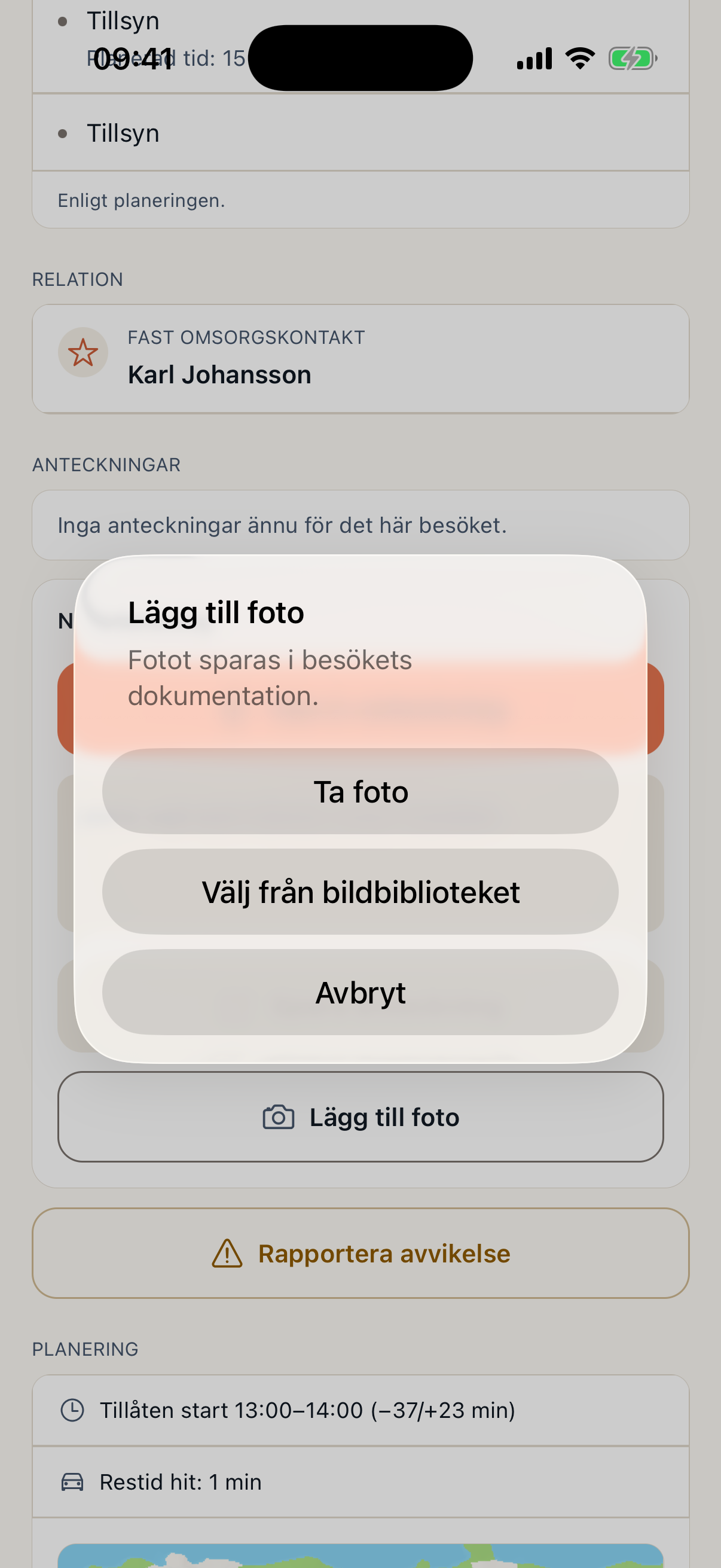
The same published plan — the right view for every person.
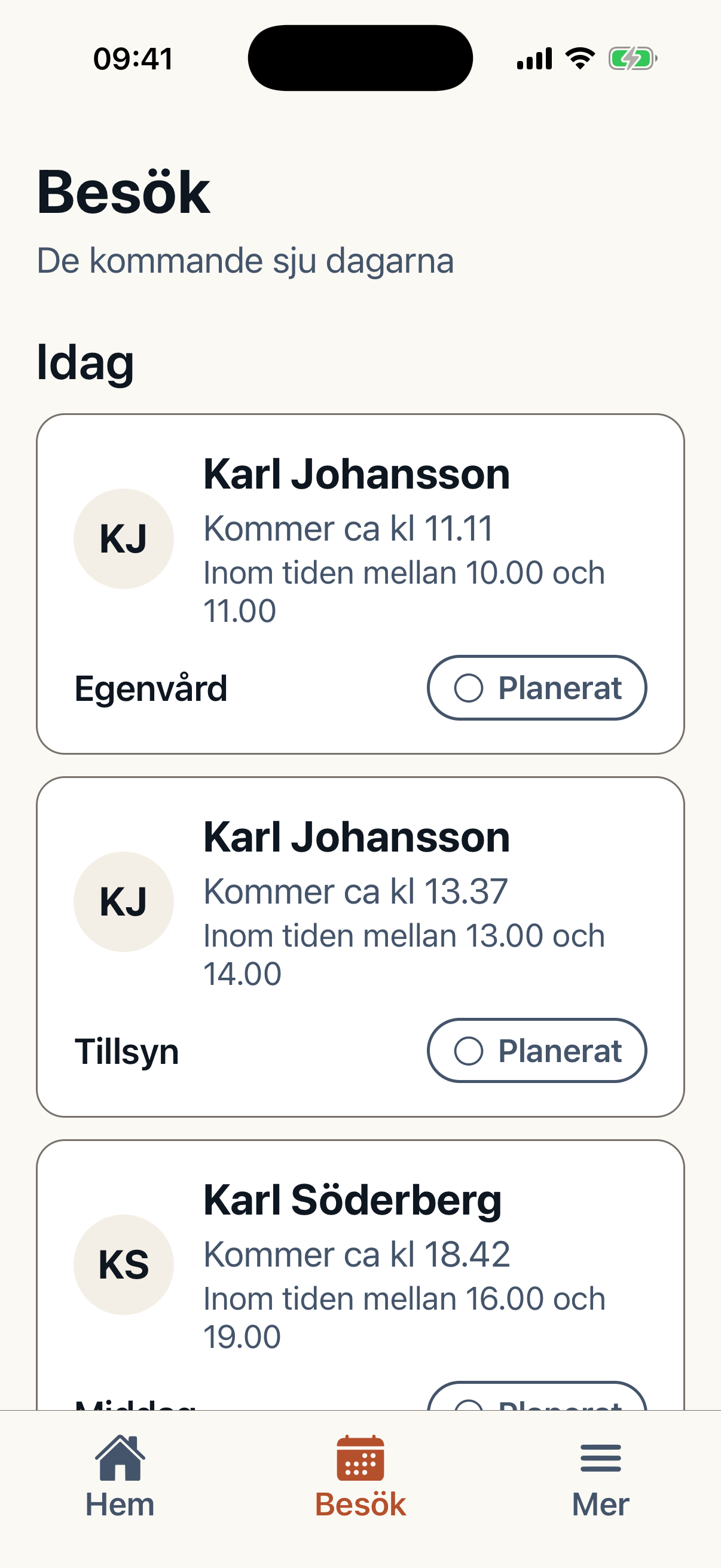
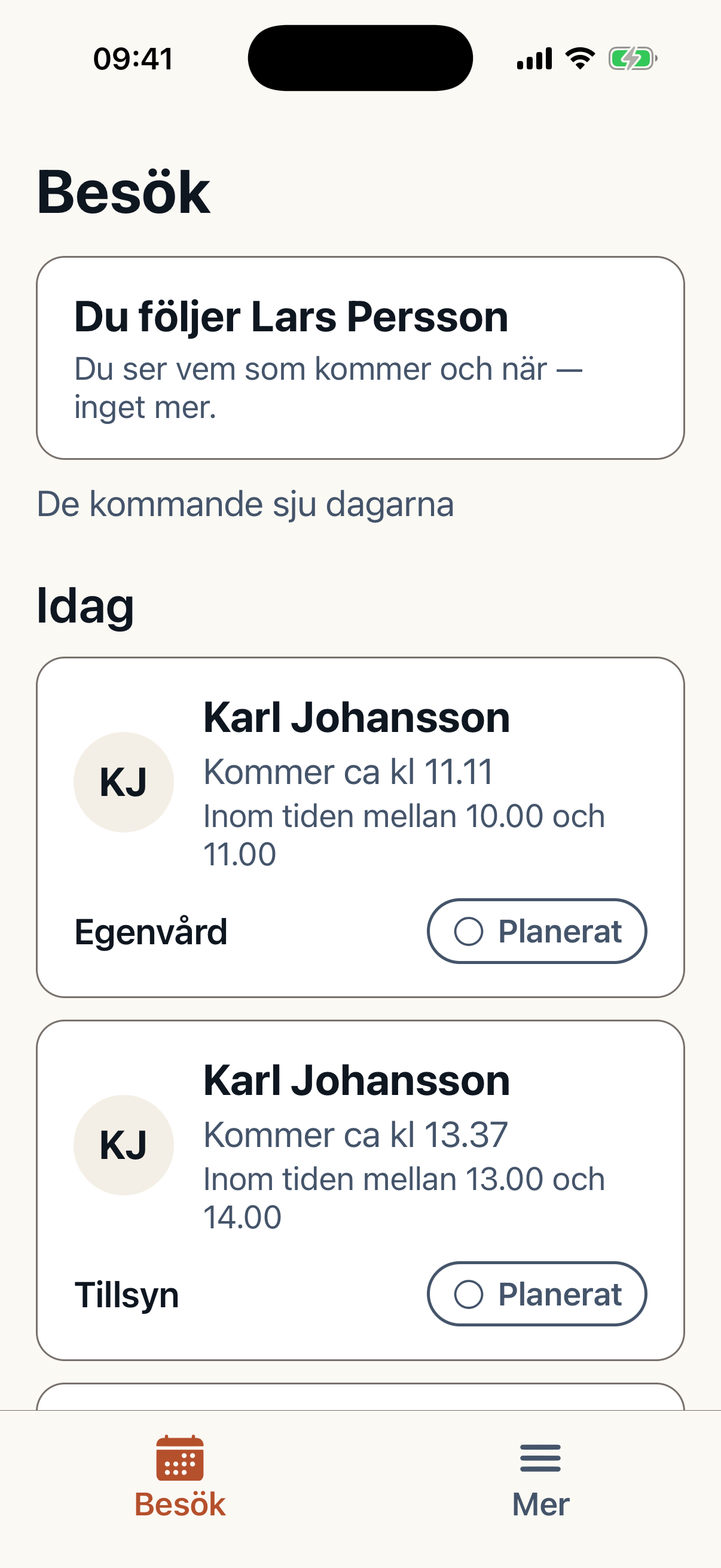
The caregiver sees the assignment and their actions. The client sees who is coming and roughly when. Family members see the status the organization and the client have approved.
Caregiver assignment · time window ·
actions
Client next visit · approximate time
Family permitted status · office
updates
Organization consent · access ·
revocation
No record notes are shown in these views. Consent and permissions control which visit information is shared.
SAME VISIT · LARS PERSSONWelfare check · 13:00–14:00
Permission-controlled and office-mediated · no open direct
channel to caregivers
15
AI proposes. The planner decides.
Caire uses your visit rules, shifts and priorities to produce several comparable schedule proposals. Nothing is published before a planner has reviewed and approved it.
The planner decidesComparable proposalsRole-based accessExplained impact
GDPR- and EU AI Act-aligned design
16
START WITH EVIDENCE · CONTINUE WHEN READY
Two reports are the first step. Production readiness comes next.
Quickstart provides an isolated comparison without production changes. When you want to publish, complete real staff, shift templates, skills, and operational rules.
UploadVisit report + client and address register
Read the sourcePlanned · evidenced actual · bottlenecks
Compare candidatesAssignment rate · client-time share · same
calendar
Prepare productionStaff · shift templates · skills · rules
Review and decideNothing is published without planner approval
Synthetic demo · no production changes before joint review17
Bring one unit.
We show what is worth changing.
Bring one planning period and the metrics you already trust to a data workshop. You get a comparable baseline, clear bottlenecks and a shared plan for the next step.
CONNECT & ANALYZE
YOU BRING1 unit1 planning periodmetrics you trust
YOU GETa comparable baselineclear bottlenecksa shared next step
info@caire.se
Caire · planning that holds from decision to delivery18