Routing is only one part of scheduling
A short drive can still be wrong if it breaks continuity, skills, labor rules, or an important time window.
Humans approve
Caire Core can prepare candidates, but publishing requires a responsible planner to understand and approve the tradeoff.
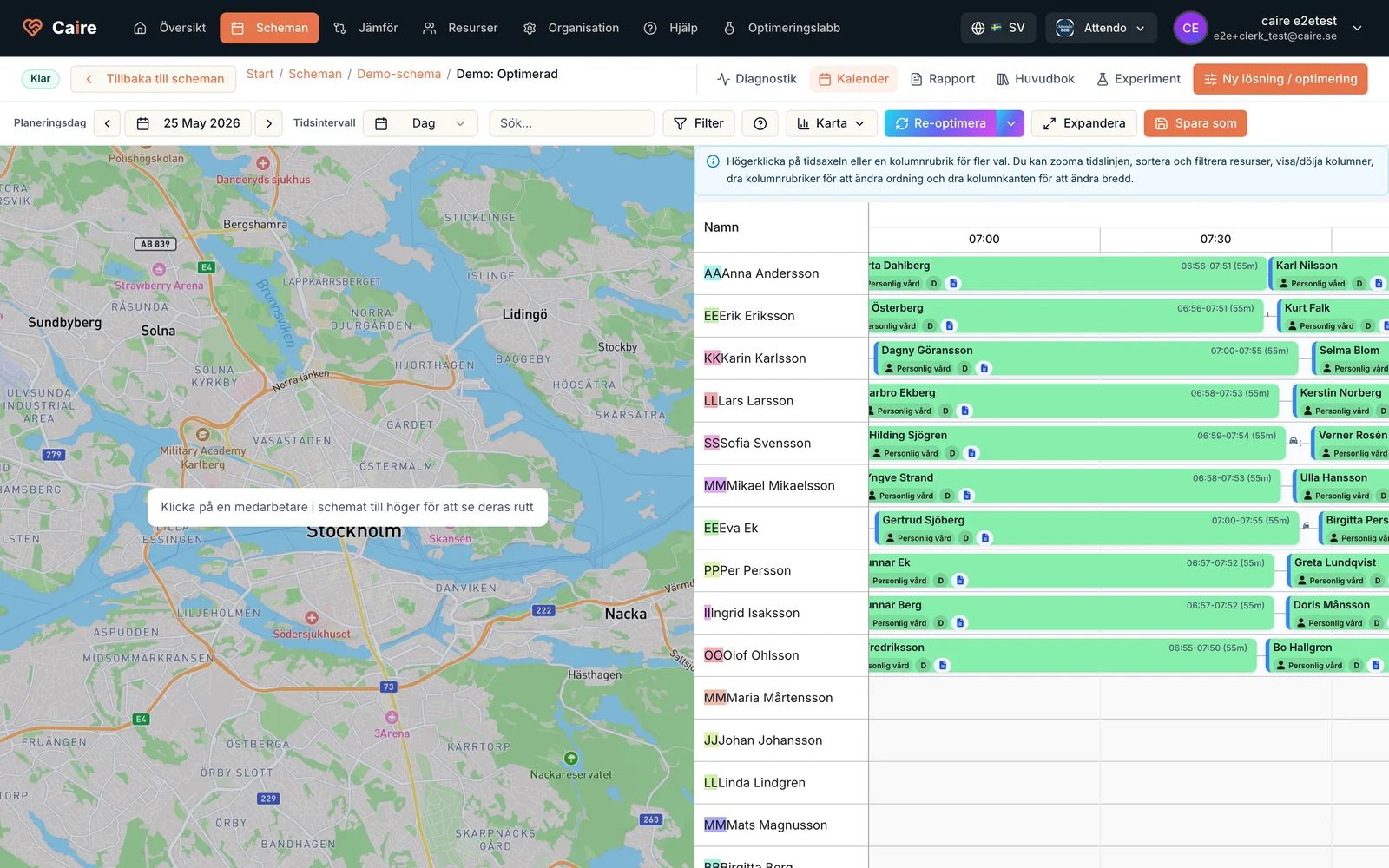
Baseline makes improvement honest
Every candidate is compared with current reality: travel, continuity, coverage, cost, and workload together.
Audit-friendly AI
Decisions should be explainable through rules, quality metrics, locks, and historical relationships.
The Routing Intractability & Hybrid Imperative
01
Executive Summary
Home-care routing is a fusion of VRPTW, staff scheduling, skills matching, and multi-objective optimization. Even a modest daily schedule with 350 visits and 28 caregivers creates an astronomical search space before labor rules and continuity are applied.
Caire's model is hybrid. Humans shape stable rounds, local rules, and qualitative exceptions. Caire Core evaluates configured candidates, reports their measures, and keeps a responsible planner in the approval loop before publishing.
02
Mathematical Reality of Home-Care Scheduling
Example: 350 visits, 28 caregivers, 07–22, more than 10 visits per shift. The platform source used this example to show why brute force is not operationally meaningful.
All possible schedules
1. The Astronomical Solution Space (All Possible Schedules)
With 350 visits and 28 caregivers, each visit must be assigned to the right person and ordered in the right route. A practical upper-bound expression is often shown as (350!)^28; a more detailed partitioning gives 350! × C(377,27) ≈ 10^781.
That is far larger than the number of atoms in the observable universe. The point is not to enumerate every option, but to show why manual inspection runs out.
Legally and operationally valid schedules
2. The Feasible Region (Legally & Operationally Valid Schedules)
Only a microscopic part of the search space works in reality: rest periods, breaks, weekly hours, time windows, geography, continuity, skills, practical obstacles, preferences, and stability all have to hold at once.
The feasible region is tiny, fragmented, and high-dimensional. Moving one visit by ten minutes can make an otherwise good plan invalid.
Comparable candidate scores
3. Candidate Scoring Against a Configured Objective
Caire Core scores candidates with a configured weighted objective for travel, continuity deviations, overtime, fairness, stability, and utilization. The run reports measures and tradeoffs for planner review.
The important part is that every candidate can be compared against baseline and explained to the planner.
Feasibility changes during the day
4. But in Reality the Feasible Region is a Moving Target
Sick leave, traffic, new clients, cancellations, key problems, longer visits, and changed availability move the problem into a new part of the search space.
That is why yesterday's candidate may not match today's inputs and needs to be evaluated again.
Traveling Salesman Problem
The shortest tour that visits each location once. For one caregiver, it is the question: in which order should today's 14–25 clients be visited?
Vehicle Routing Problem with Time Windows (VRPTW)
Multiple routes, multiple people, and earliest/latest start times. In home care, this collides with breaks, skills, continuity, and local promises.
Home Health Care Routing & Scheduling Problem (HHCRSP)
Combines routing, workforce assignment, skills, continuity, and labor rules. Every constraint interacts with geography and relationships.
Multi-objective optimization
Travel, continuity, fairness, overtime, coverage, workload, and stability pull in different directions and need transparent weighting.
Feasibility map
H: human-feasible
Pinned rounds, local knowledge, relationships, acceptable changes, and manual locks.
S: computable candidate region
Route and schedule candidates are compared using rules, KPIs, history, and mobile outcome data.
Candidate for planner review: measured travel and continuity tradeoffs, plus a decision the planner can explain.
03
1. Proof Sketch: Why Routing Blows Up
A classic route problem is already hard. Home care adds workforce assignment, time windows, continuity, priorities, labor rules, local promises, and mobile outcomes.
Constraint explosion
| Layer | Effect |
|---|---|
| Time windows | Narrow the feasible route set and can create sharp feasibility boundaries when visits move. |
| Continuity weights | Make continuity deviations visible without promising a specific operational outcome. |
| Skills & certifications | Can create separate candidate groups when only some employees may perform a visit. |
| Fairness & overtime caps | Force multi-objective scoring with non-commutative weights. |
| Disruption buffer | Requires a new candidate when absence or other inputs change. |
5. Why Human-Made Slingor Need Revision After Changes
A round is a static weekly pattern. Reality is dynamic. When a caregiver becomes sick, a visit takes longer, traffic increases, or a new client is added, the previous feasible region moves.
A changed input can move the feasible region, so the planner needs a new candidate and a fresh review before publishing.
Constraint Pressure Index
A practical evaluation should expose how many hard constraints, soft constraints, and planner locks are active before accepting a candidate.
6. Planner-Guided Human + Optimization
Humans define acceptable operating regions. Caire Core prepares alternatives within those regions for planner review.
Humans create stable templates (slingor)
When inputs change, the planner can run optimization again against the stable template instead of replacing local judgment with an opaque route.
04
2. Planner-Guided Optimization
Let H be the human feasible region: pinned rounds, local knowledge, sensitive relationships, and politically acceptable changes. Let S be the candidates Caire Core can compare using rules and KPI tradeoffs. Their intersection H ∩ S gives the planner relevant alternatives to review.
Hybrid flow: planner-approved optimization
Human planners
Planners define stable rounds, soft limits, and exceptions.
Caire Core knowledge graph
Caire Core knowledge graph gathers constraints, history, and mobile outcome data.
Optimization
The optimization engine proposes deltas, scores, and explanations.
Planner approval
The planner approves, rejects, or adjusts before publishing.
Continuous learning
Mobile execution data feeds a continuous learning loop.
Sequence flow: from constraint to field result
- 1Planner pins rounds and soft rules
- 2Caire Core sends constraints and history
- 3Caire Core routing calculates candidate and score deltas
- 4Planner reviews diff view and explanation
- 5Approved plan is published to the field
- 6Outcome data is captured for the next improvement
Division of strengths
| Scenario | Human-only | Solver-only | Hybrid |
|---|---|---|---|
| Weekly slingor | Stable patterns but limited global comparison | Broad search but no tacit operational context | Pins, alternatives, and planner review |
| New clients | Manual placement with local knowledge | Ignores tacit promises | Alternatives reviewed by the planner |
| Mid-day sick leave | Manual swaps and review of follow-on effects | May reshuffle pinned visits | A new run with visible pins |
05
3. The Six NP-Hard Problems
Home-care scheduling is not one optimization problem. It is a composition of six difficult problems, each already hard on its own.
3.1 Traveling Salesman Problem (TSP)
Find the shortest order for each caregiver's visits. Complexity grows as N!, and even 25 stops create a search space that cannot be brute-forced.
3.2 Vehicle Routing Problem (VRP)
Assign multiple routes across multiple workers and score workload, travel, and geographic fragmentation.
3.3 Staff/Crew Scheduling
Who works which shift under labor rules, breaks, maximum hours, weekend fairness, and local staffing? This is hard even before routing.
3.4 Workforce Assignment
The right caregiver for the right visit based on skills, delegation, continuity, zones, language, and preferences.
3.5 Time-Window Scheduling
Every visit has earliest start, latest start, soft windows, and duration. Five minutes late can create downstream infeasibility.
3.6 Multi-Objective Optimization
Travel, continuity, fairness, overtime, idle time, distance, reserve capacity, and stability are goals that often conflict.
06
4. Why Home-Care Routing Is Harder Than Logistics
Logistics companies solve hard routing problems, but home care introduces human-service constraints that change the problem class.
Home care is harder than logistics
| Factor | Logistics | Home care |
|---|---|---|
| Human-to-human interaction | No | Yes |
| Skills and certifications | Rare | Common |
| Continuity requirements | No | Critical |
| Legal time constraints | Mild | Strict |
| Multiple daily windows | Rare | Default |
| Uncertain durations | Some | High |
| Operational disruptions | Some | Recurring |
| Geographic fragmentation | Low | High |
| Multi-objective fairness | No | Required |
07
5. Why Humans Alone Cannot Solve It / 6. Why Algorithms Alone Cannot Solve It
The old platform article separated these into two sections. The point is one: the reliable operating region is the overlap between human context and computational search.
Humans are strong at
Can handle
- relationships and tacit knowledge
- local promises and sensitive exceptions
- geographic intuition
- stable weekly patterns
Cannot handle alone
- many alternatives
- systematic scoring of travel tradeoffs
- consistent fairness computation
- replanning after changed inputs
Algorithms are strong at
Can handle
- large-neighborhood search
- constraint satisfaction
- configured candidate scoring
- mathematical fairness
Cannot handle alone
- patient relationships
- unstructured qualitative context
- local political sensitivity
- new signals not yet represented in data
08
7. The Planner-Guided Hybrid Model
Phase 1: Human-Designed Weekly Templates ("Slingor")
Planners shape stable rounds, continuity, and local rules. Caire Core reports configured feasibility checks for planner review.
Phase 2: Configured Candidate Comparison
Caire Core scores travel and workload and reports results for configured hard and soft time windows.
Phase 3: Replanning After Changes
When inputs change, the planner can start a new run, review the alternatives, and publish an approved proposal.
09
8. Research Background and Measures
The research describes the problem class and established optimization methods. It is background, not evidence for a generic customer outcome from Caire. The operation needs to compare candidates against the same frozen source snapshot.
Measures to review for each run
- client-facing time and paid shift time
- travel time and waiting time
- continuity per client
- overtime and other hard constraints
- unassigned visits and their reasons
Key Research Papers
- Rasmussen et al. (2022), Home Care Scheduling Problem – A Review
- Eveborn et al. (2006), Optimization of Home Care Planning and Scheduling
- Solomon (1987), VRPTW algorithms
- Ernst et al. (2004), scheduling and rostering review
- Deb (2001), multi-objective optimization
Evaluate with Your Operation's Data
Run multiple alternatives from the same frozen source snapshot and compare travel, client-facing time, continuity, overtime, and unassigned visits side by side. Caire does not promise a generic effect; the operation's own data and constraints determine the outcome.
Scalability and performance
Scalability and solve time should be verified for the current operation's data volume, constraints, and run configuration. Report the result for each run.
10
Evaluating Caire Core routing and optimization technology
A serious evaluation needs more than a map and travel time. It should show optimization quality, scalability, constraint support, measured solve time, and explainability.
Optimization Quality
Compare travel, workload, time windows, continuity, and how the candidate handles pinned relationships on the same frozen planning problem.
Critical Distinction: Route Engine vs Schedule Solver
A route engine can calculate one path between points. It does not evaluate a complete home-care schedule against configured skills, time windows, and workload goals.
Evaluation requirements
| Constraint type | Requirement |
|---|---|
| Skills & certifications | Reports whether assignments meet configured skills and certification constraints |
| Shift times & breaks | Evaluates configured labor rules, breaks, and lunch periods |
| Customer priority or time windows | Hard and soft time windows with different priority levels |
| Time-dependent travel | Uses configured travel-time inputs supplied for the current run |
| Continuity requirements | Measures changes to client–caregiver relationships over time |
| Complex service durations | Evaluates configured visit durations; uncertainty handling must be tested for the current planning scope |
Replanning after changed inputs
Start a new run after absence, traffic, longer visits, or add-ons and review how locks are handled.
Scalability
Test the current operation's data volume, service areas, and planning period.
Constraint Support
Verify skills, breaks, labor rules, continuity, time windows, and double staffing.
Solve time
Measure solve time for the current run and report it together with solution quality.
11
10. Conclusion
Home-care routing is not a pure map problem. It is a care-adjacent operations problem where mathematics, human knowledge, and mobile reality need to connect.
The workflow combines human judgment with Caire Core: clear goals, calculated candidates, transparent tradeoffs, planner-guided publishing, and outcome data fed into the next planning run.
Deep dive
How the workflow works in practice
The Routing Intractability & Hybrid Imperative
The Routing Intractability & Hybrid Imperative
Why Swedish home-care routing explodes combinatorially, why brute-force or purely human planning cannot cope, and how CAIRE's planner-guided model combines human-crafted slingor with solver-generated alternatives for review.
Executive Summary
Home-care routing is not a logistics afterthought. It is a fusion of VRPTW, crew scheduling, workforce assignment, and multi-objective optimization. Even a modest daily schedule with 350 visits and 28 caregivers already creates (350!) 28 permutations before labor law and continuity are applied.
CAIRE's architecture combines the tacit expertise of municipal planners with constraint-based candidate search. Planners pin visits that need stability; the solver compares the remaining assignments and travel options, and the planner reviews legality and KPI tradeoffs before publishing.
Mathematical Reality of Home-Care Scheduling
Example: 350 Visits, 28 Caregivers (07–22, >10 visits per shift)
The daily home-care scheduling problem can be understood in three nested layers:
1. The Astronomical Solution Space (All Possible Schedules)
With 350 visits and 28 caregivers , the total number of ways to:
350! × C(377,27) ≈ 10 753
Explanation: The binomial coefficient C(377,27) counts the ways to partition 350 visits among 28 caregivers (using 27 dividers among 377 total positions). The factorial 350! counts all possible orderings of the visits. Together, this represents every possible assignment and route ordering.
This number is 673 orders of magnitude larger than the number of atoms in the observable universe (≈10⁸⁰).
- assign each visit to a caregiver
- order the visits within each caregiver's route
2. The Feasible Region (Legally & Operationally Valid Schedules)
Inside the astronomical solution space, only a microscopic subset of schedules is actually feasible , i.e., they satisfy:
Mathematically: The feasible region is a tiny, fragmented, high-dimensional subset of the giant search space.
- Swedish labor law (rest periods, breaks, weekly rest, maximum hours)
- Union and municipal requirements
- Time windows (earliest/latest, soft/hard)
- Travel times & geography
- Client–caregiver continuity
- Skills and certification requirements
- Reasonable workload & unused time
- Coordination of breaks and lunch periods
3. Candidate Scoring Against a Configured Objective
Inside the configured feasible region, each run scores candidates using:
arg min f (travel, continuity, overtime, fairness, stability, utilization)
Explanation: "arg min" identifies the lowest configured score among the candidates evaluated in that run. The function f combines travel time, continuity deviations, overtime, fairness, schedule changes, and utilization according to the configured weights. The score supports comparison; it does not prove that every possible schedule was evaluated or promise a particular operational outcome.
A planning run can therefore present:
- a subset of candidate schedules that pass the configured hard-constraint checks, and
- their measured scores and tradeoffs for planner comparison.
4. But in Reality the Feasible Region is a Moving Target
Home care is non-stationary.
Every small event shifts the feasible region:
Each change moves the feasible region to a new part of the solution space.
This means the previous candidate may no longer match the current inputs and needs to be evaluated again.
- a caregiver becomes sick
- a visit takes 7 minutes longer
- traffic increases
- a new client is added
- a client cancels
- continuity requires a specific match
- availability changes
- legal rules collide with schedule delays
5. Why Human-Made Slingor Need Revision After Changes
A slinga is a static weekly pattern created by humans.
So the moment a single disruption occurs:
Manual replanning becomes harder as each changed input creates a new multi-constraint, NP-hard planning problem.
- the slinga leaves the feasible region
- it becomes invalid
- replanning is required
6. Planner-Guided Human + Optimization
Given:
- the gigantic search space (~10⁷⁵³)
- the microscopic feasible region
- the constantly moving constraints
- the fragility of slingor
- the need to reassess a plan after inputs change
a practical planner-guided workflow is:
Humans create stable templates (slingor)
→ encode tacit knowledge, continuity, geography, relationships → define baseline structure
- → encode tacit knowledge, continuity, geography, relationships
- → define baseline structure
Optimization proposes revised candidates
This workflow combines stable human structures with systematic candidate comparison and planner review.
- → compares many alternatives against the configured constraints
- → tracks moving feasibility
- → evaluates configured legal rules and flags violations for review
- → measures changes to pinned and stable assignments
- → surfaces disruption tradeoffs for the planner
- → produces a new candidate when the planner starts a run after inputs change
1. Proof Sketch: Why Routing Blows Up
A single day with 350 visits and 28 caregivers produces (350!) 28 route permutations. Adding Swedish labor contracts, sick leave, and continuity transforms the feasible region into billions of isolated pockets.
Constraint Explosion
Continuity layer: Each client-to-caregiver promise adds a bipartite constraint; breaking one ripples across the entire day. Breaks & fairness: Paid vs unpaid breaks plus fairness windows create temporal holes that humans fill by intuition but solvers can evaluate systematically. Disruptions: Every sick leave instance converts the deterministic problem into a stochastic VRPTW, proven PSPACE-hard. TSP VRPTW HHCRSP Multi-objective
- Continuity layer: Each client-to-caregiver promise adds a bipartite constraint; breaking one ripples across the entire day.
- Breaks & fairness: Paid vs unpaid breaks plus fairness windows create temporal holes that humans fill by intuition but solvers can evaluate systematically.
- Disruptions: Every sick leave instance converts the deterministic problem into a stochastic VRPTW, proven PSPACE-hard.
Constraint Pressure Index
Normalized to Karlstad pilot (Q3 2025), anonymized service areas.
2. Planner-Guided Optimization
Let H be the human feasible region (pinned slingor, tacit geography, politics) and S the candidates a solver can compare using configured rules and KPI tradeoffs. Their intersection H ∩ S gives the planner relevant alternatives to review.
Division of Strengths
Human planners: Understand building access, qualitative promises, and acceptable disruption patterns. Solver adapter: Evaluates configured constraints, fairness measures, and alternatives for the current planning run. Planner-guided result: Planners pin visits that need stability, choose which remaining visits may move, and review every proposed change before publishing. Scenario Human-only Solver-only Hybrid Weekly slingor Stable relationships, manually assessed travel Configured constraints without tacit context Pinned relationships with reviewed tradeoffs New clients Manual placement and conflict checks Ignores tacit promises Candidate compared and approved by a planner Mid-day sick leave Manual swaps, overtime risk May reshuffle pinned visits Planner compares new-run candidates against configured pins
- Human planners: Understand building access, qualitative promises, and acceptable disruption patterns.
- Solver adapter: Evaluates configured constraints, fairness measures, and alternatives for the current planning run.
- Planner-guided result: Planners pin visits that need stability, choose which remaining visits may move, and review every proposed change before publishing.
Hybrid Flow
flowchart TD A[Human planners define slingor] -->|Pinned constraints| B[CAIRE knowledge graph] B --> C[Solver adapter constraint evaluation] C -->|Candidate deltas| D[Diff view & KPIs] D -->|Approve| E[Published schedule] E -->|Execution feedback| B D -->|Reject| F[Manual edit sandbox] sequenceDiagram participant Planner participant CAIRE participant Solver participant Field Planner->>CAIRE: Pin slingor & soft limits CAIRE->>Solver: Provide constraints + history Solver-->>CAIRE: Scored candidate + score deltas CAIRE-->>Planner: Diff view + explainability Planner->>CAIRE: Approve hybrid plan CAIRE->>Field: Publish & monitor execution Rasmussen et al. 2022 Eveborn et al. 2006 Solomon 1987 Deb 2001 (MOO)
3. The Six NP-Hard Problems
Home-care scheduling is not one optimization problem. It is a composition of six NP-hard problems , each already difficult on its own. Together, they create a problem of extreme combinatorial difficulty.
3.1 Traveling Salesman Problem (TSP)
Find the shortest route visiting a set of locations once. Complexity grows as N! . For caregivers: "in which order should I visit these 14–25 clients?" Even 25! ≈ 1.55 × 10²⁵ permutations → intractable.
3.2 Vehicle Routing Problem (VRP)
Assign multiple routes to multiple workers. Score workload and travel, evaluate shift bounds, and represent spatial fragmentation. Home care uses VRP with Time Windows (VRPTW) , one of the most challenging variants in operations research.
3.3 Staff/Crew Scheduling
Determine which caregivers work which shifts with labor law, union rules, breaks, maximum weekly hours, rest periods, and weekend fairness. Crew scheduling alone is NP-hard.
3.4 Workforce Assignment
Match the right caregiver to each visit. Constraints include skills, certifications, continuity ("same caregiver as usual"), geographic zones, and cultural preferences. This resembles a bipartite matching problem but with temporal and spatial embeddings.
3.5 Time-Window Scheduling
Each visit has earliest start, latest start, optional soft windows, and duration. Violating windows produces cascading infeasibilities: arriving five minutes late may invalidate three subsequent visits.
3.6 Multi-Objective Optimization
Home care optimizes many contradictory objectives: travel time, continuity, fairness, overtime, idle time, distance, zoning, emergency capacity, and stability. No scalar function can perfectly represent all trade-offs.
4. Why Home-Care Routing Is Harder Than Logistics
Logistics companies (e.g., UPS, DHL) solve routing problems, but home care introduces unique factors that make it exponentially more complex:
Home care is not "delivery routing with people." It is a multi-layered human-service optimization problem.
5. Why Humans Alone Cannot Solve It
Human planners are exceptionally skilled at:
- Understanding client relationships
- Encoding tacit rules ("she prefers Anna on Tuesdays")
- Geographic intuition ("that elevator is always slow")
- Maintaining stable weekly patterns
But humans cannot:
- Systematically compare many possible schedules
- Systematically score travel-time tradeoffs
- Reassess a plan after inputs change
- Balance fairness scores mathematically
- Compute cascading time window effects
A human planner can consider a limited number of local swaps at once. A solver supports systematic comparison across a broader candidate set.
6. Why Algorithms Alone Cannot Solve It
Solvers are exceptional at:
- Large-neighborhood search
- Constraint satisfaction
- Configured candidate scoring
- Mathematical fairness
- Recomputation after changed inputs
But solvers cannot:
- Understand patient relationships
- Interpret contextual history
- Reason about unstructured qualitative constraints
- Encode tacit local knowledge
- Assess political or emotional implications of caregiver assignment
The solver's feasible region S does not fully overlap with the human feasible region H . Their intersection H ∩ S identifies candidates that still require planner review.
7. The Planner-Guided Model
CAIRE's scheduling architecture combines human and machine strengths in three phases:
Phase 1: Human-Designed Weekly Templates ("Slingor")
Humans define stable baselines Continuity and qualitative constraints embedded Solver evaluates configured legal and feasibility constraints for planner review
- Humans define stable baselines
- Continuity and qualitative constraints embedded
- Solver evaluates configured legal and feasibility constraints for planner review
Phase 2: Configured Candidate Comparison
Compares alternatives against configured constraints Scores travel against configured weights Scores workload against configured weights Reports hard- and soft-time-window results Includes new clients supplied as planning inputs Evaluates configured lunch and overtime constraints
- Compares alternatives against configured constraints
- Scores travel against configured weights
- Scores workload against configured weights
- Reports hard- and soft-time-window results
- Includes new clients supplied as planning inputs
- Evaluates configured lunch and overtime constraints
Phase 3: Replanning After Changes
Review these tradeoffs: stable patterns, continuity, travel, service time, workload, and unassigned visits for the current planning run.
- When disruptions occur (sickness, delays, cancellations, urgent add-ons)
- A new run produces candidates for the remaining visits
- Compares changes against the human-designed structure
8. Research Background and Measures
Peer-reviewed studies describe the problem class and established optimization methods. They do not establish a generic customer outcome for Caire:
Measures to Review for Each Run
Client-facing time and paid shift time Travel time and waiting time Continuity per client Overtime and other hard constraints Unassigned visits and their reasons
- Client-facing time and paid shift time
- Travel time and waiting time
- Continuity per client
- Overtime and other hard constraints
- Unassigned visits and their reasons
Key Research Papers
Rasmussen et al. (2022). Home Care Scheduling Problem – A Review. Eveborn et al. (2006). Optimization of Home Care Planning and Scheduling. Solomon (1987). VRPTW Algorithms. Ernst et al. (2004). Scheduling and Rostering Review. Deb (2001). Multi-Objective Optimization.
- Rasmussen et al. (2022). Home Care Scheduling Problem – A Review.
- Eveborn et al. (2006). Optimization of Home Care Planning and Scheduling.
- Solomon (1987). VRPTW Algorithms.
- Ernst et al. (2004). Scheduling and Rostering Review.
- Deb (2001). Multi-Objective Optimization.
Evaluate with Your Operation's Data
Run alternatives from the same frozen source snapshot and compare:
- Client-facing time and paid shift time
- Travel time and waiting time
- Continuity per client
- Overtime and unassigned visits
Interpret each comparison in the context of the operation's own data, constraints, and planning period:
- Compare like-for-like source snapshots
- Keep hard constraints fixed across alternatives
- Review tradeoffs before publishing
- Record the measured result for the current run
Important: Caire does not promise a generic effect. The operation's own data and constraints determine the result, and a planner reviews every candidate before publication.
Scalability and Performance
Scalability and solve time should be verified for the current operation:
The research provides background for evaluation; customer-specific claims require results measured on the customer's own planning data.
- Test the operation's current visit and employee volume
- Use the configured service areas and planning period
- Include the operation's actual constraints
- Report solve time together with solution quality
9. Evaluating Routing and Optimization Technology
When evaluating solver adapters for home-care scheduling, consider the operation's own planning data, constraints, and review workflow:
Optimization Quality
Look for: Travel comparison: Compare candidates against the same frozen source snapshot Balanced workload distribution: No caregiver should be systematically over- or under-loaded On-time arrival rates: Measure each candidate against the same source schedule Continuity and travel: Compare both measures and their tradeoff for the current run
- Travel comparison: Compare candidates against the same frozen source snapshot
- Balanced workload distribution: No caregiver should be systematically over- or under-loaded
- On-time arrival rates: Measure each candidate against the same source schedule
- Continuity and travel: Compare both measures and their tradeoff for the current run
Replanning After Changed Inputs
The engine should handle:
Measure the solve time and solution quality for each run, then let the planner review the candidate before publishing.
- New visits dropped during the day
- Cancellations or overruns of visit durations
- Priority visits added as new planning inputs
- Caregiver absences or delays
Scalability
During evaluation, test: The operation's current visit volume The operation's current employee and service-area scope Complex constraints and multi-day scheduling Multi-objective optimization with multiple competing goals
- The operation's current visit volume
- The operation's current employee and service-area scope
- Complex constraints and multi-day scheduling
- Multi-objective optimization with multiple competing goals
Constraint Support
Home care requires more than basic routing. Key capabilities include:
Performance and Latency
Consider both: Job-to-route computation time: Measure it for the current data volume and planning period Consistency under load: Performance should not degrade significantly at high volumes Changed-input run: Start a new run and review its solution quality when inputs change
- Job-to-route computation time: Measure it for the current data volume and planning period
- Consistency under load: Performance should not degrade significantly at high volumes
- Changed-input run: Start a new run and review its solution quality when inputs change
Critical Distinction: Route Engine vs Schedule Solver
Route engines can calculate a single path between two points, but they do not evaluate a complete home-care schedule against configured constraints:
Solver adapters support these multi-constraint, multi-objective planning problems and produce complete candidate schedules for planner review, not just individual paths.
- Assign visits across many caregivers
- Evaluate configured skills or time-window constraints
- Rebalance workloads
- Produce complete multi-stop plans for the configured scope
- Start a new run when planning inputs change
10. Conclusion
Home-care scheduling is not merely difficult. It is computationally explosive , combining multiple NP-hard problems into a changing operational challenge.
Neither humans nor solvers can handle the entire complexity alone.
A planner-guided workflow combines stable human structures with solver-generated alternatives and explicit review.
This is the foundation of CAIRE's scheduling model: clear constraints, comparable candidates, and planner-controlled publication.
- Humans provide continuity, context, and qualitative insight.
- Solvers provide systematic candidate comparison, constraint evaluation, and fairness measures.
Traveling Salesman Problem (TSP)
The TSP seeks the shortest tour that visits every location once. Its search space grows as n!, making brute force impossible even for 50 stops. Every caregiver effectively solves a TSP-like sub-problem daily.
Vehicle Routing Problem with Time Windows (VRPTW)
VRPTW extends TSP to multiple routes with earliest and latest service times. Swedish municipalities often require two overlapping windows per client, fracturing the feasible region into thousands of micro pockets.
Home Health Care Routing & Scheduling Problem (HHCRSP)
HHCRSP combines routing, staff assignment, skills, continuity, and labor regulations. It is recognized as one of the hardest NP-hard problems because every constraint interacts with geography and human relationships.
Multi-objective Optimization
Home-care planning weighs client-facing time, travel, continuity, overtime, and fairness. These goals conflict, so optimization methods compare configured weighted objectives instead of relying on a single static formula.
| Layer | Effect |
|---|---|
| Time windows | Narrow the feasible route set and can introduce sharp feasibility boundaries when visits move. |
| Continuity weights | Make continuity deviations visible without promising a specific operational outcome. |
| Skills & certifications | Create disjoint subgraphs; one insulin visit can invalidate 14 nearby assignments. |
| Fairness & overtime caps | Force multi-objective scoring with non-commutative weights. |
| Disruption buffer | Requires a new candidate when absence or other inputs change. |
| Scenario | Human-only | Solver-only | Hybrid |
|---|---|---|---|
| Weekly slingor | Stable relationships, manually assessed travel | Configured constraints without tacit context | Pinned relationships with reviewed tradeoffs |
| New clients | Manual placement and conflict checks | Ignores tacit promises | Candidate compared and approved by a planner |
| Mid-day sick leave | Manual swaps, overtime risk | May reshuffle pinned visits | Planner compares new-run candidates against configured pins |
| Factor | Logistics | Home Care |
|---|---|---|
| Human-to-human interaction | No | Yes |
| Skills and certifications | Rare | Common |
| Continuity requirements | No | Critical |
| Legal time constraints | Mild | Strict |
| Multiple daily windows | Rare | Default |
| Uncertain durations | Some | High |
| Schedule disruptions | Some | Constant |
| Geographic fragmentation | Low | High |
| Multi-objective fairness | No | Required |
| Constraint Type | Requirement |
|---|---|
| Skills & certifications | Reports whether assignments meet configured skills and certification constraints |
| Shift times & breaks | Evaluates configured labor rules, breaks, and lunch periods |
| Customer priority or time windows | Hard and soft time windows with different priority levels |
| Time-dependent travel | Uses configured travel-time inputs supplied for the current run |
| Continuity requirements | Measures changes to client–caregiver relationships over time |
| Complex service durations | Evaluates configured visit durations; uncertainty handling must be tested for the current planning scope |