Role-based access
Planners, leaders, caregivers, clients, and family members get different views and permissions based on role and consent.
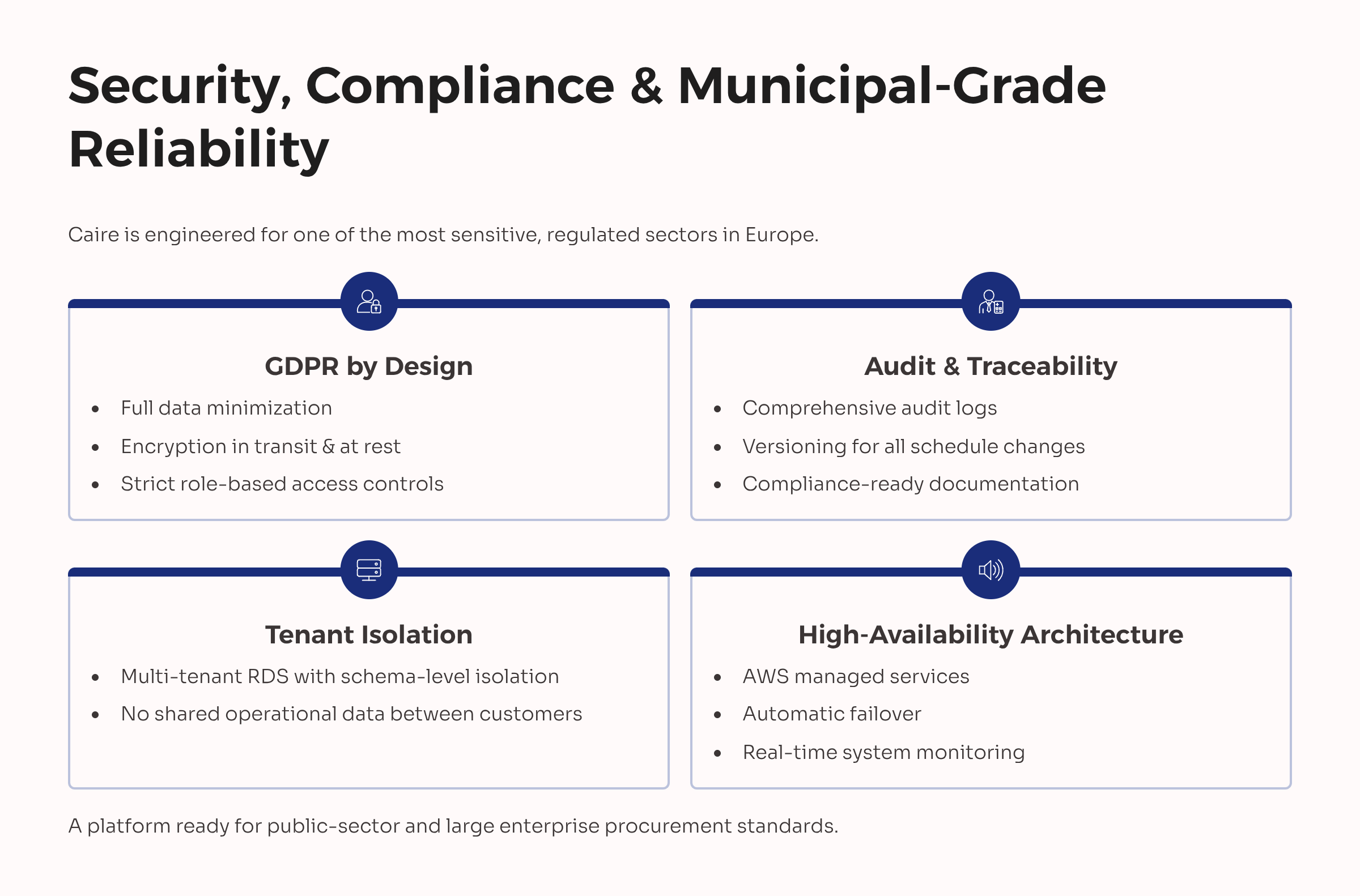
Caire handles sensitive operating data with clear permissions, traceability, data minimization, and controlled workflows. The goal is to make AI and planning audit-friendly for leadership, planners, and care teams.
Current page
Security & compliance
Permissions, traceability, data protection, and controls.
Product trust
Caire Core connects data, recommendations, human decisions, and outcomes in a continuous learning loop where responsible users can review what changes and why.
Planners, leaders, caregivers, clients, and family members get different views and permissions based on role and consent.
Decisions, changes, publishing events, and mobile activity can be traced so the organization understands who did what.
Pages and flows show relevant information to the right role without unnecessarily spreading internal operating data.
AI recommendations remain decision support. Responsible users review, approve, and publish.
Responsible AI
AI in Caire is decision support for planning, not autonomous public authority decision-making. Recommendations should be transparent, human-in-the-loop, and reviewable after the fact.
AI creates candidates, but responsible planners review, adjust, and approve before a schedule is published.
Users should understand why a recommendation appears, which goals it affects, and what trade-offs it creates.
Recommendations, changes, and decisions are saved as operational traces for follow-up and internal control.
AI is used for planning and operational support with clear boundaries, responsibilities, and escalation paths.
Caire treats AI scheduling as operational decision support. The EU AI Act is considered through transparency, documented scope, human oversight, and risk-aware controls rather than unverified certification claims.
Customer operating data is handled for the organization’s workflow. Caire does not position public scheduling optimization as hidden generative-model training on customer records.
Constraint governance
Skills, no-overlap rules, time windows, permissions, pinned visits, and safety-critical limits are treated as rules the planning flow must respect.
Continuity, travel time, workload balance, unused hours, and preference goals are optimized transparently so planners can understand tradeoffs before publishing.
AI recommendations are transparent, planner-approved, and scoped to operational decisions. The product is designed so organizations can document controls and responsibilities.
The product is designed to help organizations explain data sources, human oversight, evaluation routines, and operational controls when they document their AI use.
Deep dive


Diagram 1
Diagram 2
Workflow section
Caire automates 50%+ of manual scheduling work, pushes staff efficiency to 75–80%, and protects continuity for tens of thousands of clients. Explore how the platform runs end-to-end—from data ingestion and optimization to enterprise-grade security.
Workflow section
Proven production metrics from Swedish municipal deployments show how the Caire platform transforms operational, financial, and human outcomes simultaneously.
Workflow section
Each optimization run produces better schedules, happier staff, and more predictable outcomes. Data from every execution feeds the intelligence layer, strengthening the platform for all providers on the network.
Workflow section
The platform eliminates spreadsheet firefighting and unlocks strategic execution.
Workflow section
The evolution of home care operations from Level 0 to Level 4.
Workflow section
A unified architecture supporting all levels of automation—from assisted planning to predictive operations.
Workflow section
flowchart LR %% ========= COLORS (Caire palette-inspired placeholders) ========= classDef source fill:#cce7ff,stroke:#2a7de1,color:#000; classDef storage fill:#e0ffe5,stroke:#31a353,color:#000; classDef process fill:#fff3c4,stroke:#c79b00,color:#000; classDef security fill:#ffe0e0,stroke:#d63a3a,color:#000; classDef output fill:#e4d7ff,stroke:#7a4ed8,color:#000; %% ========= DIAGRAM START ========= subgraph "Attendo Systems (eCare Welfare)" welfareAPI["Welfare API (REST / Authentication)"]:::source welfareCSV["Welfare CSV Export (optional)"]:::source welfarePDF["PDF: Care Decisions (manual upload)"]:::source end subgraph "Caire Platform (AWS Stockholm - EU/EEA)" ingest["Data Ingestion Layer (API Gateway / Import Services)"]:::process validate["Validation + Normalization (Business Rules)"]:::process encrypt["Encryption & Access Controls (Transport & At-Rest)"]:::security store["Datastore
Workflow section
Planning Data (Visits, Time Windows, Addresses, Skills/Tags) Staff Data (Shifts, Availability, Skills, Employment Type, Geography) Case/Welfare Data (Needs, Care Plans, Restrictions) Location Data (Home addresses, Units, Zones)
Workflow section
API ingest (preferred) CSV import (secondary) Secure PDF uploads (care plans) Validation + Schema Mapping
Workflow section
Phase 1: Demand Aggregation – Merge visits by time/route/geo, Identify batchable windows Phase 2: Candidate Assignment Generation – Match employees → visits by constraints, Filter by role, skills, continuity, travel feasibility Phase 3: Optimization – Routing solver (minimize travel time), Compression objective (reduce idle time), Priority: continuity → employee preference → cost → travel Scheduler Experience
Workflow section
Caire auto-resolves sick calls, route conflicts, and gaps in minutes. Planners start each morning with validated proposals and can launch what-if scenarios with one click.
Workflow section
The recommendation engine guides planners from the first municipal decision to continuous optimization:
Workflow section
Conservative continuity, balanced operations, aggressive savings—the continuous learning loop runs them all on the same data so leaders can select the path that matches policy and budgets.
Workflow section
Protects continuity at all costs. Useful during change management and sensitive client cohorts.
Workflow section
Recommended daily driver weighting travel, efficiency, and continuity for steady 75–80% performance.
Workflow section
Pushes costs and wait times down when staffing is tight—often used for special projects.
Workflow section
Fine-tune weights per municipality, area, or contract. Save templates for recurring scenarios.
Workflow section
The platform blends modern web tech, optimization engines, and secure EU infrastructure.
Workflow section
Caire uses a deterministic "White Box" approach, ensuring full transparency and control.
Workflow section
A transparent, secure, and compliant foundation for modern home care. We ensure your data remains yours—never used to train public models.
Workflow section
Input: Data is ingested via secure APIs (e.g., Carefox), encrypted CSV imports, or direct input. Import is manual — triggered when creating a schedule, not on an automatic timer. Storage: All data resides in EU-hosted PostgreSQL databases with strict tenant isolation (Row Level Security). Processing: The AI engine optimizes schedules in memory using mathematical rules. No customer data is used for training. ( See Caire Core scheduling and routing technical overview ) Output: Optimized schedules are presented for human review and can be exported back to source systems. EU AI Act
Workflow section
Low Risk Classification: CAIRE is an operational optimization tool, not a "High Risk" system under the EU AI Act. Explainable by Design: No "black box" neural networks. Every decision is traceable to configured rules and weights. Data Sovereignty: You own your data. We do not use it to train generative models or share it with third parties. Human-in-the-Loop: The system is designed to support human planners, not replace their final judgment.
Workflow section
Designed for Swedish municipalities with EU residency, GDPR controls, and healthcare data governance from day one.
Workflow section
All data hosted in EU via Amazon RDS (Stockholm region). Organization ID enforced on every query and cache lookup. Nightly backups with point-in-time recovery and retention policies. Full audit trails for schedule changes and optimization runs.
Workflow section
Clerk MFA, SSO, and per-role permission enforcement. HttpOnly, SameSite, and Secure cookies; CSRF protection. CloudWatch + Sentry alerts for anomalies and degradation. Pen-test ready: layered defenses and sanitized inputs. Implementation Model
Workflow section
Caire hides the complexity but never removes oversight. Teams approve changes, run what-if experiments, and export back to source systems on their terms.
Workflow section
Technical details on how recurring patterns (slingor) and visit pinning enable stable yet flexible scheduling.
Workflow section
slinga: Stores recurring weekly patterns per caregiver, weekday, and shift. Includes version tracking for pattern evolution. slinga_visits: Individual visits within a slinga pattern, including planned times, sequence, and pinning status. visits: Extended with slingaId , pinned (boolean), and assignment fields ( assignedEmployeeId , assignedStartTime , assignedEndTime ). solution_visits: Candidate assignments from optimization jobs, allowing comparison before acceptance. Pinning Mechanics
Workflow section
Pinned visits: Marked with pinned=true , these visits cannot be moved by the optimization engine. They maintain continuity and stability. Unpinned visits: Marked with pinned=false , these visits can be optimized by AI to improve efficiency, travel time, and workload balance. Pinning rules: When a visit is pinned, earlier conflicting visits in the same shift must also be pinned to satisfy optimization constraints. Assignment flow: Visits start unpinned, get optimized, then become pinned when accepted by planners. From-Patch API
Workflow section
Full solve endpoint: Used for cold starts and major redesigns. Sends complete schedule with all visits and pinning flags. From-patch endpoint: Used for incremental updates. Sends only changed visits, inherits previous solution and pinned assignments. Use cases: Real-time disruptions (Scenario C), adding new clients (Scenario B), fine-tuning daily schedules. Performance: From-patch is faster because it reuses previous solution as starting point, typically completing in seconds vs minutes for full solve. Data Flow
Workflow section
Import: External schedules converted to slingor with visits marked pinned=true . Daily expansion: Published slingor expanded into concrete visits for each date, all marked pinned. Optimization: Full schedule sent to optimization engine. Pinned visits stay fixed, unpinned visits can move. Solution storage: Candidate assignments stored in solution_visits table for comparison. Acceptance: When planner accepts, assignment fields updated on visits. Slinga template remains unchanged. Technical Constraints
Workflow section
Hard constraints: Skills matching, no overlaps, time windows, and pinned flags are always respected by the optimization engine. Soft constraints: Continuity, travel time, workload balance, and unused hours recapture are optimized but can be overridden when necessary. Pinning validation: System ensures that when a visit is pinned, all earlier visits in the same shift that would conflict are also pinned. Freeze time: For real-time disruptions, visits that have started or are imminent remain pinned automatically (freeze time concept).
Workflow section
Scalable AI stack, modern data model, and professional user interface. Built for enterprise scale while maintaining the simplicity that makes CAIRE powerful.
Workflow section
Enhanced Optimization Engine: Improved solver performance with better constraint handling and faster optimization cycles GraphQL API: Unified API layer replacing REST endpoints for better performance and developer experience Microservices Architecture: Modular design enabling independent scaling of optimization, analytics, and data processing Real-time Processing: Support for live schedule updates and instant optimization feedback Advanced Caching: Intelligent caching layer reducing optimization job times by up to 40% New Data Model
Workflow section
Normalized Schema: Complete redesign for better data integrity and query performance Slingor Support: Native support for recurring weekly patterns (slingor) as first-class entities Revision System: Built-in versioning for schedules, solutions, and optimization scenarios Flexible Constraints: Enhanced constraint model supporting complex organizational rules Audit Trail: Comprehensive logging of all schedule changes and optimization decisions Multi-tenancy: Improved tenant isolation and data security at the database level Redesigned UX
Workflow section
Professional Calendar View: Industry-leading calendar component for intuitive drag-and-drop scheduling Status-Based Visual System: Color coding by scheduling status (optional, mandatory, priority) rather than care type Real-time Validation: Instant feedback on constraint violations during drag operations Optimization Scenarios: Pre-configured optimization presets (Daily Plan, New Clients, Disruption Management) with customizable weights Comparison Mode: Side-by-side comparison of schedule revisions with delta metrics Mobile Responsive: Optimized experience across desktop, tablet, and mobile devices
Workflow section
Workflow section
Handle 10x more schedules simultaneously 50% faster optimization job completion Support for organizations with thousands and tens of thousands of employees Sub-second response times for common operations
Workflow section
Intuitive drag-and-drop scheduling interface Reduced learning curve for new schedulers Better visual feedback and constraint validation Streamlined workflows for common tasks
Workflow section
How CAIRE aligns with the EU AI Act, ensuring transparency, safety, and human control.
Workflow section
As the European Union’s Artificial Intelligence Act comes into effect, business leaders seek clarity on how AI solutions align with regulations. At CAIRE, we prioritize transparency.
Our optimization engine is distinct from generative AI or predictive ML models. It does not learn patterns from large training datasets. Instead, it relies on pre-programmed algorithms and rules to find optimal solutions in a fully deterministic way.
Workflow section
Because we do not use "training data" as defined in the AI Act, many compliance obligations simply do not apply. There are no hidden biases from training sets, no opaque statistical models, and no hallucinations.
Workflow section
Yes. The EU AI Act defines AI systems broadly to include rule-based, logic-driven, and optimization algorithms. CAIRE qualifies because it performs reasoning and decision-making based on user input and hard-coded constraints.
However, while it fits within the scope, the deterministic, rule-based nature of our solver algorithms ensures that it avoids the Act’s strictest regulatory burdens typically reserved for more opaque or adaptive AI systems.
Workflow section
Every decision made by our solution can be traced back to pre-programmed rules (e.g., "minimize travel time," "ensure continuity").
This aligns perfectly with the AI Act’s transparency considerations.
Workflow section
Most use cases for schedule optimization fall into operational optimization (logistics, resource planning), which are generally not considered "High Risk" under the AI Act.
However, in HR applications that significantly affect workers' rights (like shift allocation), systems can fall under the high-risk category. CAIRE addresses this by design:
Workflow section
Your data remains yours. No Training on Customer Data: We do not use your data to train external generative models. No Hidden Biases: Since no training data is used, there are no inherited biases from external datasets. Non-Adaptive: The system does not self-modify post-deployment.
Workflow section
Privacy Policy → Terms of Service →
Workflow section
The upcoming CAIRE 2.0 platform (planned for early 2026) will maintain and enhance all existing compliance measures while introducing new capabilities:
Workflow section
CAIRE 2.0 maintains the same deterministic, rule-based optimization approach. The enhanced architecture provides better audit capabilities and transparency while preserving the "no black box" principle that makes CAIRE compliant today.
Learn more about CAIRE 2.0 →