What is Caire?
Understand the platform, the workflow, and how planners approve AI recommendations.
Modules for AI scheduling, routes, analytics, and Ask Caire — built around a planner flow: maintain standing data directly in Caire, compare schedule candidates, and approve one before publication.
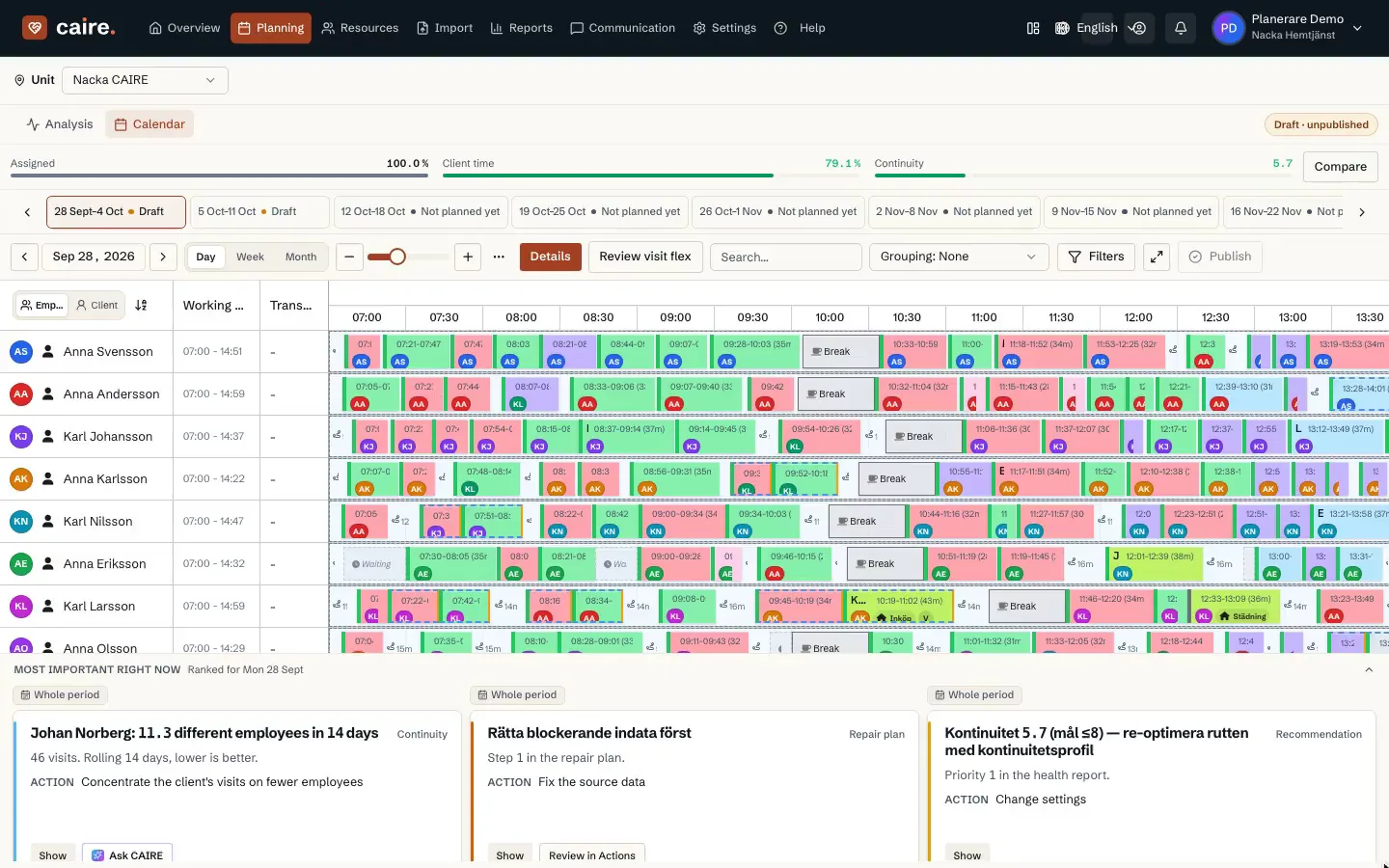
Start with the connected platform, explore a specific planning task or see what each role can do during the working day.
Understand the platform, the workflow, and how planners approve AI recommendations.
Watch a day with Caire — planning, changes during the day, and the caregiver app in one flow.
Open the planning dashboard demo or the mobile apps demo — no login.
Start from the full feature overview for scheduling, routes, analytics, and data readiness.
Choose the page that matches the buyer or planner role.
The modules participate in the same planning workflow. Here is how scheduling, routes, analytics, and data readiness work together.
The scheduling engine uses the current planning inputs and constraints to prepare schedule candidates for planner review.
Chat with your schedule in plain language via Ask Caire. The AI assistant answers questions about continuity, efficiency, and unassigned visits – and can suggest stand-ins, move out low-priority visits, and update the schedule when visits are cancelled.
Route optimization compares route alternatives and makes travel-time trade-offs visible within the schedule constraints.
The analytics module gives you the ability to transform raw data into useful insights with interactive dashboards and reports.
Register and validate staff, clients, units, and visit templates directly in Caire before the first optimization run.
Security controls include role-based access, encryption, and traceability.
The Ask Caire AI assistant lives right inside the schedule. Ask questions in plain language about efficiency, continuity, and unassigned visits – and get answers grounded in the current solution.
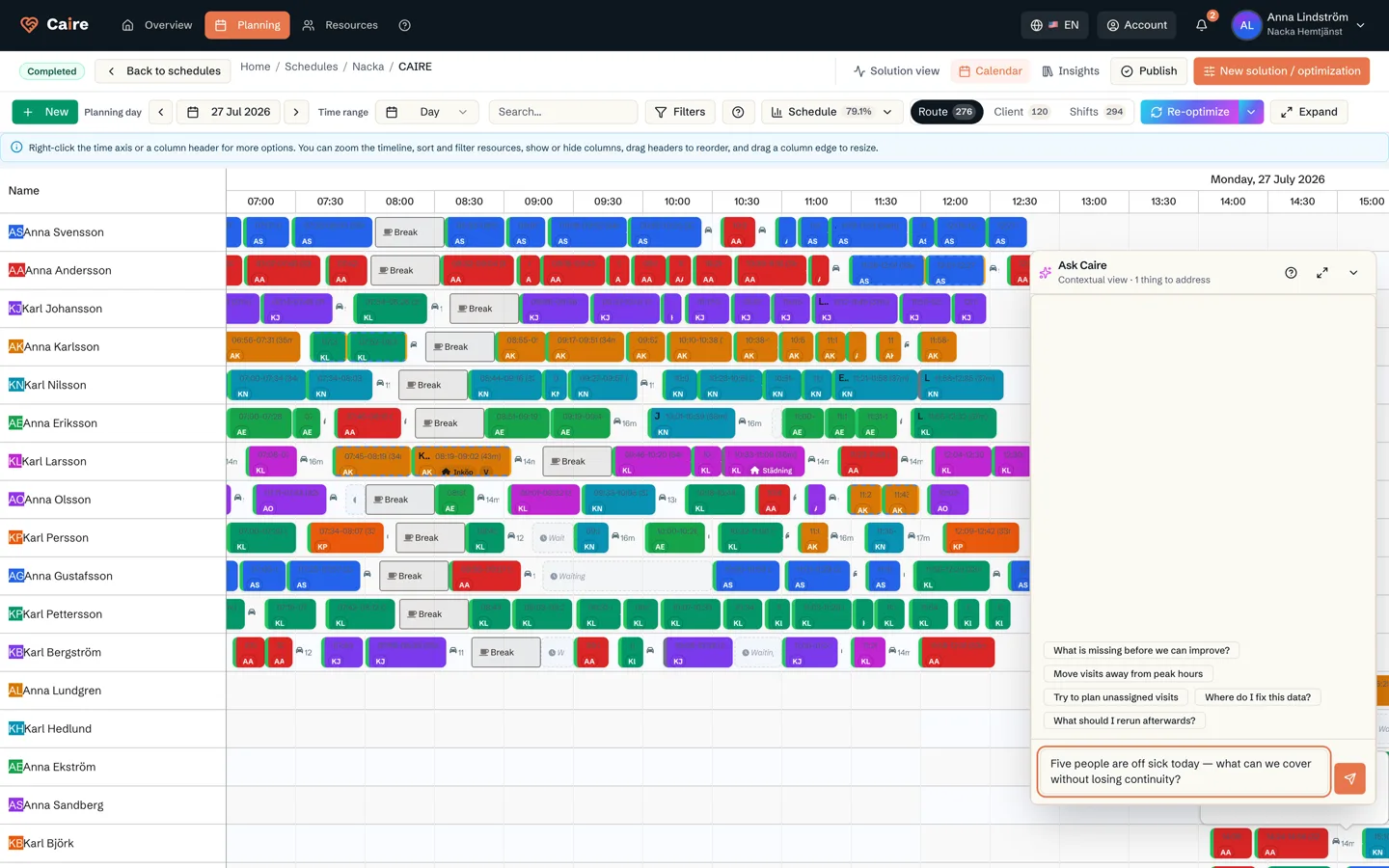
The AI assistant provides an entry point for questions and support in the platform. Access and available actions follow the user's permissions.
Scheduling home care is complex. Without tools, planning easily becomes a puzzle with high stakes, where human planners do their best but are limited by time and overview.
Each day, a large number of home visits need to be distributed among many employees. Each client has specific times for their visits, and each employee has limited working hours and skills.
Staff need to travel between clients. Without a shared view of schedule and route constraints, the coordinator must compare many travel-time trade-offs manually.
The quality of care increases if the same client gets to meet the same caregiver as often as possible. Keeping track of such preferences while still making the schedule work is a major challenge.
Sick leave, emergency services, or changed visiting times can come on short notice. A single change can require rescheduling of multiple people's schedules, often with very little notice.
Coordinators work under time pressure. Incorrect schedules can lead to overtime hours, unused work hours, or the need to hire expensive extra staff. All of this negatively affects the operation's margin.
The consequence can be stressed staff, increased costs, and less satisfied clients.
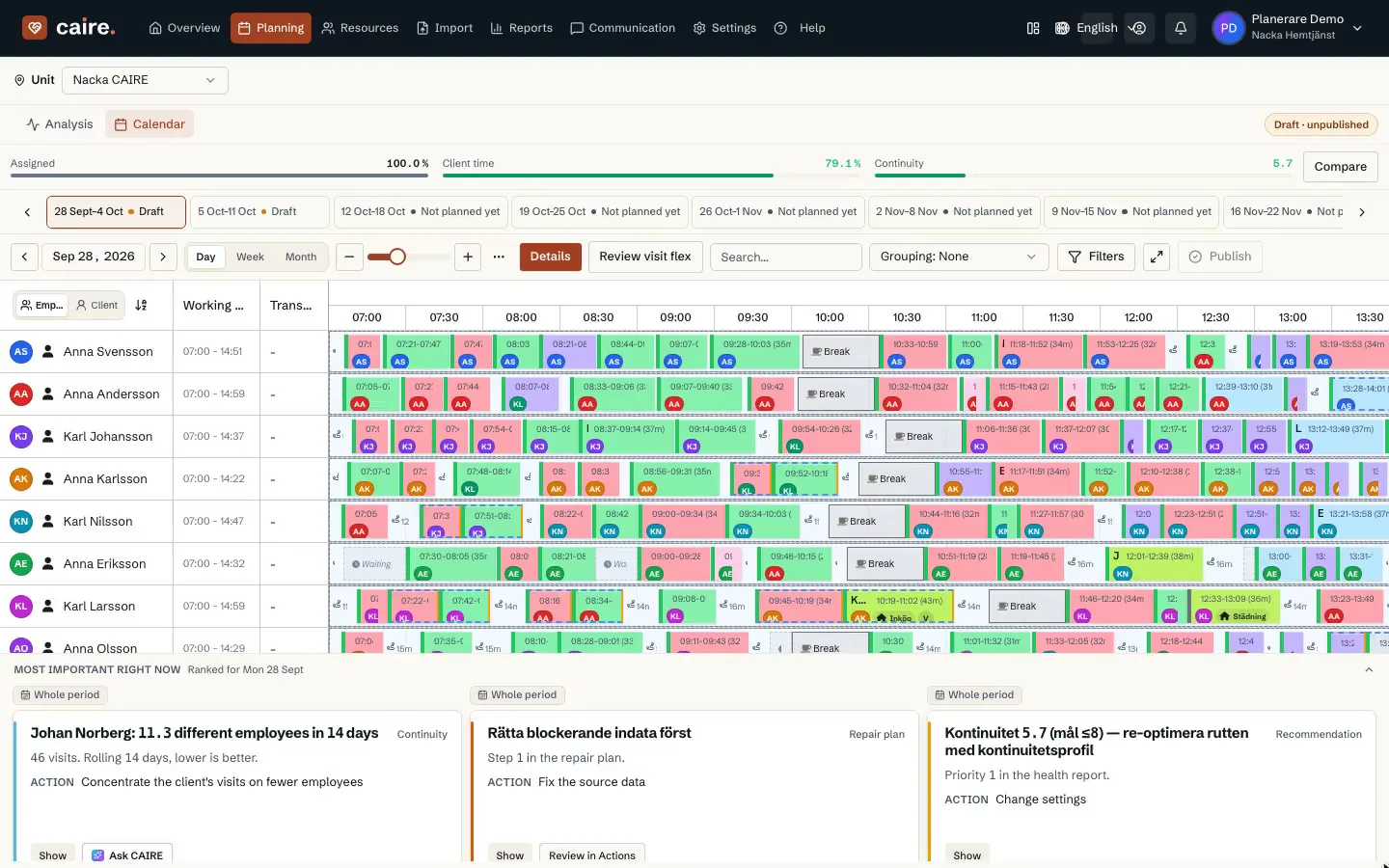
The calendar shows visit placement. The result selector provides access to different planning results for the period.
The Caire platform is designed to handle precisely these challenges. Through AI and smart software, Caire can:
Build clients, care plans, and visits as standing data directly in Caire. Caire calculates staffing, places visits into shifts and routes, and gives you comparable schedule proposals — you review and choose which one to publish.
Caire scores candidates against configured constraints and objectives, including coverage, continuity, and travel-time trade-offs.
Compare overtime, temporary staffing, travel time, and other cost drivers across schedule candidates before choosing a result.
Continuity can be configured as an objective and reviewed alongside the other constraints and metrics for each candidate.
Each schedule, both original and optimized, comes with detailed key performance indicators (KPIs). This gives decision-makers a clear picture of how changes affect operations.
Caire prepares comparable candidates. Human coordinators review the trade-offs and approve the result before it is published.
Read more about the benefits for your business →When planning inputs change, the coordinator can update the source data, start a new run, and compare schedule candidates before deciding whether to publish one:
When conditions change, update the planning inputs and start a new run. Caire prepares candidates for comparison; nothing changes until the planner reviews and publishes a result.
Update availability and start a new planning run to inspect coverage and schedule candidates. The planner reviews the result before publication.
Diagnostics show gaps and available capacity in the current candidate so the planner can compare trade-offs before approval.
Schedule diagnostics expose unassigned visits and constraint warnings in the current solution for planner review.
Each change becomes new planning input. Caire prepares candidates, and the planner decides whether a result is ready to publish.
The planner controls whether and when an updated schedule is published.
The calendar shows visit placement and employees’ working days. Read it together with the planning result and organisational rules.
The results view shows calculation status and available candidates. A candidate and its results belong to a defined period.
Caire's scheduling engine uses planning inputs such as working hours, skills, approved services, distances, rules, and preferences to prepare schedule candidates for planner review.
The engine evaluates candidates against explicit constraints and objectives in the current planning snapshot. The planner compares the results and approves before publication.
Route optimization is part of Caire's planning workflow. It compares route alternatives and travel-time trade-offs within the same constraints as scheduling.
When planning inputs change, the coordinator can start a new run and review an updated schedule and route candidate. Established rules govern later automatic staffing changes and visible exceptions.
Caire accepts supported exports from your existing system and can export planning and reports as PDF or Excel.
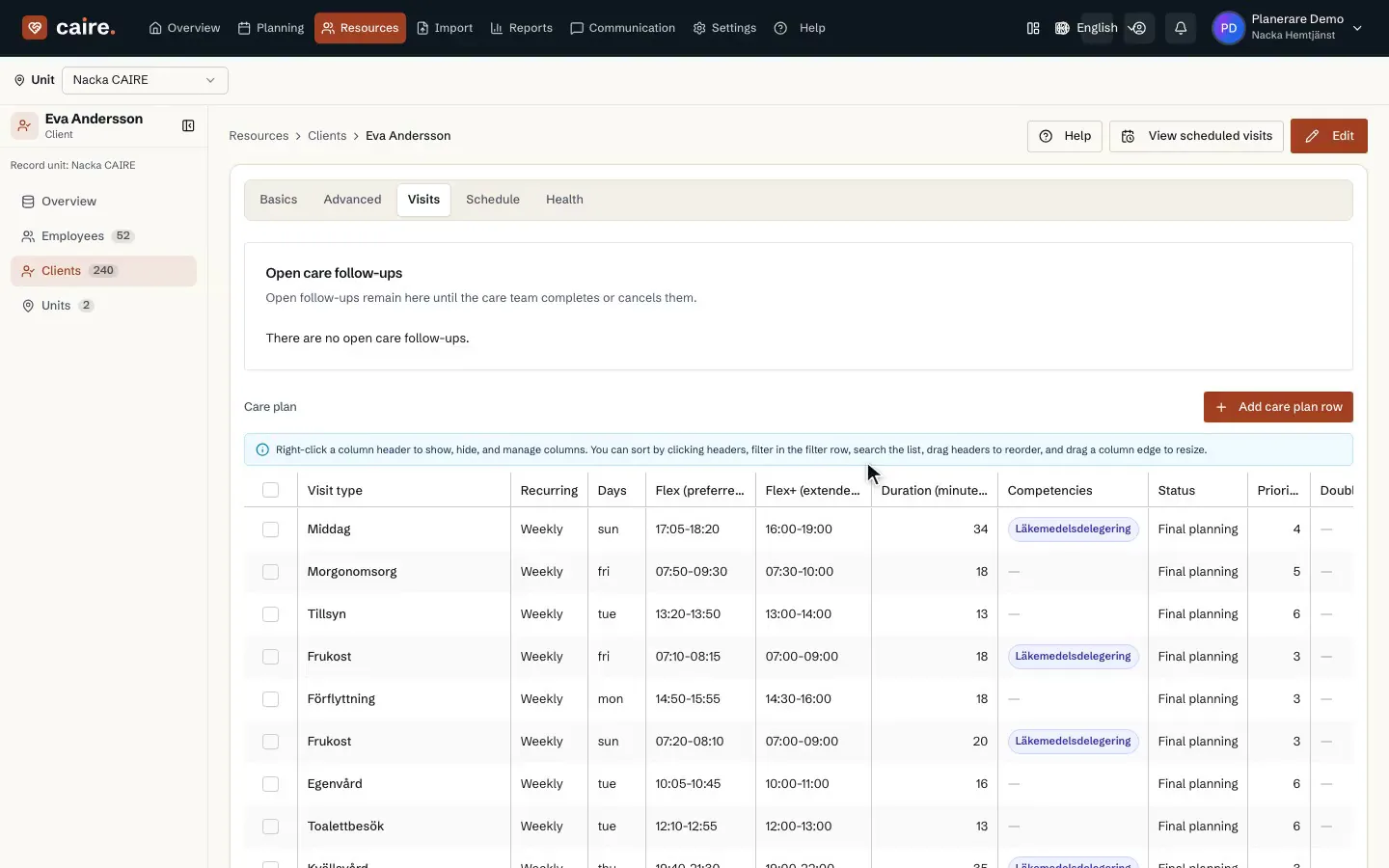
Visit requirements describe time windows and which visits may move. Changes follow organisational rules and permissions.
A central product is Caire's planning tool, which forms the platform's user interface for scheduling, optimization, and follow-up. This is where coordinators and managers review solutions, adjust assumptions, and approve changes.
Caire includes an analytics module as a product, which gives you the ability to transform raw data into actionable insights. This module collects data from the scheduling engine and route optimization and presents it in the form of interactive dashboards and reports.
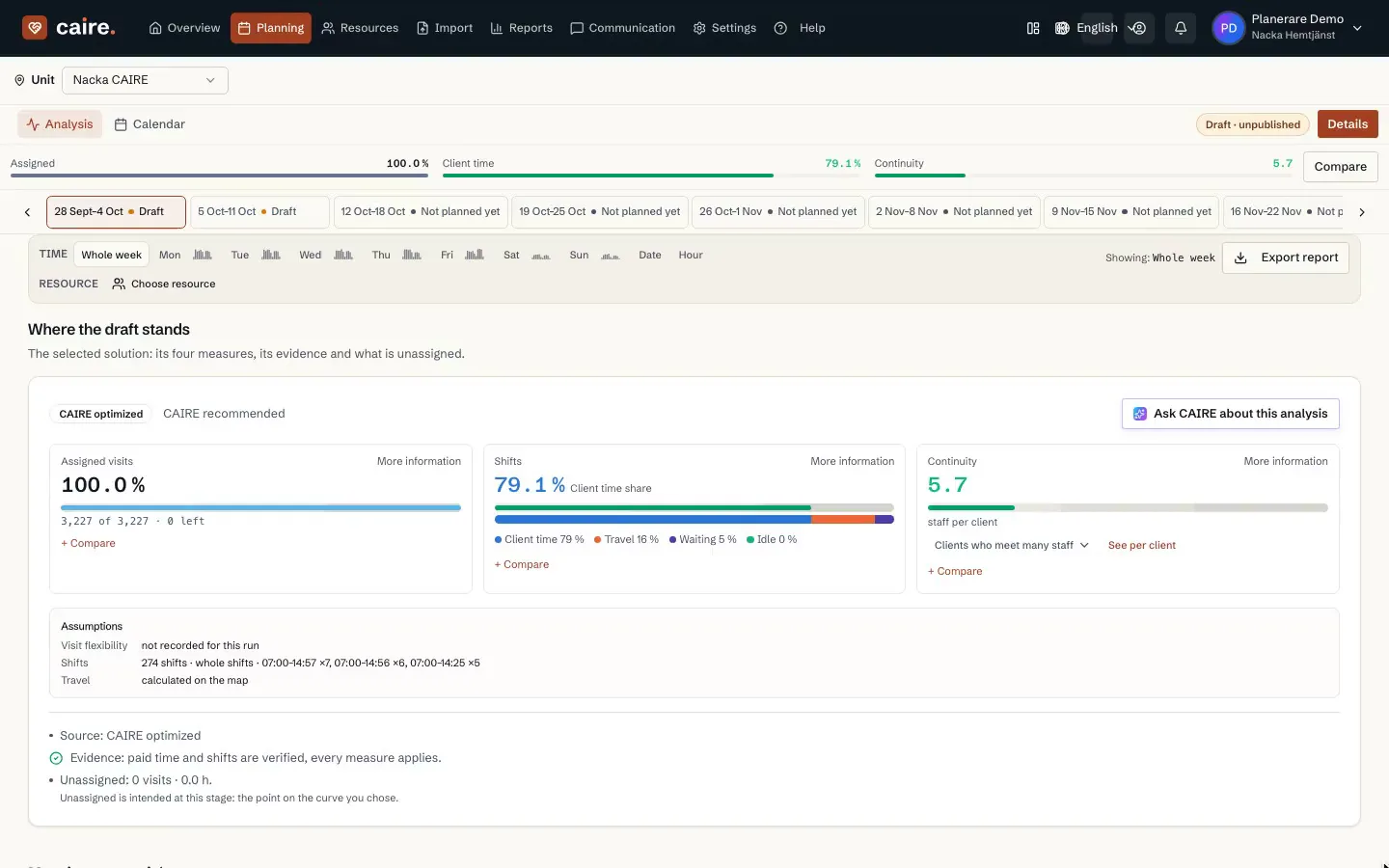
You can review metrics such as care time, travel time, continuity, and unassigned visits for the current solution.
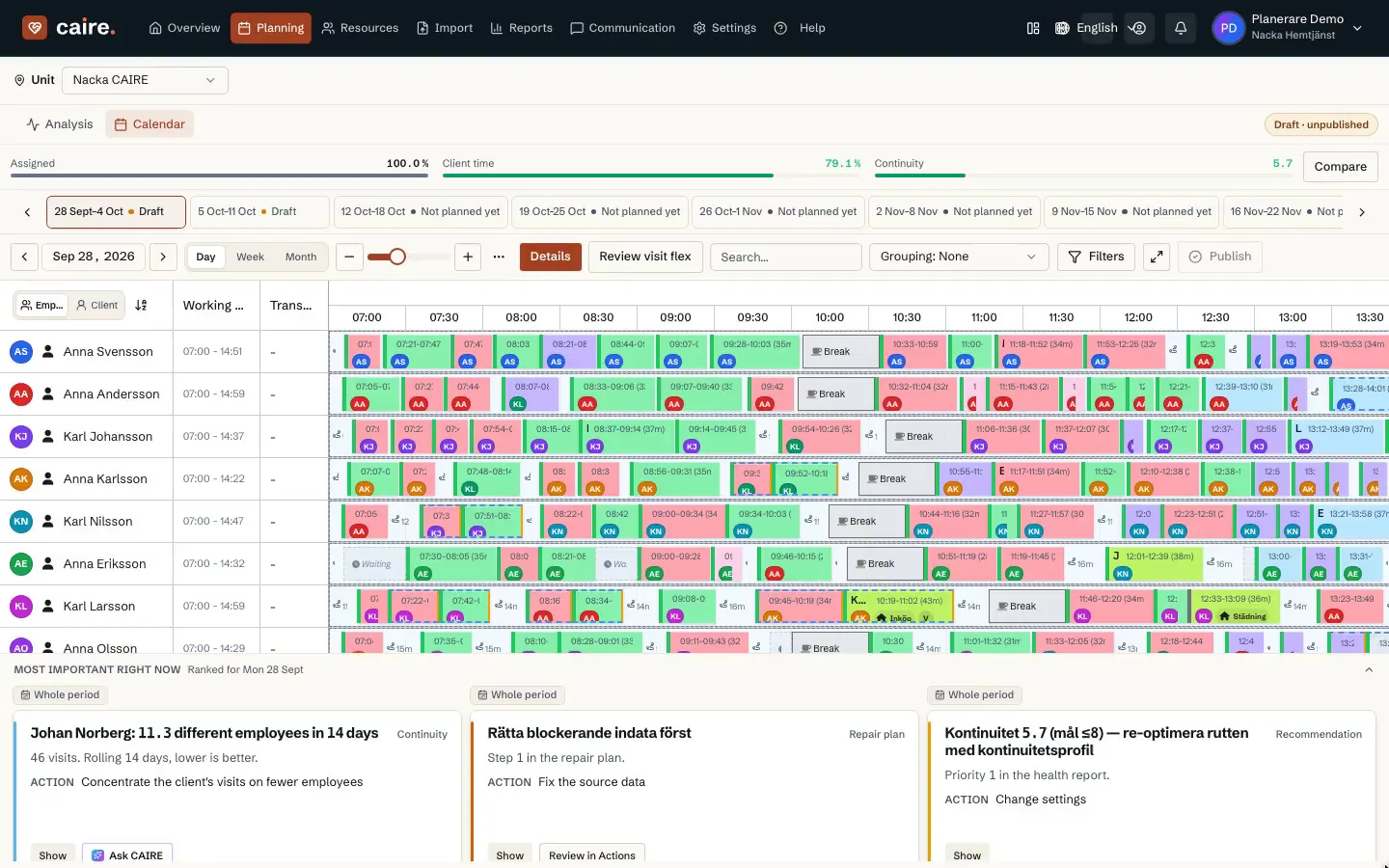
The analysis view shows planning metrics and their explanations. Compare metrics within the same period using the same definitions.
Caire is a cloud-based solution hosted within the EU. The platform uses access, encryption, and traceability controls for planning data.
Role-based permissions limit which parts of the planning information different users can view and change.
An overview of system modules, data flow, and operational boundaries
Planning engine that evaluates candidates against constraints and objectives
Schedule candidates prepared for planner review
Route alternatives with visible travel-time trade-offs
Start a new planning run when inputs change
KPI calculation and data-driven feedback
Planning engine that evaluates candidates against constraints and objectives
Schedule candidates prepared for planner review
Route alternatives with visible travel-time trade-offs
Start a new planning run when inputs change
KPI calculation and data-driven feedback
Standing data in Caire; optional custom external fetch
Optimization via AI algorithms
Planner review and publication in Caire
Analysis and continuous improvement
Clients, employees, service areas, and visit templates are maintained in the product
Configured map services provide route and travel-time data
Planning, routing, analytics, and data readiness have distinct responsibilities within one reviewed workflow.
Role-based access, encryption controls, and audit logs support controlled handling of planning data.
Staff, clients, service areas, and visit templates are prepared and validated in Caire before the first planning run.
Caire is a complete planning system for home care. Scheduling, routes, analytics, standing data, and planner approval participate in one workflow.