Care time
Visible time distribution
See how a proposal affects care time.
More client-facing time, protected continuity, and fewer unassigned visits — planners review every proposal
Try Caire for freeBook a walkthroughYour organisation's permissions and rules govern who sees and changes the plan. Review trust and data protection
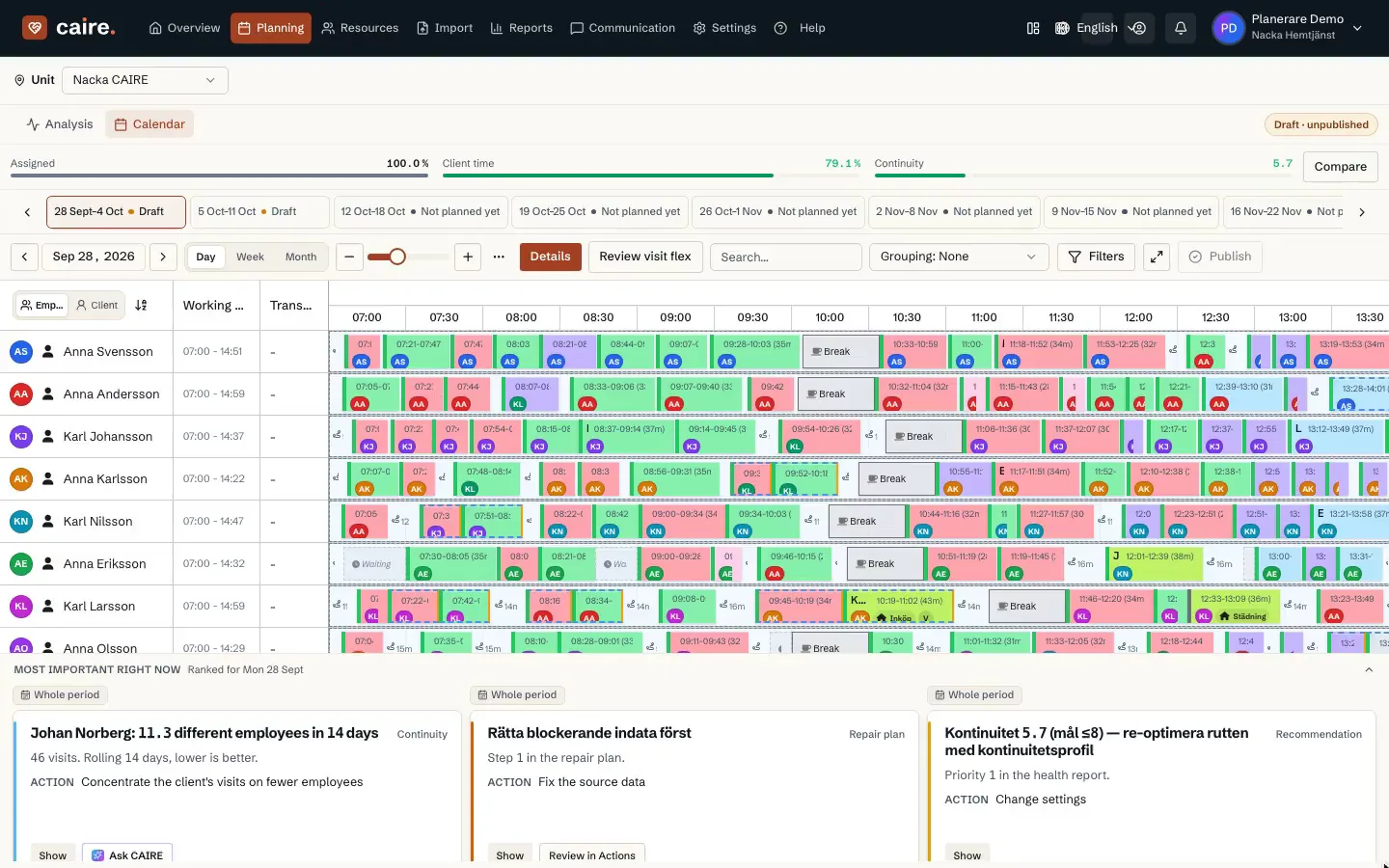
The calendar shows visit placement and employees’ working days. Read it together with the planning result and organisational rules.
Calculated journeys between addresses are checked against visit times and shifts, so a shorter route does not hide an unassigned visit.
Modelled from optimisation runs on real home care schedules, not measured customer outcomes. Your result depends on your data.
Current page
Route optimization
Less travel, better continuity, and clearer routing decisions.
Answer first
CAIRE calculates route and schedule proposals while planners stay in control. It considers geography, time windows, skills, continuity, and unassigned visits without autonomous publishing or replacing records, HR, payroll, or source systems.
Route planning in home care is a complex task that often requires consideration of many factors simultaneously. Traditional methods struggle with:
Varying visit times, specific time windows, different skill requirements, and clients who need to be visited multiple times per day create a difficult puzzle to solve.
Manually planning optimal routes for a team of caregivers who need to visit dozens of clients is mathematically too complex to be solved efficiently by a human.
Traffic conditions, sick leave, emergency visits, and other unforeseen events require quick adjustments that are difficult to make manually in an optimal way.
Inefficient routes result in higher fuel costs, waste of staff time, increased environmental impact, and reduced time for actual care.
CAIRE's route optimization technology significantly improves productive care time by reducing travel time, allowing caregivers to spend more time with patients.
See how a proposal affects care time.
Weigh route changes against continuity.
The planner remains in control.
Make the effect of a route change on productive care time visible.
Compare travel time with continuity and staffing before approving a proposal.
This illustration is modelled and shows how travel, care time, and continuity can be weighed against one another. Real outcomes depend on the operation's own data and must not be read as a customer result.
Use our calculator to see how much your operation can save with CAIRE's route optimization.
Match staffing to visits by skills, continuity, units, and travel time — planners approve
Complete planning system — Carefox can remain for the journal; planners publish in Caire
Caire Core uses a transparent routing model where continuity, travel, and planner approval are weighed together. For a deeper article, read the routing science guide in resources.
Open the routing science articleContact us to see how our AI-driven route optimization can reduce your driving time and increase care quality.
Contact usStart with one free analysis of a selected period. Understand continuity, time allocation and opportunities to improve, based on the evidence in your reports. Help from Caire is available.
Create an account, accept the terms, the privacy policy and the DPA, and upload your schedule from Carefox or Alfa eCare Welfare. Caire then analyses it.
One analysis of a selected period per organisation, including one optimisation with calendar, comparison and diagnostics for available results. Upgrade for ongoing planning. A paid pilot is a separate choice.
See how route optimization for home care – compare planner-reviewed trade-offs supports run-specific comparison
Analyzes geographical distances and traffic patterns for efficient routes
Optimizes visit times based on client needs and staff schedules
Distributes visits evenly among staff for reduced stress