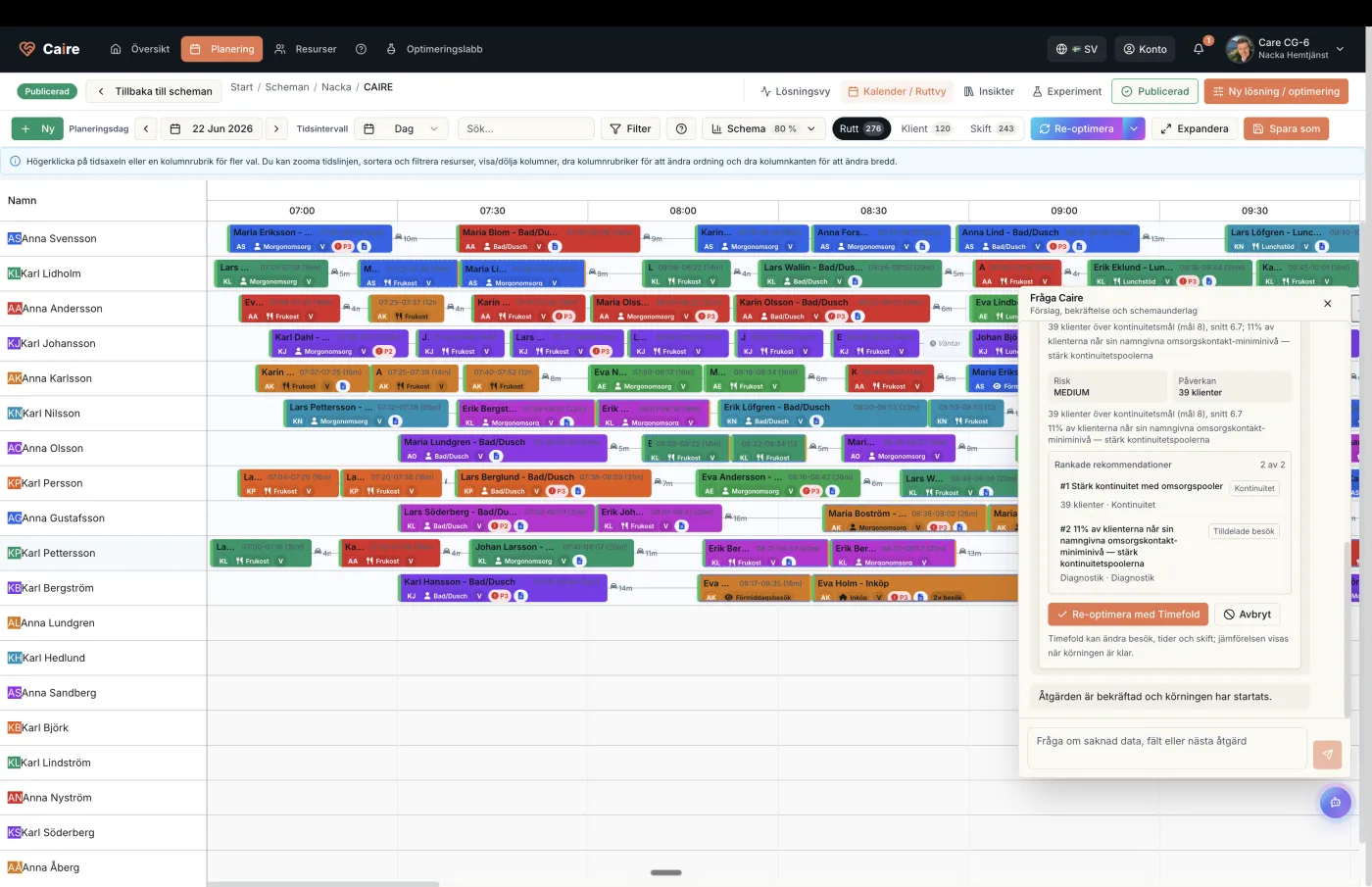
The same questions and answers as Ask Caire on the home page — gathered on one page. What Caire is, how you get started, what it costs and how your information is protected.
What is Caire?
What is Caire?
Caire is an AI support tool for home care that keeps the planning in one place: your clients, what help each one needs, your caregivers and their hours. From that, Caire works out a finished schedule with routes — and you as the planner review, compare and approve before anything takes effect. You own the decisions; Caire does the arithmetic.
Caire is built for home care: private providers from a few dozen caregivers up to large organisations, and municipalities running home care themselves. Planners and operations managers use Caire the most — caregivers meet it through the mobile app.
Is Caire just a scheduling tool?
No. An ordinary calendar doesn't know what a home-care visit requires. Caire keeps together the things that decide whether a schedule works in real life: skill requirements, two-caregiver visits, travel, continuity and which times must be kept. That's why the proposals are workable, not just tidy boxes.
What can I ask Caire?
Most things you wonder about your planning, in your own words: where the toughest hours fall, why a visit ended up without a caregiver, who could take a shift when someone calls in sick, or how much of the working time becomes visit time. Caire answers with figures from your own planning and suggests what you can do about it — you approve.
ChatGPT can write text about home care, but it doesn't know your clients, your caregivers or your schedule. Caire does. Ask Caire takes its answers straight from your own planning — which visits fall when, who is working, what the routes look like — and can put a change in front of you to look at and say yes to before anything happens. In short: ChatGPT guesses, Caire works it out from your own operation.
You put in the things that rarely change: your clients, what help each one needs, your caregivers and their working hours. Caire then lays the visits out on the calendar, day by day, and works out who takes which visit, at what time and in what order. Ask Caire is the chat on top: ask in your own words, get answers about your own planning, and see every proposal before you approve it.
How do you get from client details to a finished schedule?
In three steps. First the things that stay put: your clients, what help each one needs, your caregivers and their working hours. Then Caire lays that out on the calendar — which visits happen on which day. Finally Caire works out the rota itself: who takes which visit, at what time and in what order. You can put several plans side by side and compare them before you pick one.
How is Caire different from a traditional scheduling system?
In an ordinary system you have to know where things live: the right view, the right form, the right button. In Caire you ask in your own words instead — "why does Anna see so many different caregivers?" — and get the answer, the reason behind it, and a suggestion for what you can do about it. The details stay just as organised and traceable as before. You just don't have to go hunting.
No. Caire reads and analyses straight away, but never changes anything on its own. When Caire wants to change something, you first see what it looks like today and what it would become, side by side. Nothing is saved until you say yes. If something is to be deleted, changed in bulk, or the whole schedule reworked, you get an extra clear question first.
No. Visits that involve personal care, visits that are critical, and visits you have locked yourself are never touched by Caire's suggestions. When Caire suggests widening times, it only concerns flexible visits that can safely move — and you always see exactly which ones before you say yes.
No. Caire's answers are built on the same figures the rest of the system calculates with — the schedule, visits and working hours you see on screen. If something is missing, Caire says so plainly instead of guessing. Here on the website, Caire answers from examples, never from any real operation.
Caire is AI-assisted planning: the system analyses, calculates and suggests, but the planner approves every change. Fully self-running re-planning in real time is something we are building towards — that's the future, not a claim about today. That order is deliberate: in care, a person should hold the decisions.
Your current system
Do we have to replace our current system?
No. Caire runs alongside the system you have today. You start from a file you can already export from it, and Caire works out better schedules on top. You don't have to cancel anything, move any documentation or change how your caregivers work to see what Caire gives you.
Yes, in practice: many providers run Carefox or Alfa eCare, and Caire is built to run alongside them — you start from a file you export from there. Direct connections where the systems talk to each other automatically are on our plan ahead, but they aren't needed to get started.
You start with what you already have: a file from your current system with clients, tasks and caregivers. Caire reads the file and shows you how it understood each part, so you can correct anything that came out wrong before it is saved. Caire then works out a first schedule you can compare with how you plan today.
You log in and upload a file from your current system, and Ask Caire reads it for you. Caire then shows you how it has understood each client, each task and each visit, so you can correct anything that came out wrong. Nothing is saved until you approve it. Don't upload real care plans to the chat here on the website.
Today Caire takes a file you export from your current system — the kind of file that opens in Excel. We connect one system at a time, so get in touch and we'll tell you whether yours is already connected. Caire always shows you what it read out of the file before anything is saved. We don't promise Word, PDF or photos yet, because that isn't switched on.
Yes. Every organisation gets a ready-made practice area with made-up clients and caregivers, where you can build schedules, work out proposals and try Ask Caire without touching any real details. It can be reset at any time, so there is no way to break anything.
How long does it take to get started?
A smaller operation can see its first Caire schedule within days. A full rollout — checking the details, training, and a first schedule running alongside what you have — usually takes two to four weeks depending on size. Nothing is replaced until you are confident in the new plan.
Planners get training from us as part of the start, and that goes a long way — Caire is built so you can ask in your own words instead of learning menus. Caregivers need no training: they keep working as usual and see their schedule on their phone.
Safety and GDPR
Is our information safe in Caire?
Real details about clients and staff are only handled once you are logged in. There you see only your own organisation and your own area, and Caire never changes anything without you approving it first. This chat on the website needs no login and isn't stored by us — but still, don't type real names, personal numbers or care notes here.
How does Caire handle GDPR?
Caire is built with GDPR as a baseline requirement: only authorised people in your organisation see your details, access is controlled by roles, and what happens in the system can be traced afterwards. Operations run within the EU, in the Stockholm region. If your data-protection lead wants the detail, we're happy to share our security documentation.
Is Caire ISO certified?
We are working towards ISO 27001 and the certification work is under way — we say honestly that it isn't finished yet. Security is already built on the same principles: controlled access, traceability and operations within the EU. If you are procuring and need documentation, we're glad to answer your security questionnaire.
Does Caire meet the EU's AI rules?
Caire is designed around openness and human control: every suggestion shows the figures and rules behind it, and no change happens without a planner approving it. Those are important practices under the EU's AI rules, but they are not enough on their own to establish legal compliance. A definitive assessment depends on the specific use and organisation and should involve qualified legal review.
Caire Core is 9,900 kr per month for 1–33 active employees. From employee 34, the price is 300 kr per active employee per month. One-off four-week schedules and larger set-ups are quoted separately — the full price list is on the pricing page, and the calculator lets you run the numbers on your own operation.
No. The pricing page shows the tiers openly, and anything that needs a quote — such as tailored set-ups — is handled before you decide, not after. You should never be surprised by an invoice.
Yes. The idea is that you see the value before you decide: connect your details, see where the time goes today and what a better schedule would give. Book a walkthrough and we'll set it up together — looking costs nothing.
Run it on your own numbers: how many hours planning takes today, how much travel the schedule contains and how much of the working time becomes visit time. The calculator on the website does that arithmetic for you — and in a walkthrough we go through the model together, without wishful maths.
Yes. Caregivers, clients and family members each have an app against the same published schedule. The caregiver sees their shifts and visits, the client sees who is coming and when, and family can follow what they've been given the right to see. Everyone sees their part — no one sees more than their role allows.
Today's shifts and visits in order, with addresses, a map and what the caregiver needs to know before each visit. Visits are checked off in the app, changes show up straight away, and they can ask colleagues for help. The app is built to survive a working day — it copes even when coverage drops.
Yes, if the client wants it. Family members can see planned visits and that they happened, and messages go via the office so nothing ends up in the wrong place. It tends to ease worry a great deal — no more calling to ask whether someone has been.
Yes, the staff handbook is part of Caire: routines, guidelines and onboarding gathered digitally, right in the caregiver's app. New hires get the same answers as the veterans, and you're rid of binders no one is sure still apply.
Can Caire help with documentation?
Yes. The caregiver can speak their note after the visit, and Caire turns the speech into structured text — within the EU. The caregiver always reads it through and approves before anything is saved. Caire makes no care decisions; people do.
Continuity
How does continuity get better with Caire?
In Caire, continuity is a rule the schedule has to respect, not a hope. Each client can have a designated contact and a circle of familiar caregivers, and Caire works out schedules that keep that circle small — without travel and times falling apart. You see continuity per client, so no one disappears into an average.
Yes, fully. You set the client's designated care contact and which caregivers the client prefers, and Caire weighs that in every time the schedule is worked out. The designated-contact requirement is in Swedish law — in Caire it lives inside the planning rather than in a separate list.
Per client, not as an average. An average can look fine while ten clients meet far too many different faces — so Caire shows how many different caregivers each individual client meets over time, and how that changes with every new schedule proposal.
For the client it means feeling safe: familiar faces who know the routines and notice changes in how they're doing. For the operation it means fewer misunderstandings, better observations and happier clients. Caire treats it as a goal the schedule must meet, not something left to chance.
Yes. When someone calls in sick, you ask Caire who can realistically take the visits — and get suggestions for caregivers in the same area, with their current workload, instead of a phone list. You choose and approve the actual change. What used to take a morning takes minutes.
Yes, per visit. Insulin at eight is at eight — you lock that down. Cleaning and shopping can be given roomier times, and the more visits that can shift a little, the better the schedules Caire can work out. You decide what is untouchable; Caire works within those limits.
Yes. Visits that need two caregivers are planned so both are actually there at the same time, and visits that belong together — like a morning visit that must be followed by another — are kept together in the schedule. That's the kind of thing that's hard to get right by hand, and Caire works it out within the rules you've set.
Yes, hour by hour. Caire shows where the need for care is greater than the staffing — and where, conversely, there is time to spare — so you see the peaks before they turn into stress. From there you can ask Caire to suggest what would even out the day.
Caire reviews the schedule for you and flags what chafes: visits without a caregiver, clashing times, overly long journeys and missing details. Every flag comes with a suggested action, so you don't just see that something is wrong — you see what you can do about it.
Yes. Every time Caire works out a schedule it becomes its own proposal — nothing is overwritten. You put two or three proposals side by side and see the difference in travel, visit time and continuity in black and white, before you decide which one counts.
Yes. You pick a planning profile that says what matters most right now — continuity, travel, an even workload or coping with the peaks — and Caire works out the schedule accordingly. If you want to see what a different focus would give, you simply work out another proposal and compare.
The honest answer: it depends on your starting point, which is why Caire measures instead of promising. You see travel, waiting and how much of the working time becomes visit time — per schedule proposal, before and after. Run your own operation through the calculator to see where your potential lies.
With open measures, always with the formula visible. The basic one is simple: care time divided by paid working time — how much of the hours actually become visits in clients' homes. On top of that: travel, waiting and continuity per client. The same figures carry into every comparison, so improvements can be proven rather than claimed.
You get the first analysis as soon as your details are read in — it shows straight away where the time goes today. The schedule improvement itself shows when the first Caire schedule can be compared with your current one, and from there you follow the trend schedule by schedule.