How Caire works
How Caire works
A clear path from data to decisions – with people in control
How it works
From decision to visit. One plan all the way.
What lives in the planner's head today lives in Caire. So the decision, the plan and reality agree.
- 1 · Municipal decision
Granted time
Which service, how long and how often. No weekday and no time of day yet.
How oftenAbout once a year, and when a new client starts. If the client changes provider the decision usually stays; only the assignment moves to the new provider.
- Breakfast30 min · every day
- Cleaning90 min · every other week
- 2 · Client + provider
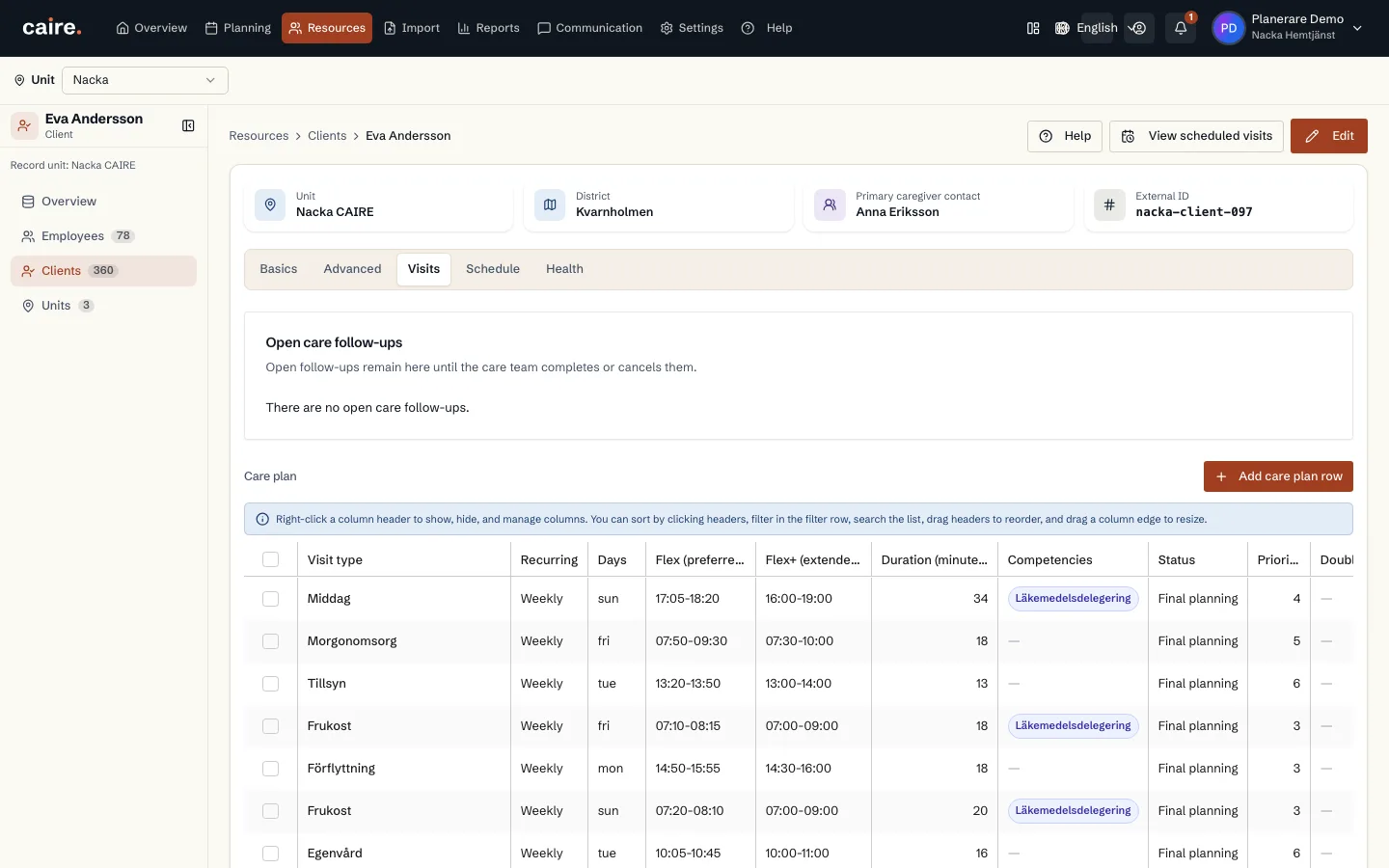
Care plan
A weekly pattern you agree together: weekday, preferred time and flex. No dates.
How oftenMade together with the decision, and often anew when the client changes provider. The client and provider change it when needs change, as long as it fits the decision.
- BreakfastEvery day · 08:00 ±15 · 30 min
- CleaningTuesdays, alternate weeks · 14:30 ±45 · 90 min
- 3 · The planner
Planned visits
Visit planning turns the pattern into real visits on real dates, within staff shifts, with travel and the right person.
How oftenContinuously. Caire runs visit planning automatically from the care plans and staff shifts, and updates it as reality changes.
- BreakfastMon 5 Oct · 08:09–08:39 · Anna
- CleaningTue 6 Oct · 14:10–15:40
- 4 · The caregiver
Performed visits
The goal is the same as planned. If anything changes, the caregiver and the client see it in the app.
How oftenEvery day. What happens in the day flows back into the plan, so visits match the planning when they are carried out.
- Breakfast08:09–08:39 · as planned
- Cleaning14:10–15:20 · 20 min to the time pool
The time pool: granted time is never lost
If a service visit runs shorter, the granted time is saved in a pool and scheduled later. The client receives all their granted time, and the provider is paid for the care plan.
Time-bound needs come first
Personal needs tied to a time of day always come first: getting up, dressing, transfers, medication, meals, toileting, showering and escort to a doctor's appointment. Service visits such as cleaning, laundry, shopping and walks are set by how often they happen. They have a fixed day and move only as an exception when staff are short, within the decision's window.
Clients, loved ones and staff see the same plan, and why it changes.
Example scenario
Three flows
The same care plans. Three ways to plan.
Everything starts from the care plans and visit planning: when a new client starts, when the weeks ahead are planned and when the day changes.
- 1 · New client
New client and care plan
Add the client and the visits in the care plan. Before anything is saved, Caire searches for a weekday and time that work with the client's needs, the routes and the other clients. The planner chooses.
- 2 · Pre-planning
The weeks ahead
Visit planning and the need for shifts are planned continuously weeks ahead, from the care plans. Caire prepares proposals; the planner compares and publishes.
- 3 · Real time
When the day changes
A sick call, a cancellation, a delay or a new visit: Caire finds cover in seconds. Visits and routes are recalculated from the published plan, with travel times from current traffic when traffic awareness is switched on. Work already done stays put, and everyone affected is told in the app.
One plan for every role: the web app for the office, the app for caregivers, clients and families, Ask Caire for questions and proposals, and MCP for AI assistants as an option.
Why Caire
Three plans that should be one.
Breakfast on Monday, 30 minutes. This is the same visit through the day.
Traditionally
Three different answers- Care plan
- 08:00
- Visit planning
- 08:20
- Morning text
- “around 8”
- Performed
- 08:45
Performed: 45 min late
Visit planning already differs from the care plan. A text message in the morning if you are lucky. The caregiver arrives late and nobody knew in advance.
With Caire
One plan- Care plan
- 08:00 ±15
- Planned visit
- 08:09 · Anna
- In the app
- the week before
- Performed
- 08:09
Care plan, visit planning and performed agree, because travel and staffing are included from the start. The ±15 minute flex is visible to everyone.
When staff are short
Cleaning has a fixed day. It moves only as an exception.
Time-bound needs such as breakfast and toileting always come first. A service visit such as cleaning is set by how often it happens. If staff are short it may move within the decision's two weeks as an exception, then back to its usual day.
- Granted · 90 min every other week
- Care plan · Tuesdays, alternate weeks · 14:30 ±45
- Exception · within weeks 41–42
- Priority · breakfast and toileting 1 · cleaning 2
| Mon | Tue | Wed | Thu | Fri | |
|---|---|---|---|---|---|
| Week 41 | Mon 5/10 08:00 Breakfast | Tue 6/10 08:00 Breakfast Cleaning · 90 min14:10–15:40 | Wed 7/10 08:00 Breakfast | Thu 8/10 08:00 Breakfast | Fri 9/10 08:00 Breakfast |
| Week 42 | Mon 12/10 08:00 Breakfast | Tue 13/10 08:00 Breakfast | Wed 14/10 08:00 Breakfast | Thu 15/10 08:00 Breakfast | Fri 16/10 08:00 Breakfast |
The normal case: cleaning is on its fixed day from the care plan, Tuesday 6 Oct 14:10–15:40, like any other visit.
Example scenario
What does it mean for me?
I am…
Sick call at 06:40? Sorted before the coffee is ready.
Caire proposes a replacement with the right skills who already knows the clients. You approve.
- A replacement proposal at once
- You always approve
- The whole week in one view
Want to see Caire with your data?
Book a walkthrough and we will show the flow from import to published proposal—tailored to your organization.