Scheduling architecture for real home care
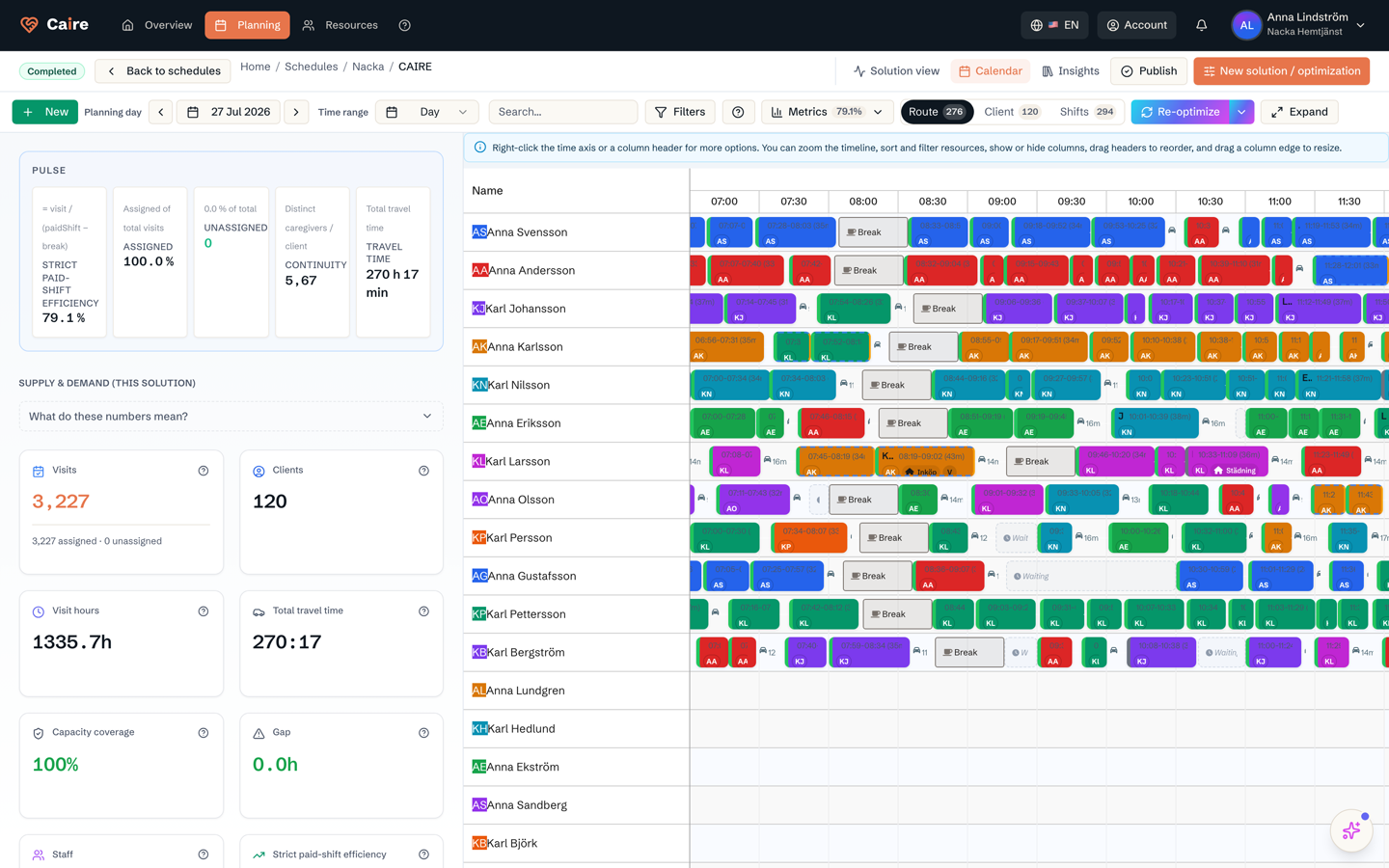
Caire Core is the technical layer that turns care decisions, master data, and operating rules into transparent schedule candidates that planners can review, explain, and publish.
Current page
Caire Core
The technical scheduling architecture behind planning.
Technical evaluation
What makes the architecture evaluable
Shared operating model
Clients, care plans, visits, time windows, skills, shifts, service areas, and travel all live in one model.
Configurable goals and constraints
Planners can weigh continuity, care time, travel, cost, skills, preferences, and working conditions without hiding the logic.
Traceable solutions
Every candidate gets quality metrics, baseline comparison, and clear reasons why visits move or stay.
Controlled publishing
AI candidates do not become production schedules until responsible planners review, choose, and publish them.
Caire Core uses two planning passes
The first pass shapes staffing demand, shift supply, breaks, and capacity. The second pass assigns visits, exact times, routes, continuity, and exceptions. From-patch lets a planner add or repair a small change without rebuilding the entire schedule.
| Aspect | Traditional planning | Caire Core |
|---|---|---|
| Staffing input | Manual configuration | Demand-driven discovery |
| Continuity | Planner memory | Continuity weighted and visible |
| Travel time | Separate map work | Route cost in the schedule graph |
Migrated architecture prototypes
From old technical mockups to the Caire Core model
The retired platform prototypes described a split between shift planning and route optimization. In Brand 2.0 that content is expressed as one Caire Core scheduling architecture: a unified dashboard, two planning passes, route costs, mobile execution, and a convergence timeline planners can evaluate.
continuous learning loop
Every optimization, change, mobile event, and planner-approved decision can become a learning signal for the next run. The model improves from observed outcomes while planner approval remains the control point.
Evaluator checklist
- Can planners explain why a visit moved?
- Can the organization tune goals without custom code?
- Can a solution be compared with baseline and previous runs?
- Can mobile outcomes feed the next cycle with human review?