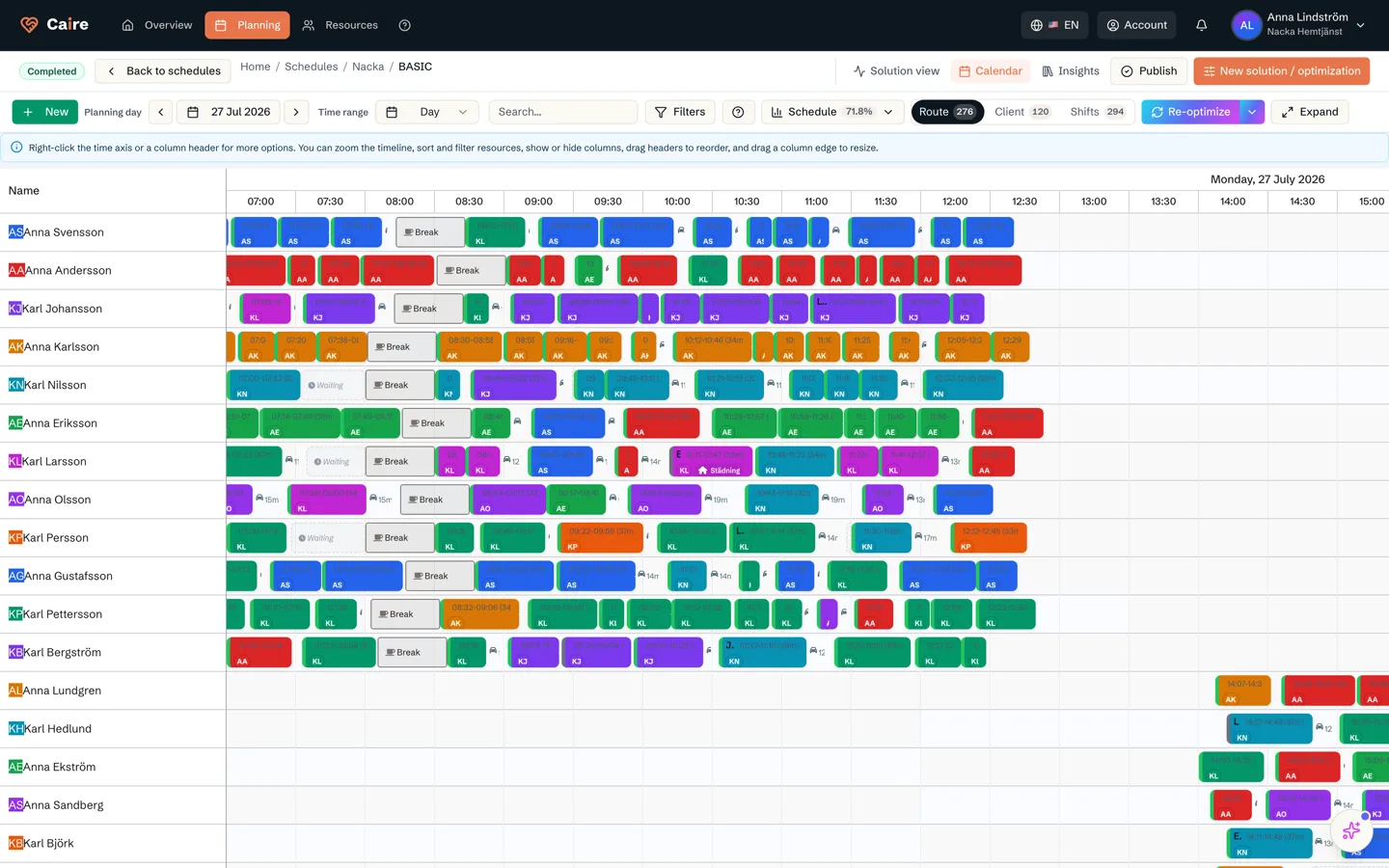
What does automatic home-care scheduling cover?
Building a home-care schedule involves more than filling shifts. Visits need to be assigned to staff, fit within available working time and take place within the time windows for each service. Planning also needs to account for skills, travel and which staff return to the same care recipient. A change to one row can affect several other visits during the day.
Caire generates schedule proposals from the visits, resources and constraints in the planning input. This helps the planner consider assignment and visit order together, rather than move every visit manually. A proposal supports a decision. It does not replace the organisation’s responsibility for staffing, accurate information or deciding what works for the care recipient.
Visit times and skills define the boundaries
Some visits have narrow time windows, while others can move within a wider interval. Planning needs to distinguish between those conditions. A visit that must take place at a specific time should not be treated as equally movable as a flexible service. Enter the times and conditions that actually apply, and check them before comparing a new schedule with the existing one.
Staff availability and skills are also part of the input. A schedule that looks efficient is not useful if the right staff member is unavailable for a visit. Check that staff records, working hours and visits are current. Incomplete input needs to remain visible during review so an unresolved need is not confused with a completed assignment.
Travel time belongs in visit planning
Two visits that look close together in the calendar can still require a longer journey. Comparing visit start and end times alone is therefore insufficient. In Caire’s schedule proposals, travel between visits is calculated on a map. The planner can then assess how visit order affects the working day and whether the proposal leaves room for the work to be performed.
Reducing travel time is a relevant goal, but it needs to be weighed against staffing and continuity. The shortest route is not always the best choice for the organisation. Compare travel and visit time over the same period and scope of visits. Here, care time means visit time as a share of worked time; travel and other paid time need separate tracking.
Compare continuity and staffing together
An organisation may want the same staff member to return to a care recipient while also covering more visits within available working time. Those goals can pull in different directions. Automatic scheduling does not remove the trade-off. It offers a way to compare proposals so the planner can understand the consequences of a choice before it becomes a published schedule.
Use the same planning input when comparing alternatives. Examine assigned visits, needs that remain unresolved and how working time is used. A proposal with lower travel time may be less attractive if it also reduces continuity. The choice should be understandable to both coordinators and operations managers, rather than expressed only as a summary number.
The planner reviews and approves
Caire distinguishes between a proposal and a published schedule. The system generates alternatives; the planner approves before anything is published. This creates space to check visits, assignments and circumstances that require the organisation’s own judgment. A new proposal should not be treated as an instruction to staff until the organisation has selected and published it.
Human review is especially important when a day includes exceptions. A care recipient’s needs, local working practices or an arrangement with a staff member may need explicit representation in the input. Read the proposal together with the conditions behind it. If an alternative does not work, investigate the reason rather than accept it because it was generated automatically.
Start with a clearly scoped comparison
Choose one unit and a period whose conditions you understand. Gather visits, working hours and the constraints you want to review. Then check which input is complete and which questions still need answers. A scoped comparison makes it easier to understand the difference between your existing schedule and a new proposal without simultaneously changing planning across the entire organisation.
Assess the result using several measures: visit coverage, care time, travel time, continuity and use of working time. Decide what would count as a relevant improvement for your organisation. Outcomes depend on input and conditions; this page promises no fixed percentage saving. A free schedule analysis is the next step to examine your schedule and obtain concrete input for a further conversation.
Questions about automatic home-care scheduling
How does automatic scheduling differ from AI scheduling?
Automatic scheduling describes the work a system proposes: assignment, times and visit order. AI scheduling describes how proposals can be generated and compared. The practical question is whether the input and constraints produce a useful schedule. In Caire, the planner reviews alternatives before publication.
Does Caire publish a schedule automatically?
No. Caire generates schedule proposals and the planner approves before publication. A calculated proposal is therefore different from the schedule staff should work from. The organisation retains the decision about which alternative is selected and when it takes effect.
Can scheduling account for travel time and skills?
Caire’s proposals use planning input and registered constraints. Travel between visits is calculated on a map. Availability, skills and visit time windows need to be correctly recorded in the input. Check those conditions and any unresolved visits when reviewing the result.
Do we need to replace all our systems to get started?
Caire is a complete planning system where standing data is maintained in Caire. Which other systems can remain and how information is brought in depend on your setup and configured integrations. Start by describing your current workflow and what you want to analyse so the appropriate input and scope can be chosen.
How can we tell whether automatic scheduling helps us?
Compare your existing schedule with proposals from the same input and period. Track visit coverage, care time, travel time, continuity and working time together. Assess outcomes against your circumstances. Start with a free schedule analysis to examine your planning needs; no general level of savings is guaranteed.
Explore what your schedule could improve
Start with your planning needs. Read about the free analysis and the input needed before taking the next step.
Analyse your schedule for free