Everyone does their best, and still the day falls apart
Translated from the Swedish original.
I have MS, and for five years I have had help from home care in my own home. I see the day from one side of the door. The staff tell me what it looks like from the other side, and home-care companies and municipalities what it looks like from the office. I hear the same from one of the large British home-care groups. The day below is put together from what they tell me, what I see myself and what audits and research show.
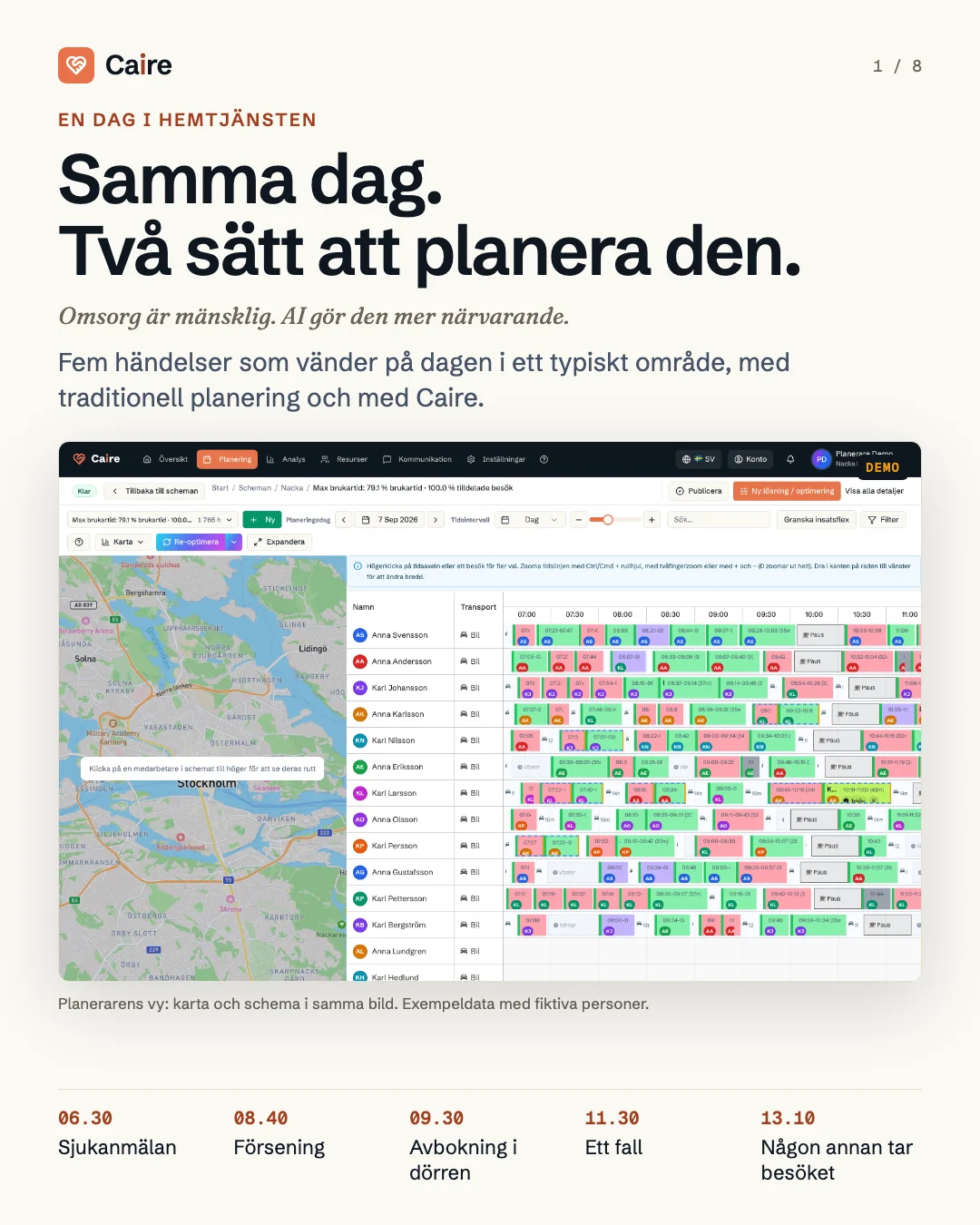
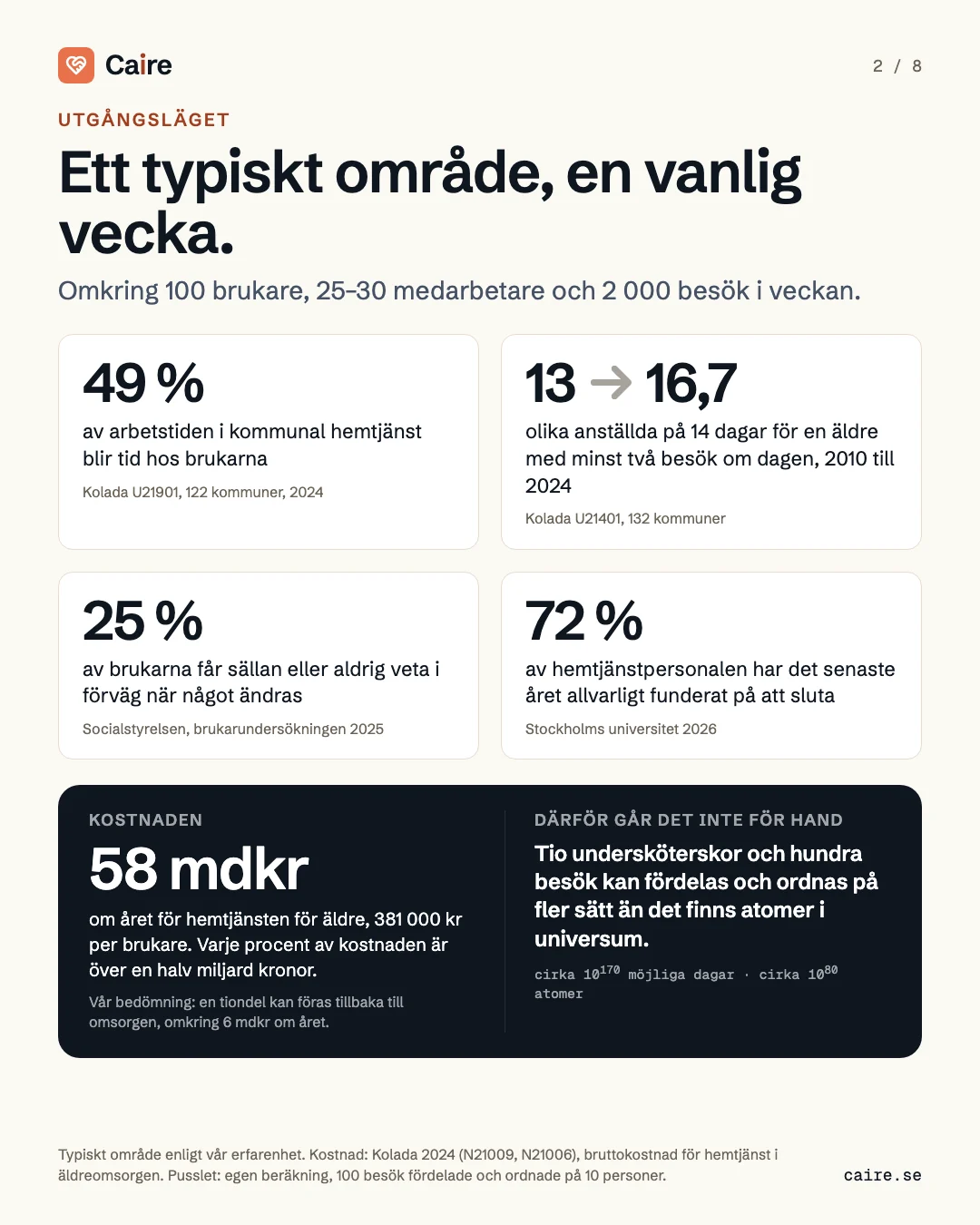
A typical area has about 100 clients, 25–30 staff and 2,000 visits a week. The day shift runs roughly 07–16 with a 30–45 minute lunch, the evening shift 16–22 and the night shift 22–07.
06.30 – The sick calls
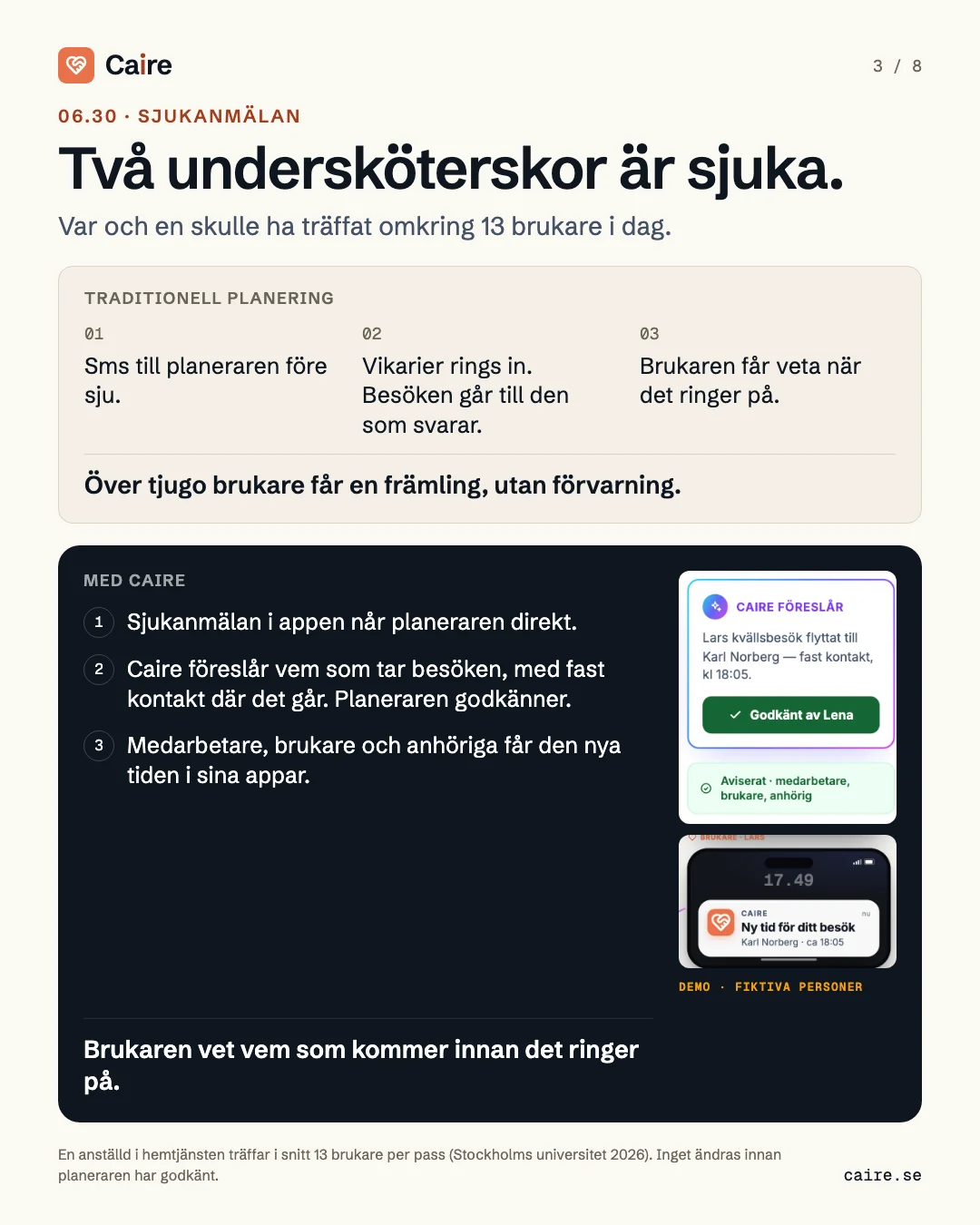
The planner arrives and already has two text messages. Two assistant nurses are ill. A home-care worker sees 13 different clients on an average shift, so more than twenty people will be helped today by someone other than planned. When auditors reviewed home care in Finspång, the planners started at 06.30 and the day had to be planned by 06.45. Fifteen minutes to redo a puzzle that took weeks to put together.
The planner picks up the phone, calls temps and gives the visits to whoever answers. Whoever answers is rarely the person who knows the client. The auditors wrote that planning was driven first by efficient use of resources and not by the clients' need for continuity. Staff only learn in the morning which clients and visits are theirs. A skilled planner builds a better schedule, but the knowledge sits with one person. Assistant nurses in elderly care have more than twice as many sick-leave cases as the average worker, so the next sick call is never far away.
07.00 – The list
The assistant nurse gets today's list. It does not look like yesterday's. Three names are new, and the code to a front door is written on a note. That “Bertil is heavy – send two” and that “the pill organiser is refilled on Thursdays” lives in the planner's head or in a free-text field.
The assistant nurse reads the care plan in the car and calls a colleague. The time comes out of the visits, and the knowledge does not travel when the planner is off. The travel time in the schedule rarely allows for finding a parking space. Staff tell me they often get parking fines they pay themselves, because otherwise they would not make the visit.
07.30 – The morning rush
Now everyone needs help at the same time: toilet, medication, breakfast. At my home, yet another new person stands in the hall, and everything has to be explained from the start. A man with dementia does not open the door at all, because he does not recognise the person ringing the bell.
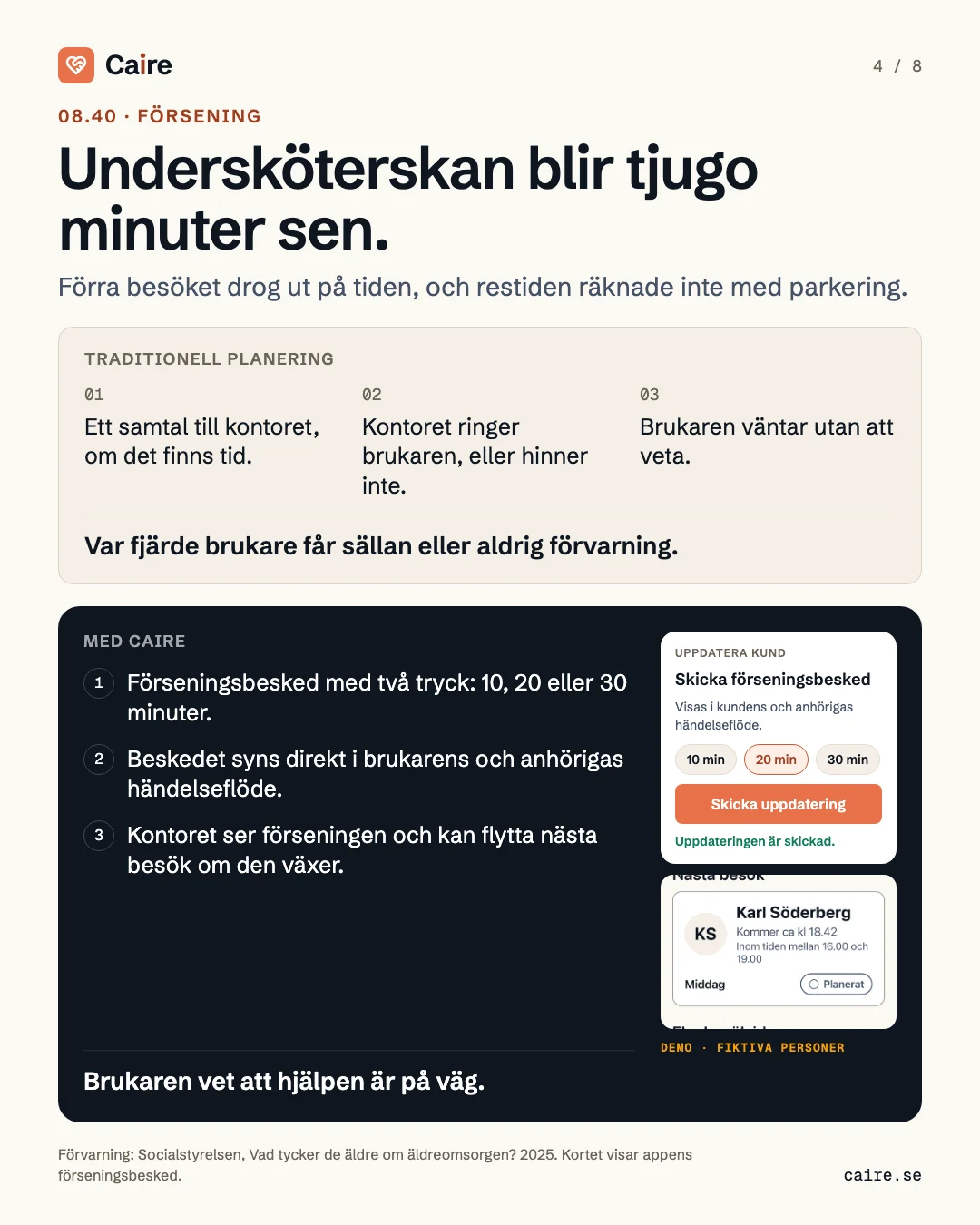
The staff run. A home-care worker now makes an average of 18 visits per shift, up from 15 ten years ago, and half of the visits last 15 minutes or less. Medication and toilet come first, and the rest is cut short. In the National Board of Health and Welfare's survey, four in five clients say staff always or usually arrive at the agreed time, but only one in five says always. One in four say they are rarely or never told in advance when something changes. In 2013 it was just over one in six.
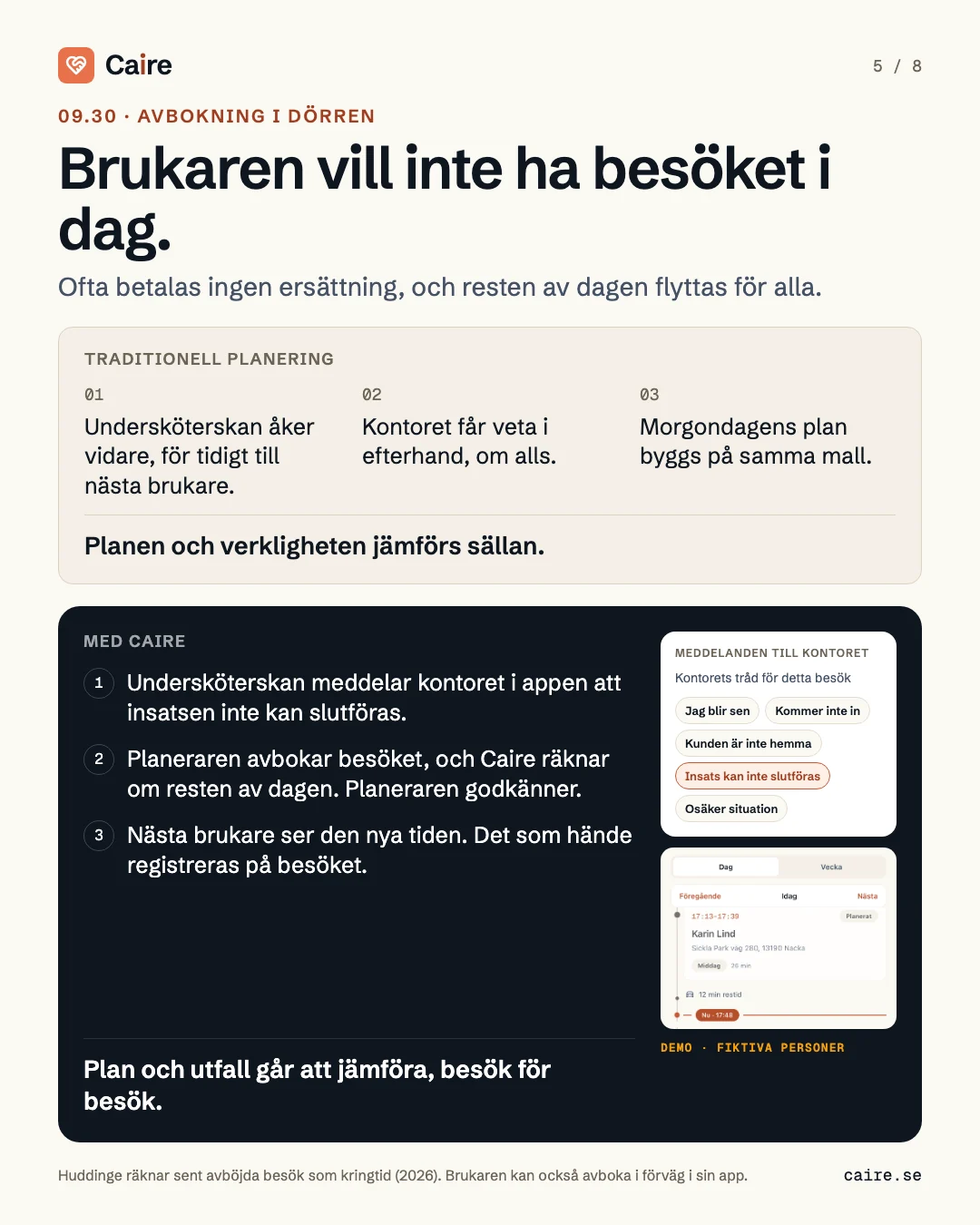
09.30 – Cancelled at the door
A client does not want today's visit and cancels at the door. Often no payment is made for it. Huddinge counts visits declined at short notice as non-client time that the hourly rate must cover, and Katrineholm pays a lower rate. The assistant nurse moves on to the next visit, earlier than planned if that client can receive them. The rest of the day then shifts for everyone further down the list.
10.00 – The office
Around ten, the changes arrive. A call from the hospital: a man is being discharged today and needs four visits a day from this evening. The provider must often be able to start within a day, the same day in urgent cases. A needs assessor has changed a decision. A relative wants to know why no one came to her mother. An assistant nurse hands in her notice.
The new work is squeezed in wherever there is a gap. Everything is handled by hand, on the phone with clients, relatives and staff. Every change moves other visits, and no one sees the whole day at once. With one planner per 30 staff, one unit manager per three planners and management on top, about five percent of the workforce plans and leads. On top of that comes the cost of the office. When the National Board of Health and Welfare asked unit managers why staff find it hard to influence the daily plan, they pointed to how needs-assessment decisions are written, to weak cooperation with the municipality and to IT systems that cannot handle flexible planning. The staff notice. According to a new study from Stockholm University, 72 percent of home-care staff have seriously considered quitting in the past year. In 2005 it was 40 percent.
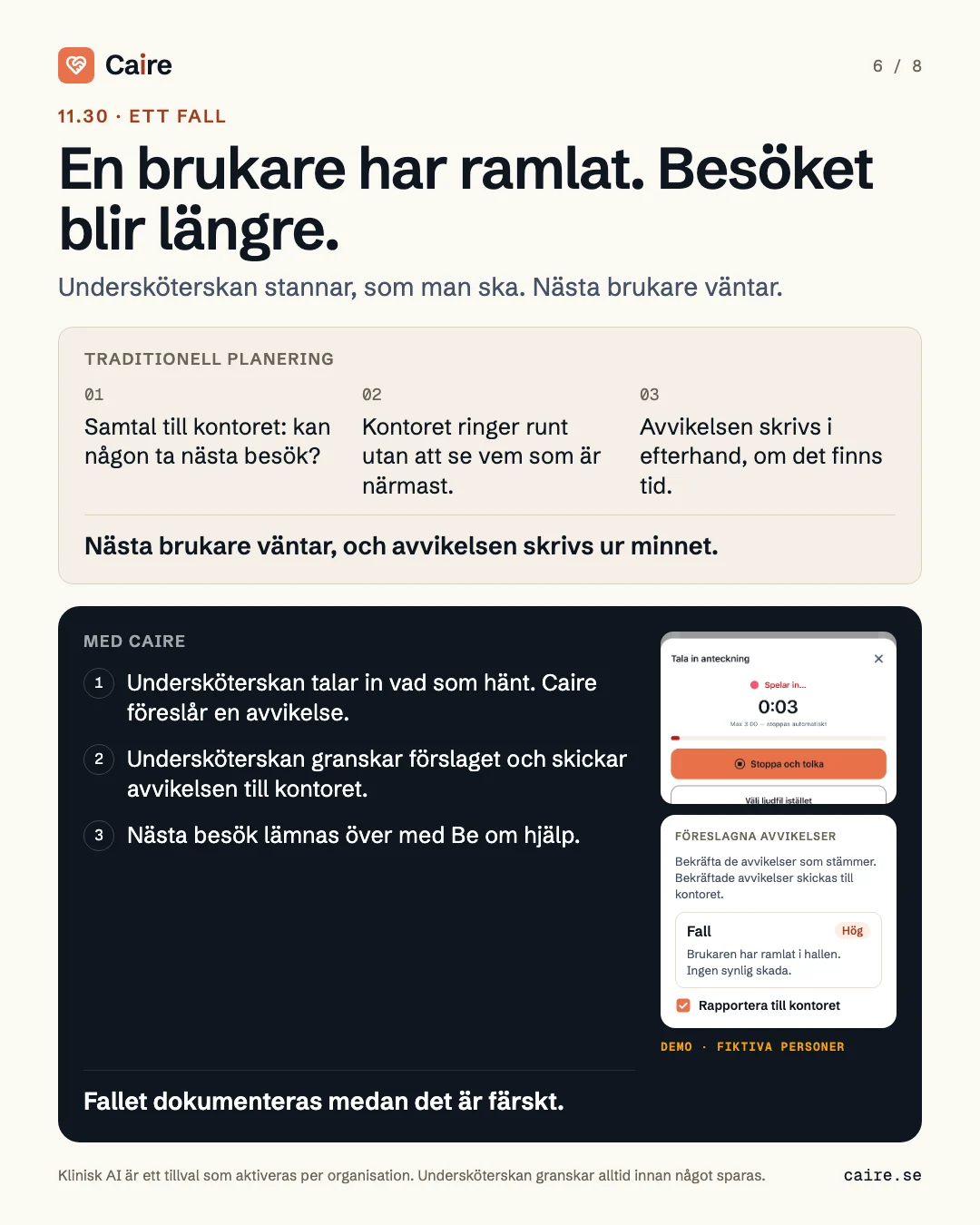
11.30 – The visit that runs long
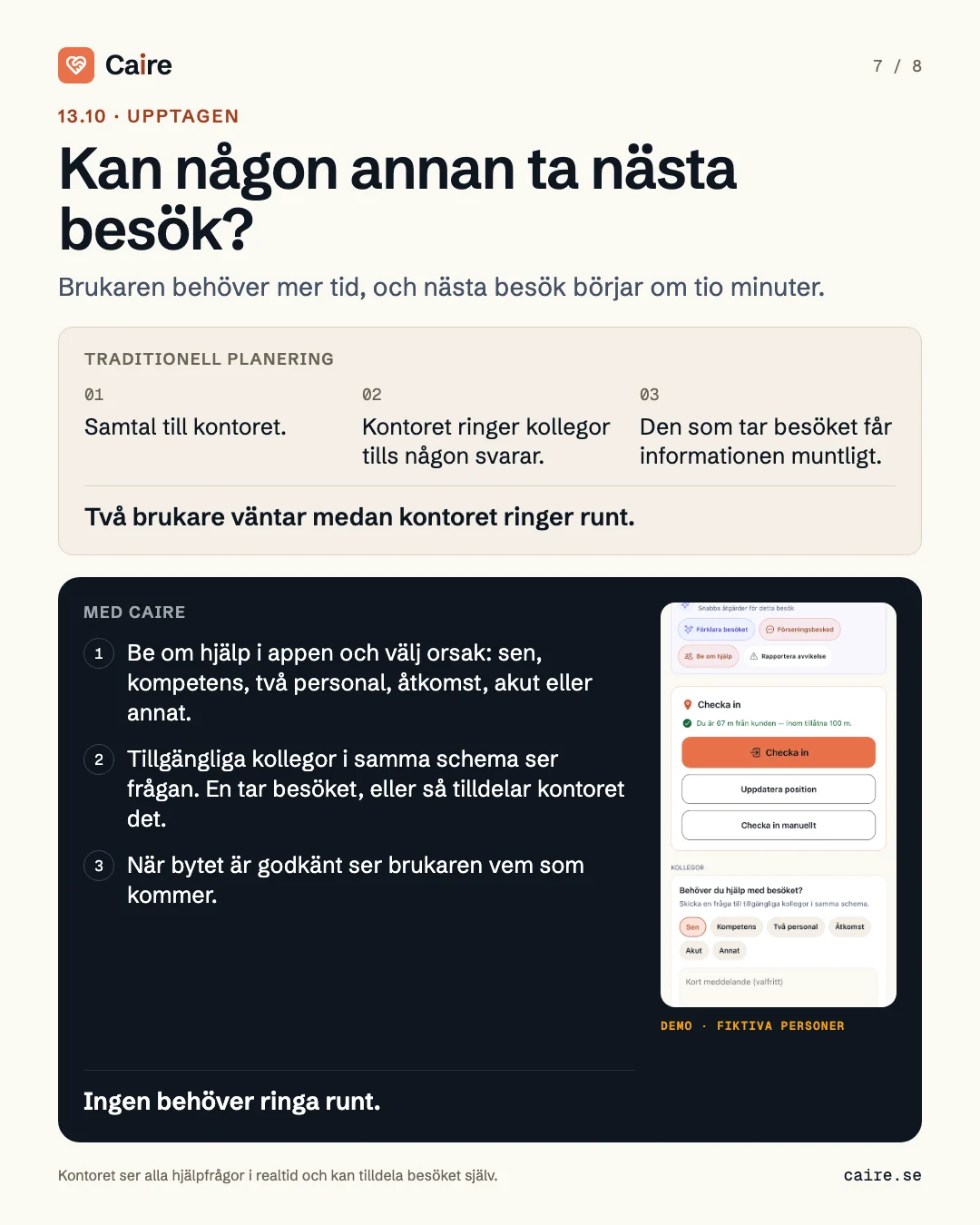
A woman has fallen. The assistant nurse stays, as they should, and the visit runs half an hour longer. But the next client is waiting, and the one after that. The assistant nurse calls the office and asks whether someone else can take the next visit. The office phones around, but no one can see who is closest and free, so the answer takes time.
12.00 – The break that never happens
When the day does not add up, the break is what gives. Half of home-care staff tell the Swedish Work Environment Authority that they rarely or never get to recover during the working day. Among those on strictly minute-controlled schedules, 57 percent say it is hard to find time for a cup of coffee or a toilet visit. Only 22 percent manage to finish their tasks on time every day.
Providers, private and municipal alike, are caught in the same squeeze. Home care is often paid per hour delivered. If a task takes longer than planned, the schedule breaks, and staff have to make up the time elsewhere. In one municipality in four, the time allotted per task is to be followed as exactly as possible. Private providers tell the National Board of Health and Welfare that low payment makes for a stretched operation with little flexibility and a heavy workload. So the visits are packed even tighter, and that is why the next morning starts with new sick calls.
16.00 – Shift change
The day shift ends. What the day staff noticed this morning, that someone ate less or seemed confused, is passed on on a note or not at all. The evening is often covered by others, sometimes by hourly temps. The National Board of Health and Welfare notes that it becomes harder to spot early changes in older people's health when many staff are hourly workers or temps.
19.00 – The evening
I wait for my evening help without knowing exactly when it will come, or who. Only half of clients say they can always or usually influence when staff come. In 2013 it was six in ten.
22.00 – The night and the alarm
The night shift takes over, with fewer people on duty and a bigger area. A safety alarm goes off. The person carrying the alarm phone is with another client giving insulin and cannot leave. The assistant nurse texts the office, but the office is changing shifts. No one goes.
SVT, the Swedish public broadcaster, has reviewed the 190 home-care incident reports under lex Sarah that the Health and Social Care Inspectorate closed in 2024. Twelve people died after failures in their care, five of them after raising the alarm without help coming. One of them had raised the alarm seven times. In Malmö, a client was found dead in the morning after an evening with several alarms that were not acted on. The investigation showed that the plan had not been followed and that visits that had not been made were reported as done.
06.00 – The next morning
Tomorrow's plan is built on the same template as today's. Who actually came, when and for how long is rarely compared with the plan. The only national measure of how many different people an older person meets was also discontinued in spring 2025. In the 132 municipalities that measured it in both 2010 and 2024, the number had risen from 13 to almost 17 different people in two weeks.
On paper and in reality
The rounds look good on paper. Gävle municipality judges that 70 percent of working time can be time with clients for home-care groups in densely populated districts, and a payment model for the City of Stockholm assumed 80 percent in 2011. When the time is measured, it comes to about half. In the 122 municipalities that measured client time in their own services in 2024, the average was 49 percent of working time, including managers and administration, and in half of them the share was between 40 and 58 percent. How you count matters too. In Västerås, the share of billed time during the day fell from about 74 to 64 percent, mainly because the rules changed. Declined visits, for example, used to count as billed time.
The staff are not standing still. But no one really knows where the time goes. Plan and outcome are rarely compared, and there are no public statistics on how many visits happen as planned. That leaves management without a basis for its decisions. Building a schedule in a few minutes that accounts for every visit, the clients' needs, continuity and the right skills cannot be done.
No one can see the whole day
The staff do their best, and so do the providers. The pattern also exists in other countries. In Norway, people receiving daily home care had on average 51 visits from 17 different people over four weeks, even though the same schedule would have allowed far fewer. In England, 42 percent of domiciliary care workers are on zero-hours contracts, and 29 percent leave every year.
The day simply cannot be planned by hand. Ten assistant nurses and a hundred visits can in theory be assigned and ordered in more ways than there are atoms in the universe, and every sick call, cancellation, discharge and delay changes the whole puzzle.
So people fall back on rules of thumb, phone chains and hourly temps. Each such stopgap passes the bill on to someone else.
What it costs
Everyone pays the bill:
- Clients get less continuity, less insight and less say. Their health suffers, the risk of falls rises and there are more hospital stays. Those who can switch provider.
- Staff pay with stress, missed breaks, their own parking fines and, in the end, sick leave or a new job.
- Planners spend the day on the phone instead of planning.
- Providers, companies or municipalities, pay for overtime, temps, recruitment and administration, and make decisions based on figures that do not add up.
- Society pays for the sick leave and the hospital care, and has to recruit into a profession where seven in ten have considered quitting.
And the bill is large. Home care for older people costs Swedish municipalities about SEK 58 billion a year, just under SEK 381,000 per client, and only half of working time becomes time with clients. Every percent of that cost spent on phone calls, waiting and replanning instead of care is worth more than half a billion kronor. If a tenth could be returned to the clients, it would be worth about SEK 6 billion a year, and no one would have to run faster for it.
What needs to happen
Measure continuity again.
The National Board of Health and Welfare is now developing a new measure. Calculate it from the visit data that already exists, relative to how many visits each client has, and report it every month for every provider, so that anyone choosing home care can compare.
Drop the minutes.
Give visits a time window instead of minutes per task, so that staff and clients can plan the day together. The Board's analysis shows that clients are more satisfied where staff can influence times and the daily plan.
Follow up what clients notice.
As purchasers and as providers, municipalities should follow up continuity, punctuality and advance notice, and compare plan with outcome, instead of just counting registered minutes.
Sick calls cannot be abolished. But a sick call does not have to mean thirteen clients meeting a stranger in the hall.
Björn Evers, home-care client and founder of Caire, which develops planning support for home care
Sources
The figures were checked against the sources below in September 2026. Most sources are in Swedish.
- PwC: Safety in home care, audit for Finspång municipality (2014)
- Strandell and Szebehely: More and more want to quit, Stockholm University (2026)
- Swedish Social Insurance Agency: sick leave in health and social care (2022)
- Swedish Work Environment Authority: inspection of home care (2025)
- Kommunal (union): Home care 2022
- National Board of Health and Welfare: Steering home care (2025)
- National Board of Health and Welfare: Status report 2025
- National Board of Health and Welfare: What do older people think of elderly care? National results 2025
- Government inquiry SOU 2020:70 on elderly-care staff and a named care contact
- Kolada: staff continuity in home care (U21401)
- Kolada: client time in home care (U21901), 2024
- Gävle municipality: review of the home-care free-choice system (2024)
- Ramböll for the City of Stockholm: a payment model for home care (2011)
- City of Västerås: review of in-house home-care costs (2019)
- Kolada: cost of home care for older people (N21009), 2024
- RKA: indicators for Municipal quality in brief
- Government of Sweden: a new measure of staff continuity in elderly care (2026)
- SVT: They died alone – home care missed the safety alarms (2025)
- City of Malmö: incident report under lex Sarah (2025)
- Katrineholm municipality: tender terms for home care under the Swedish free-choice act (2025)
- Huddinge municipality: home-care payment rates 2026
- Nyheter24: a parking fine at work, who pays? (2026)
- Gjevjon et al.: continuity in Norwegian home care (2014)
- Skills for Care: domiciliary care services in England (2025)
- Savelsbergh: routing with time windows is NP-hard (1985)
- Bice and Boxerman: a measure of continuity of care (1977)
Caire's own material
The same day with Caire
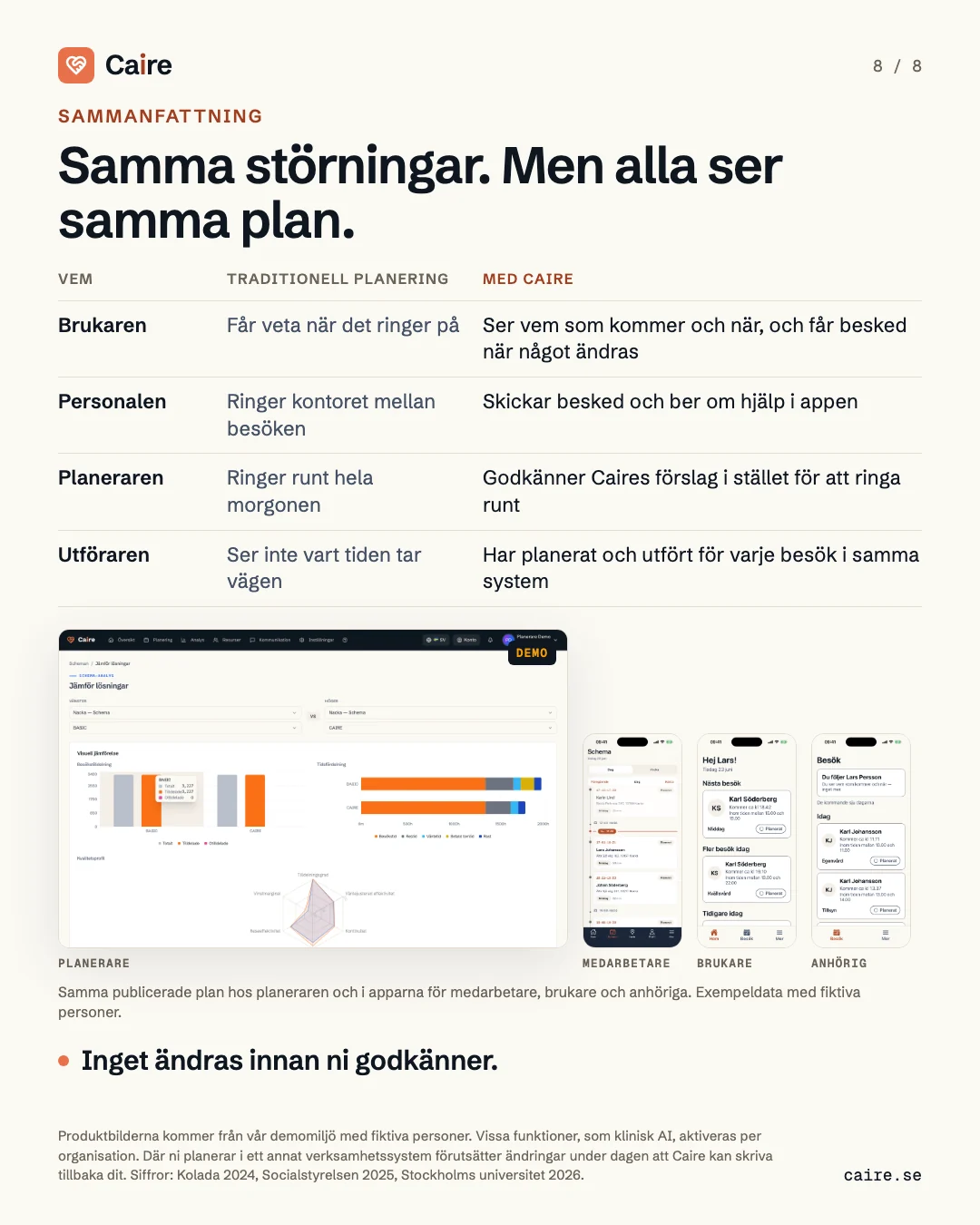
The five events as slides: what happens with traditional planning and what happens with Caire. The slides are Caire's own material, in Swedish, and show example data with fictional people.
Download the slides as PDF8 pages, 2.7 MB, in Swedish
Your own day
What does your own day look like?
Start with your existing schedule and reports. The free analysis shows continuity, time allocation and opportunities to improve in your own operation.