The care plan drives every visit in the schedule
In Caire the care plan describes what each client receives, when, and with which requirements. When you create a schedule the plan's visits become dated visits, and scheduling stays within the times the plan allows.
Current page
Care plans
Visits, time windows and visit flex the schedule follows.
Care plans retain their source and purpose
The care decision describes the approved need. The care plan connects the person’s goals and activities to recurring visits, time windows, duration and skill requirements. A declared source owns the facts; reviewed changes retain their provenance.
Creating a schedule materializes those visits and the authoritative staffing for dated days. Solutions retain the exact planning input used for their routes. Changing a template later does not rewrite an already saved solution.
Explore the data layers, publication and optimization flowIBIC connects needs, goals, activities and follow-up
Structured life areas and functioning categories connect current situation, resources and desired situation to goals, subgoals and activities. Daily records can refer to the exact plan and activity; signed records freeze their references. Follow-up records the assessment, source, time and outcome, with append-only correction and reconstructable PDF/JSON export.
Native social-care Journal and external Journal authority are explicit choices. Planning access alone does not grant clinical or journal authority.
Read about JournalWhat is a care plan?
A care plan (genomförandeplan) describes how a granted service is carried out day to day: what is done, at what time and how the client wants it. It is written together with the client. For planning, the visits' times, duration, frequency and staffing requirements decide how the schedule can be built.
From plan to schedule
- 01
Visits are set up per client
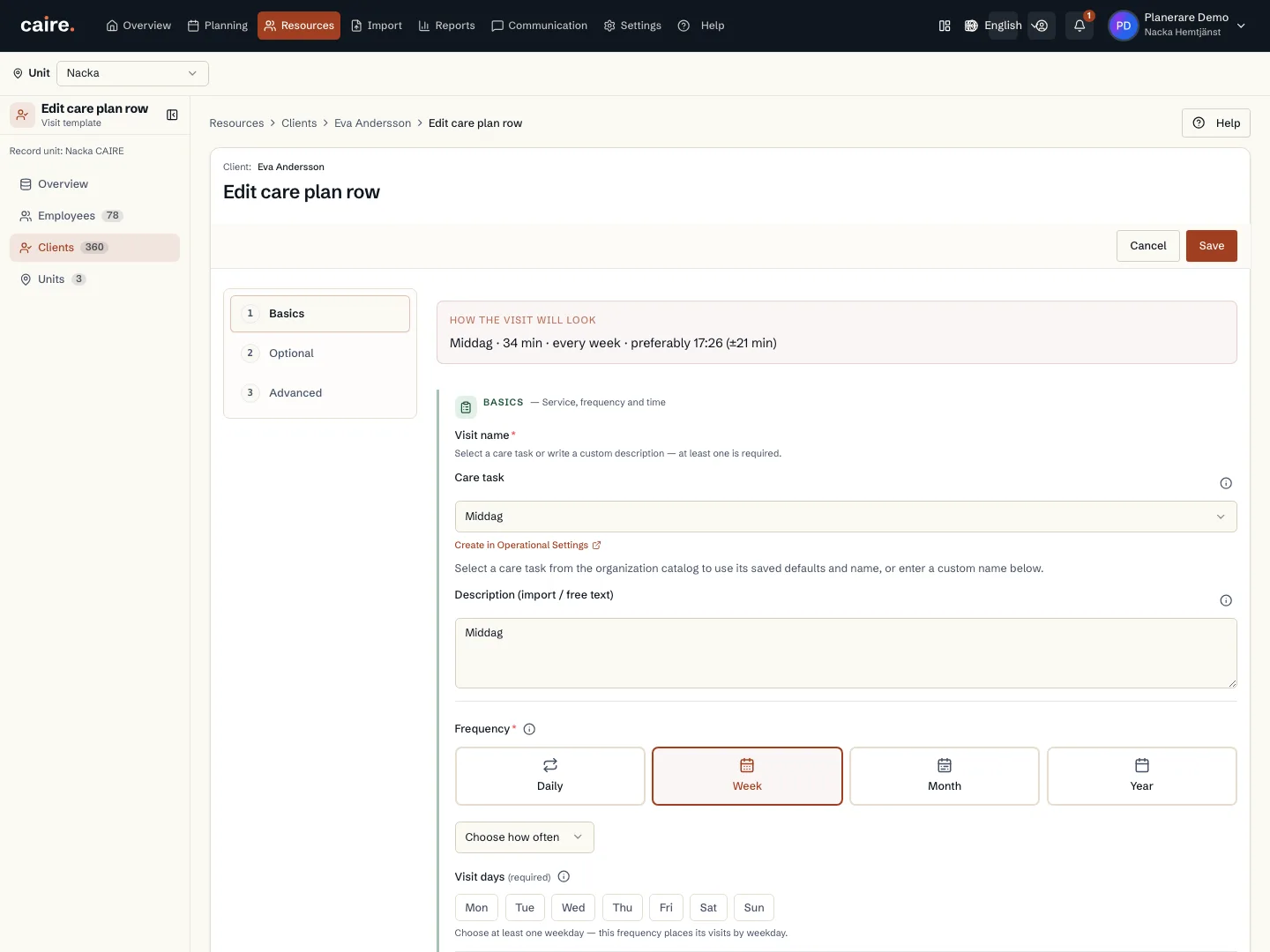
Each visit in the plan is a visit template with a care task, duration, frequency and weekdays. A template always belongs to a client.
- 02
Two levels of time window
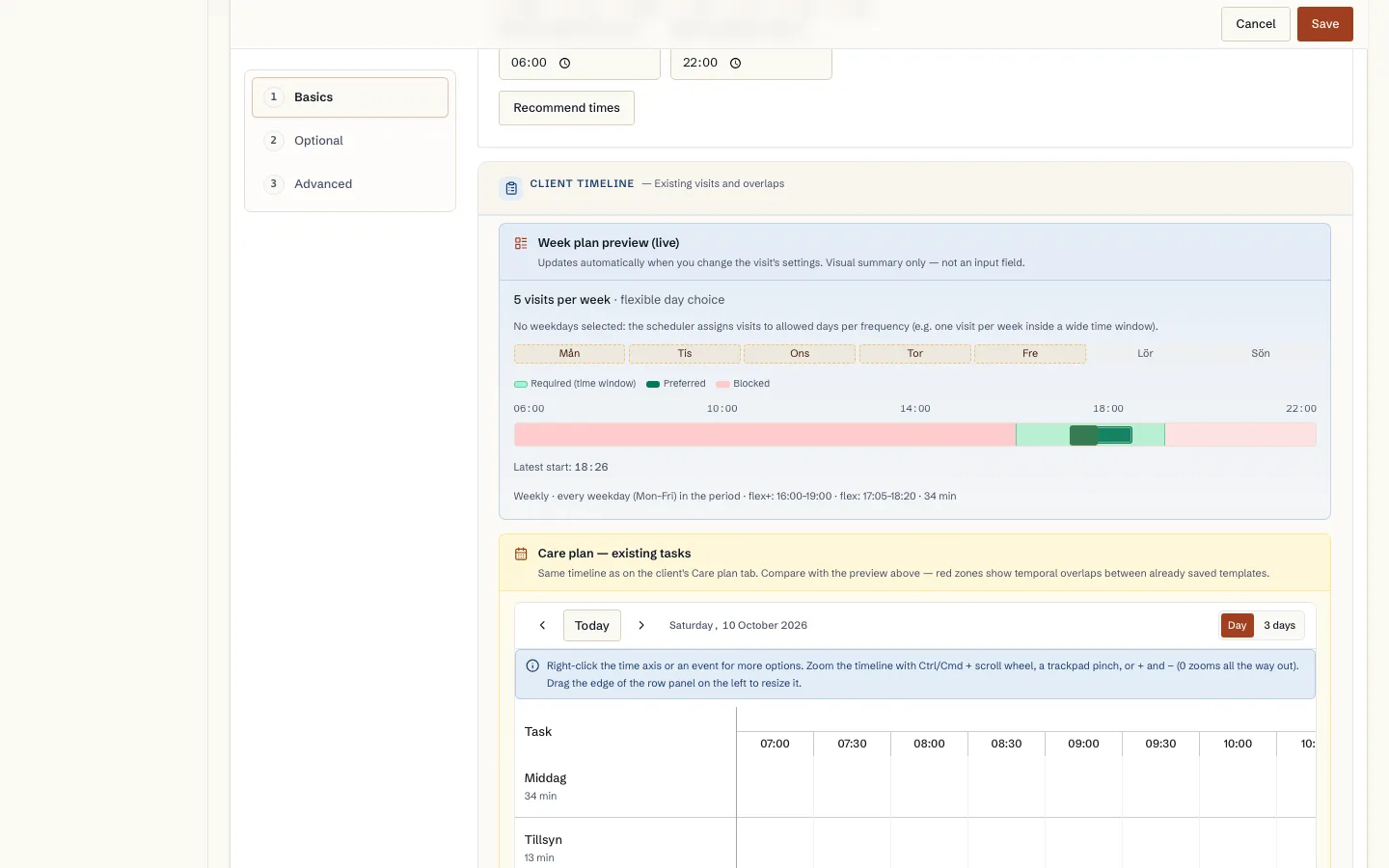
The preferred time is when the client would like the visit. An extended window sets how far the visit may move when needed. Both show on the template and on the visit in the calendar.
- 03
Requirements stay with the visit
Skills, preferred staff, double staffing and the order of a client's visits are stored on the template, where they decide who can take the visit.
- 04
Visits become a schedule
When you create a schedule the plan's visits are copied into dated visits for the period. The planner reviews the proposal before anything is published.
Template: what a care plan contains
A home-care care plan answers the same questions whatever the template: which service is granted and why, what the client wants to achieve, what is done at each visit, when and how often, how the client wants it done, who carries it out and with which skills, and when the plan is followed up. The plan is written together with the client, and the client's own words about how help is given are part of it. The Swedish National Board of Health and Welfare's documentation regulations (SOSFS 2014:5) require documenting how a decided service is carried out.
Example of a care plan in elderly care
A fictional example. Service: help with the morning routine and a shower, granted daily. Goal: Anna wants to dress herself and to feel safe in the shower. How: staff arrive between 07.30 and 08.30, help with a shower on Tuesdays and Fridays and let Anna dress herself with support. Anna wants coffee before the shower and the same staff as often as possible. Who: an assistant nurse delegated to give medication, since the morning medicine is given at the visit. Follow-up: every three months, or sooner if needs change. In planning this becomes a daily visit with a 07.30–08.30 window, a longer shower visit twice a week, a delegation requirement and a preferred caregiver.
Care plans and IBIC
IBIC (Individens behov i centrum, the individual's needs at the centre) is the Swedish National Board of Health and Welfare's method for describing needs, goals and results across life areas. The needs assessor describes needs and goals in the decision, and the provider describes in the care plan how the service is carried out to reach them. With IBIC it is clearer which goals the plan is followed up against.
Goals in the care plan
Goals describe what the client wants to achieve, not what staff will do. Many use SMART goals: specific, measurable, agreed, realistic, time-bound and suited to the client. A goal like "Anna dresses herself three mornings a week by June" can be followed up. "Anna gets help dressing" only describes the service.
Visit flex: how far a care task may move
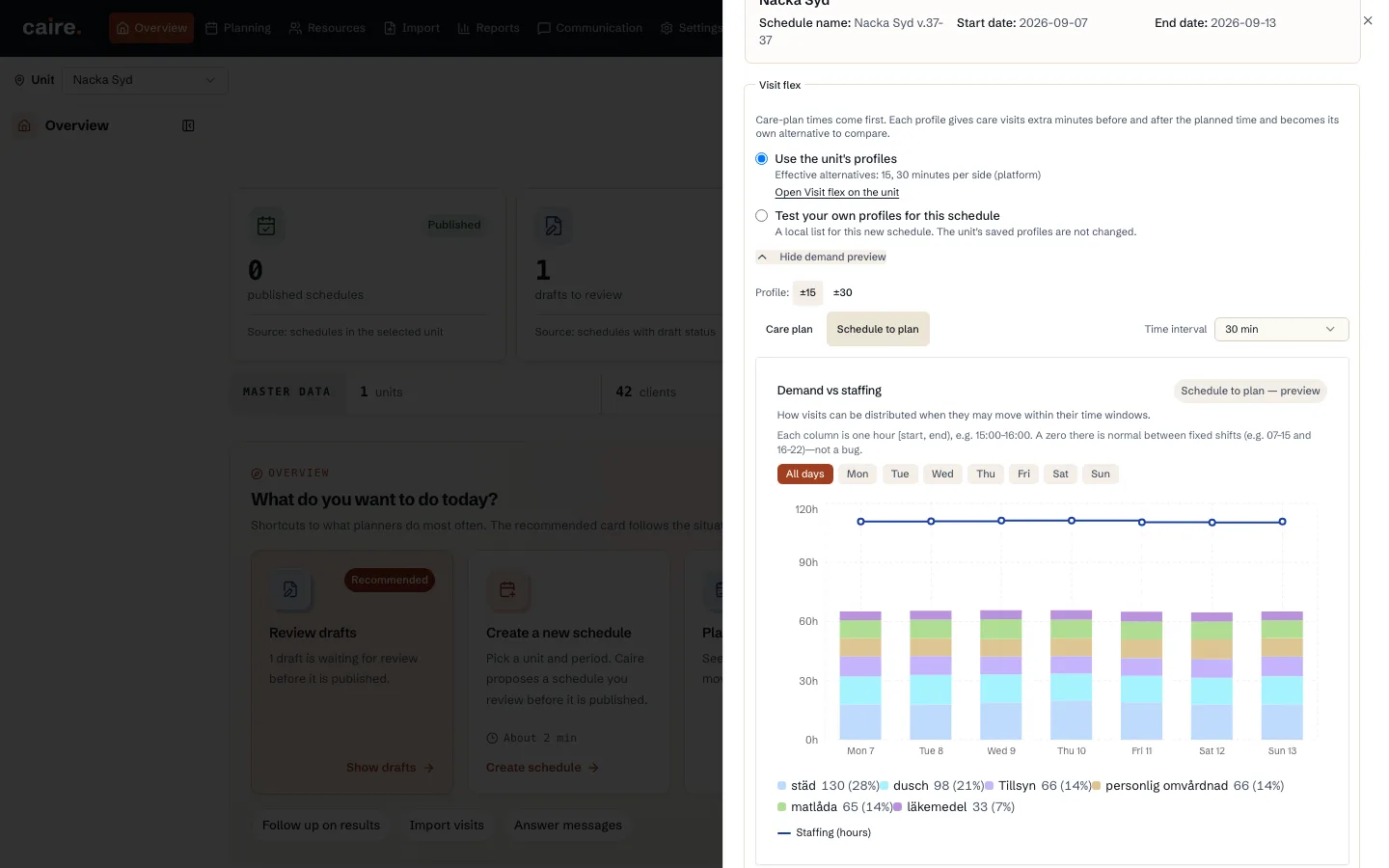
Visit flex sets how many minutes a care task may move beyond its time window when the schedule is optimised. You set it per care task for the unit and see straight away how demand across the day changes, before anything is saved. The client's preferred time is never widened, and 0 minutes means the window applies exactly as written. When you create a new schedule, different visit flex levels can be compared as separate proposals.
Checks before a template is saved
The weekly preview shows where the visit can land among the client's other visits, and clashes show before the template is saved. From the template you can also see when the visit was last scheduled and who had it.
Planning, not documentation
Caire plans from the care plan. Social documentation and follow-up use CAIRE Journal when that module is enabled and owns the records; otherwise they use your existing records system. Caire holds what you need to build the schedule and follow it up.
Download a care plan template
An editable Word template in Swedish covering the decision, the client's goals, how the service is carried out, special needs, follow-up and participation, with the example above filled in.
Download the template (Word, Swedish)Care plan questions
What is a care plan in home care?
It is the plan for how a granted service is carried out for the client: what is done, when and how. It is written together with the client and is the basis for the visits in the schedule.
How is the care plan used when the schedule is built?
The plan's visits are copied into dated visits when you create a schedule. Time windows, duration, skill requirements and double staffing come along, so the proposal stays within what the plan allows.
What is the difference between the preferred time and the extended window?
The preferred time is when the client would like the visit. The extended window is the outer span the visit may move within when the schedule does not fit otherwise.
What is visit flex?
Visit flex is the number of minutes a care task may move beyond its time window during optimisation. It is set per care task for the unit, and 0 minutes means the window applies as written.
Does Caire replace our documentation system?
CAIRE Journal is a separate module for social documentation and follow-up. When it is not enabled and selected as the source, use your existing records system.
Read next
See how your plan becomes a schedule
Send your current schedule for a free schedule analysis, or click through planning in the interactive demo.